

LITTER PRODUCTION IN FORESTS O F THE WORLD
139
3-year-old Ulmus parvifolia stand, there was a decreasing attached leaf
weight of from 438 g/mz on 20 May t o 297 g/m2 on 27 July. This decrease, which equaled 31 % of the total leaf canopy by weight and was
the result of a loss of all the lower and more shaded leaves, may be more
typical of young sapling stands than of forests of adult trees.
Individual species in Equatorial forests may also show seasonal
variation, to a lesser degree than in most Temperate forests but to a,
greater degree than the Equatorial mixed forest as a whole. rig. 5
shows a more or less bimodal pattern for three Malayan species, which
may be compared with the data for whole Malayan forests in Fig. 2.
2. Annual Variation
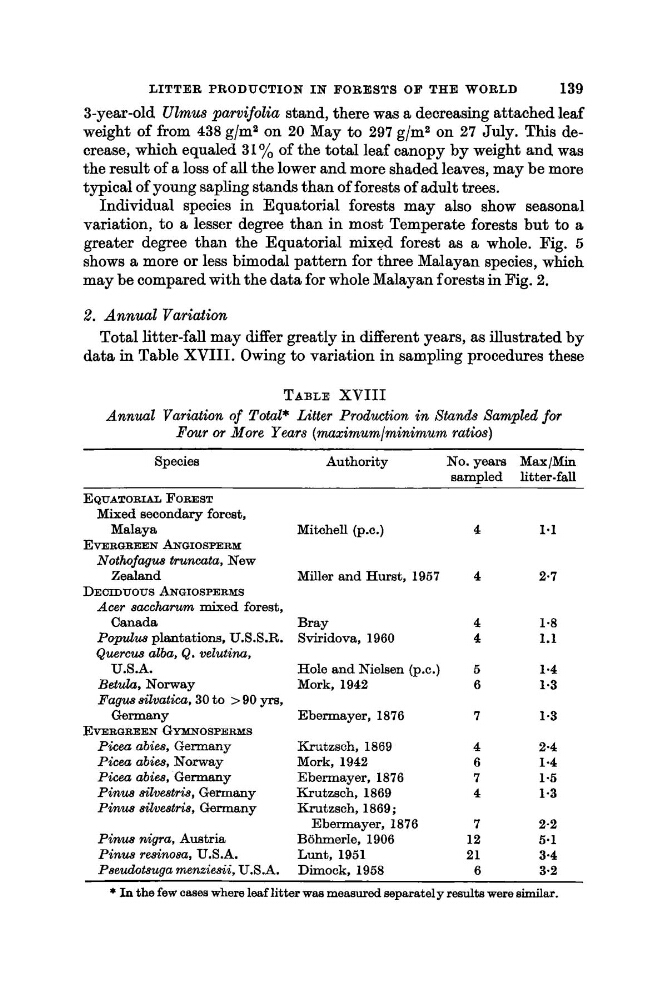
Total litter-fall may differ greatly in different years, as illustrated by
data, in Table XVIII. Owing to variation in sampling procedures these
TABLE XVIII
Annual Variation of Total* Litter Production in Stands Sampled for
Four or More Years (muximumlminimum ratios)
Species
Authority
No. yeam Max/&
sampled litter-fall
EQUATORIAL FOREST
Mixed secondary forest,
EVERGREEN ANGIOSPERM
Malaya
Nothofqua trunmta, New
Zealand
DECIDUOUS ANGIOSPERMS
Acer sacccharum mixed forest,
Popdua plantations. U.S.S.R.
Quercua alba, Q. velutina,
Betula, Norway
Fagua silvatim, 30 to > 90 yra,
Canada
U.S.A.
Germany
EVERGREEN GYMNOSPERMS
PiGea abies, Germany
Picea abies, Norway
Picea abies. Germany
Pinua silvestris, Germany
Pin- silvestris, Germany
Pinua nigra, Austria
Pinua reainosa, U.S.A.
Mitchell (P.c.)
Miller and Hurst, 1957
Bray
Sviridova, 1960
Hole and Nielsen (P.c.)
Mork, 1942
Ebermayer, 1876
Krutzsch, 1869
Mork, 1942
Ebermayer, 1876
Krutzsch, 1869
Krutzsch, 1869;
Bohmerle, 1906
Lunt, 1951
Ebermayer, 1876
4
1.1
4
2.7
4
1.8
4
1.1
5
1.4
6
1.3
7
1 -3
4
2.4
6
I -4
7
1 *5
4
1 -3
7
2.2
12
5.1
21
3.4
Pseudotsuga menziesii, U.S.A. Dimock, 1958
6
3.2
* In the few caaes where leaf litter was measured separately results were similar.
139
3-year-old Ulmus parvifolia stand, there was a decreasing attached leaf
weight of from 438 g/mz on 20 May t o 297 g/m2 on 27 July. This decrease, which equaled 31 % of the total leaf canopy by weight and was
the result of a loss of all the lower and more shaded leaves, may be more
typical of young sapling stands than of forests of adult trees.
Individual species in Equatorial forests may also show seasonal
variation, to a lesser degree than in most Temperate forests but to a,
greater degree than the Equatorial mixed forest as a whole. rig. 5
shows a more or less bimodal pattern for three Malayan species, which
may be compared with the data for whole Malayan forests in Fig. 2.
2. Annual Variation
Total litter-fall may differ greatly in different years, as illustrated by
data, in Table XVIII. Owing to variation in sampling procedures these
TABLE XVIII
Annual Variation of Total* Litter Production in Stands Sampled for
Four or More Years (muximumlminimum ratios)
Species
Authority
No. yeam Max/&
sampled litter-fall
EQUATORIAL FOREST
Mixed secondary forest,
EVERGREEN ANGIOSPERM
Malaya
Nothofqua trunmta, New
Zealand
DECIDUOUS ANGIOSPERMS
Acer sacccharum mixed forest,
Popdua plantations. U.S.S.R.
Quercua alba, Q. velutina,
Betula, Norway
Fagua silvatim, 30 to > 90 yra,
Canada
U.S.A.
Germany
EVERGREEN GYMNOSPERMS
PiGea abies, Germany
Picea abies, Norway
Picea abies. Germany
Pinua silvestris, Germany
Pin- silvestris, Germany
Pinua nigra, Austria
Pinua reainosa, U.S.A.
Mitchell (P.c.)
Miller and Hurst, 1957
Bray
Sviridova, 1960
Hole and Nielsen (P.c.)
Mork, 1942
Ebermayer, 1876
Krutzsch, 1869
Mork, 1942
Ebermayer, 1876
Krutzsch, 1869
Krutzsch, 1869;
Bohmerle, 1906
Lunt, 1951
Ebermayer, 1876
4
1.1
4
2.7
4
1.8
4
1.1
5
1.4
6
1.3
7
1 -3
4
2.4
6
I -4
7
1 *5
4
1 -3
7
2.2
12
5.1
21
3.4
Pseudotsuga menziesii, U.S.A. Dimock, 1958
6
3.2
* In the few caaes where leaf litter was measured separately results were similar.