

126
J . ROGER BRAY A N D EVILLE QORHAM
TABLE X
A Comparison of Litter Production by Evergreen and Deciduous Trees
in the Northern Hemisphere
No. regions
Evergreen
Deciduous
averaged
Gymnosperms
Angiosperms
(metric tons/he/yr)
Total litter
8
3.7
3.2
Leaf litter
9
2.6
2.4
by difference
Other litter observed
-
4
1.1
0.7
0.8
0.7
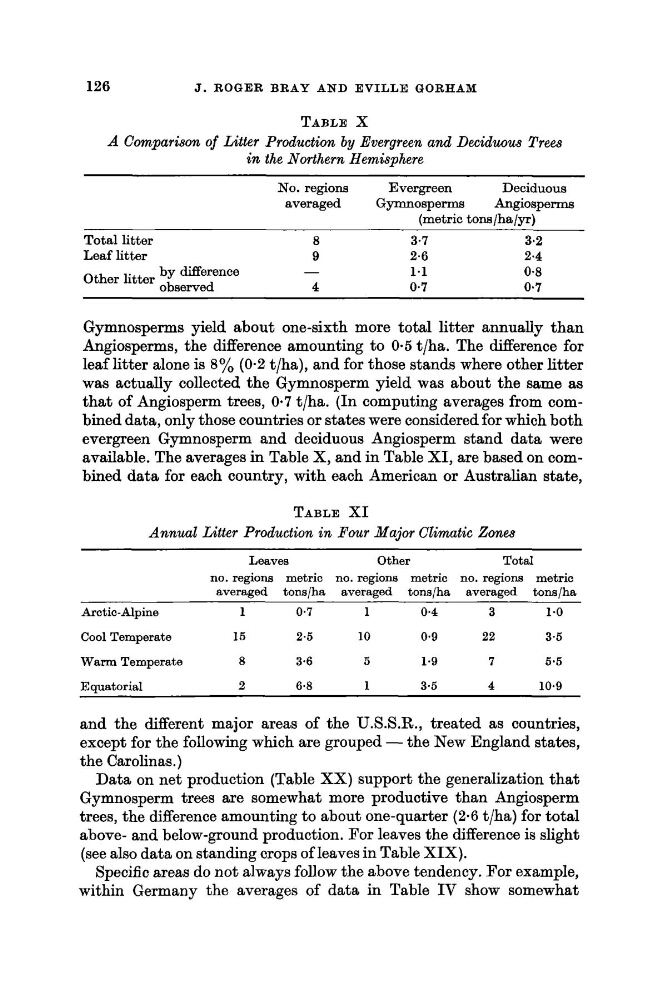
Gymnosperms yield about one-sixth more total litter annually than
Angiosperms, the difference amounting to 0-5 t/ha. The difference for
leaf litter alone is 8% (0.2 t/ha), and for those stands where other litter
was actually collected the Gymnosperm yield was about the same as
that of Angiosperm trees, 0.7 t/ha. (In computing averages from combined data, only those countries or states were considered for which both
evergreen Gymnosperm and deciduous Angiosperm stand data were
available. The averages in Table X, and in Table XI, are based on combined data for each country, with each American or Australian state,
TABLE X I
Annual Litter Production in Four Major Climatic Zones
Leaves
Other
Total
no. regions metric no. regions metric no. regions metric
averaged tons/ha averaged tons/ha averaged tons/ha
Arctic- Alpine
1
0.7
1
0.4
3
1.0
Cool Temperate
15
2.5
10
0.9
22
3.5
Warm Temperate
8
3.6
5
1.9
7
5.5
Equatorial
2
6.8
1
3.5
4
10.9
and the Werent major areas of the U.S.S.R., treated as countries,
except for the following which are grouped - the New England states,
the Carolinas.)
Data on net production (Table XX) support the generalization that
Gymnosperm trees are somewhat more productive than Angiosperm
trees, the difference amounting to about one-quarter (2.6 t/ha) for total
above- and below-ground production. For leaves the difference is slight
(see also data on standing crops of leaves in Table XIX).
Specific areas do not always follow the above tendency. For example,
within Germany the averages of data in Table I V show somewhat
J . ROGER BRAY A N D EVILLE QORHAM
TABLE X
A Comparison of Litter Production by Evergreen and Deciduous Trees
in the Northern Hemisphere
No. regions
Evergreen
Deciduous
averaged
Gymnosperms
Angiosperms
(metric tons/he/yr)
Total litter
8
3.7
3.2
Leaf litter
9
2.6
2.4
by difference
Other litter observed
-
4
1.1
0.7
0.8
0.7
Gymnosperms yield about one-sixth more total litter annually than
Angiosperms, the difference amounting to 0-5 t/ha. The difference for
leaf litter alone is 8% (0.2 t/ha), and for those stands where other litter
was actually collected the Gymnosperm yield was about the same as
that of Angiosperm trees, 0.7 t/ha. (In computing averages from combined data, only those countries or states were considered for which both
evergreen Gymnosperm and deciduous Angiosperm stand data were
available. The averages in Table X, and in Table XI, are based on combined data for each country, with each American or Australian state,
TABLE X I
Annual Litter Production in Four Major Climatic Zones
Leaves
Other
Total
no. regions metric no. regions metric no. regions metric
averaged tons/ha averaged tons/ha averaged tons/ha
Arctic- Alpine
1
0.7
1
0.4
3
1.0
Cool Temperate
15
2.5
10
0.9
22
3.5
Warm Temperate
8
3.6
5
1.9
7
5.5
Equatorial
2
6.8
1
3.5
4
10.9
and the Werent major areas of the U.S.S.R., treated as countries,
except for the following which are grouped - the New England states,
the Carolinas.)
Data on net production (Table XX) support the generalization that
Gymnosperm trees are somewhat more productive than Angiosperm
trees, the difference amounting to about one-quarter (2.6 t/ha) for total
above- and below-ground production. For leaves the difference is slight
(see also data on standing crops of leaves in Table XIX).
Specific areas do not always follow the above tendency. For example,
within Germany the averages of data in Table I V show somewhat