

86
L. B. SLOBODKIN
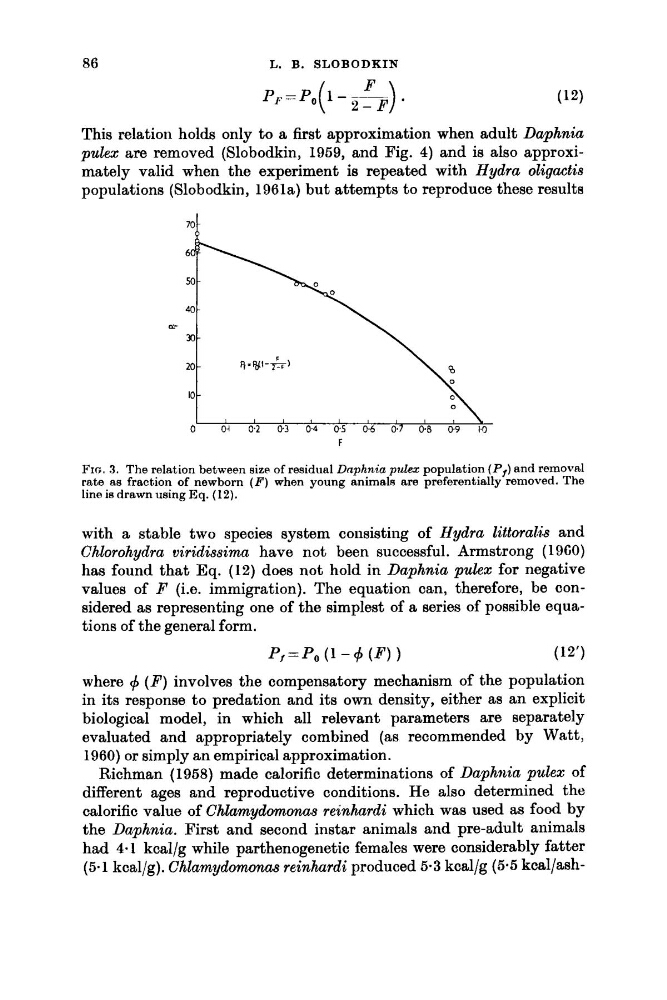
This relation holds only to a first approximation when adult Daphnia
pulex are removed (Slobodkin, 1959, and Fig. 4) and is also approximately valid when the experiment is repeated with Hydra oligactis
populations (Slobodkin, 1961a) but attempts t o reproduce these results
40 -
3010 -
0
0.1 0 2
0 3
0 4
0 5 0.6 0.7 0.8 0.9 1. 0
F
FIG. 3. The relation between size of residual Dnphnia pulez population (P,) and removal
rate aa fraction of newborn ( F ) when young animals are preferentially removed. The
line is drawn using Eq. (12).
with a stable two species system consisting of Hydra littoralis and
Chlorohydra viridissima have not been successful. Armstrong (1 960)
has found that Eq. (12) does not hold in Daphnia pubx for negative
values of F (i.e. immigration). The equation can, therefore, be considered as representing one of the simplest of a series of possible equations of the general form.
P , = P 0 ( 1 - + ( F ) )
(12')
where 4 ( F ) involves the compensatory mechanism of the population
in its response to predation and its own density, either as an explicit
biological model, in which all relevant parameters are separately
evaluated and appropriately combined (as recommended by Watt,
1960) or simply an empirical approximation.
Richman (1958) made calorific determinations of Daphqtia pulex of
different ages and reproductive conditions. He also determined the
calorific value of Chlamydomonas reinhurdi which was used as food by
the Daphnia. First and second instar animals and pre-adult animals
had 4- 1 kcal/g while parthenogenetic females were considerably fatter
(5.1 kcal/g). Chlamydomonas reinhardi produced 5-3 kcal/g (5.5 kcal/ash-
L. B. SLOBODKIN
This relation holds only to a first approximation when adult Daphnia
pulex are removed (Slobodkin, 1959, and Fig. 4) and is also approximately valid when the experiment is repeated with Hydra oligactis
populations (Slobodkin, 1961a) but attempts t o reproduce these results
40 -
3010 -
0
0.1 0 2
0 3
0 4
0 5 0.6 0.7 0.8 0.9 1. 0
F
FIG. 3. The relation between size of residual Dnphnia pulez population (P,) and removal
rate aa fraction of newborn ( F ) when young animals are preferentially removed. The
line is drawn using Eq. (12).
with a stable two species system consisting of Hydra littoralis and
Chlorohydra viridissima have not been successful. Armstrong (1 960)
has found that Eq. (12) does not hold in Daphnia pubx for negative
values of F (i.e. immigration). The equation can, therefore, be considered as representing one of the simplest of a series of possible equations of the general form.
P , = P 0 ( 1 - + ( F ) )
(12')
where 4 ( F ) involves the compensatory mechanism of the population
in its response to predation and its own density, either as an explicit
biological model, in which all relevant parameters are separately
evaluated and appropriately combined (as recommended by Watt,
1960) or simply an empirical approximation.
Richman (1958) made calorific determinations of Daphqtia pulex of
different ages and reproductive conditions. He also determined the
calorific value of Chlamydomonas reinhurdi which was used as food by
the Daphnia. First and second instar animals and pre-adult animals
had 4- 1 kcal/g while parthenogenetic females were considerably fatter
(5.1 kcal/g). Chlamydomonas reinhardi produced 5-3 kcal/g (5.5 kcal/ash-