

72
L. B. SLOBODRIN
Once the above hypothesis has been formulated it would be very
difficult to avoid unconscious selection of material if further testing
were done by continuing our survey of animals. Calorific determinations
are continuing, however, with reference t o special problems.
The highest calorific value for any whole animal was 7-432 kcal/ashfree g for Calanus hyperboreus collected in the field by Dr R. Conover of
Woods Hole. Apparently this copepod feeds very heavily on oil-rich
diatoms during the brief periods of phytoplankton blooms and subsists
largely on its own fat between blooms. A remarkably similar value of
7-380 was reported for a male C . Jinrnarchicus by Marshall and Orr
demonstrating that at least high latitude copepods become very fat and
also demonstrating that the gain in calorific value is not simply an
adaptation t o egg laying (Marshall and Orr, 1961, personal communication).
Extremely low values were found for a razor clam, Ensis minor (c. 3.5
kcallash-free g), and a polychaete worm, Strenelais articulata (c. 4-7
kcal/ash-free g). These low values may be due to the inclusion of
scleratized protein and polysaccharide shells, skins, and scales which
would burn, thereby being included in the ash-free fraction, but would
have a low calorific value. This explanation of low values requires
further test.
We received samples of dried Australian brush turkey (Leipoa
ocellata) egg yolk and found that it was identical with that of chicken
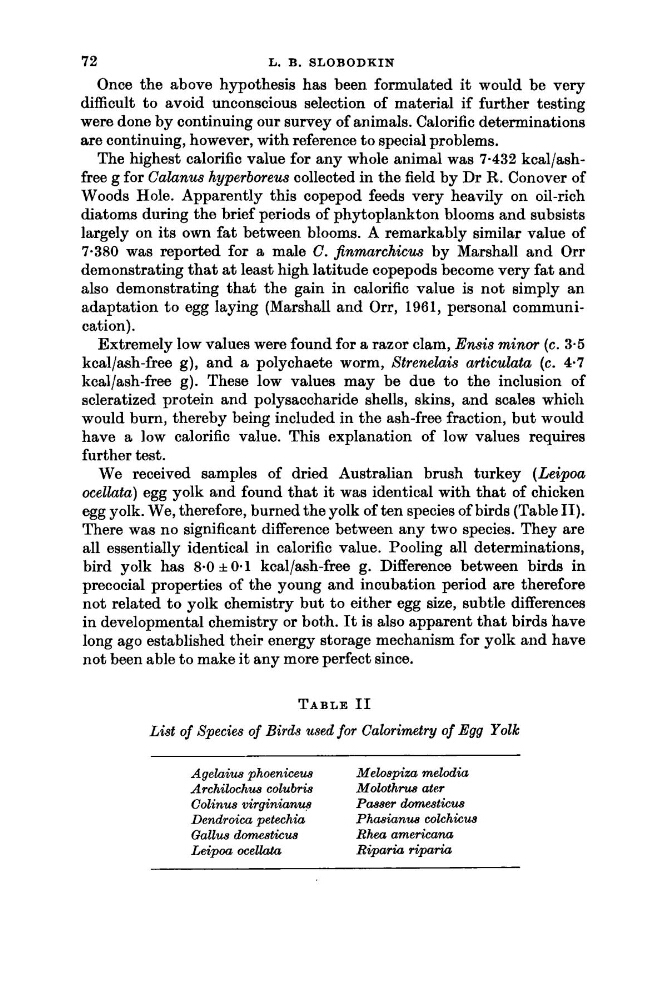
egg yolk. We, therefore, burned the yolk of ten species of birds (Table 11).
There was no significant difference between any two species. They are
all essentially identical in calorific value. Pooling all determinations,
bird yolk has 8.0 f 0.1 kcal/ash-free g. Difference between birds in
precocial properties of the young and incubation period are therefore
not related t o yolk chemistry but to either egg size, subtle differences
in developmental chemistry or both. It is also apparent that birds have
long ago established their energy storage mechanism for yolk and have
not been able t o make it any more perfect since.
T A B L E I1
List of Species of Birds used for Calorimetry of Egg Yolk
Agelaius phoeniceus
Meloepiza melodia
Archilochus colubris
Molothrus ate7
Colinus virginianw
Paaser domesticus
Dendroica petechia
Phasianus colchicue
Callus domesticus
Rhea americana
Leipoa ocellata
Riparia r i p a h
L. B. SLOBODRIN
Once the above hypothesis has been formulated it would be very
difficult to avoid unconscious selection of material if further testing
were done by continuing our survey of animals. Calorific determinations
are continuing, however, with reference t o special problems.
The highest calorific value for any whole animal was 7-432 kcal/ashfree g for Calanus hyperboreus collected in the field by Dr R. Conover of
Woods Hole. Apparently this copepod feeds very heavily on oil-rich
diatoms during the brief periods of phytoplankton blooms and subsists
largely on its own fat between blooms. A remarkably similar value of
7-380 was reported for a male C . Jinrnarchicus by Marshall and Orr
demonstrating that at least high latitude copepods become very fat and
also demonstrating that the gain in calorific value is not simply an
adaptation t o egg laying (Marshall and Orr, 1961, personal communication).
Extremely low values were found for a razor clam, Ensis minor (c. 3.5
kcallash-free g), and a polychaete worm, Strenelais articulata (c. 4-7
kcal/ash-free g). These low values may be due to the inclusion of
scleratized protein and polysaccharide shells, skins, and scales which
would burn, thereby being included in the ash-free fraction, but would
have a low calorific value. This explanation of low values requires
further test.
We received samples of dried Australian brush turkey (Leipoa
ocellata) egg yolk and found that it was identical with that of chicken
egg yolk. We, therefore, burned the yolk of ten species of birds (Table 11).
There was no significant difference between any two species. They are
all essentially identical in calorific value. Pooling all determinations,
bird yolk has 8.0 f 0.1 kcal/ash-free g. Difference between birds in
precocial properties of the young and incubation period are therefore
not related t o yolk chemistry but to either egg size, subtle differences
in developmental chemistry or both. It is also apparent that birds have
long ago established their energy storage mechanism for yolk and have
not been able t o make it any more perfect since.
T A B L E I1
List of Species of Birds used for Calorimetry of Egg Yolk
Agelaius phoeniceus
Meloepiza melodia
Archilochus colubris
Molothrus ate7
Colinus virginianw
Paaser domesticus
Dendroica petechia
Phasianus colchicue
Callus domesticus
Rhea americana
Leipoa ocellata
Riparia r i p a h