

70
L. B. SLOBODKIN
tation is not usually depleted by the activities of herbivores. Situations
in which terrestrial vegetation is eliminated often involve exotic
herbivores. The success of exotic herbivores at plant destruction implies that climate does not usually regulate the size of herbivore populations, since the exotic herbivore cannot be expected t o show higher
adaptation t o the weather than the native species. An exotic herbivore
might however be immune t o native predators.
It is tautological that if herbivores are usually predator limited, then
predators are usually food limited. Except t o the degree that water or
some other chemical component of the food is in particularly short
supply, food limitation is identical with energy limitation.
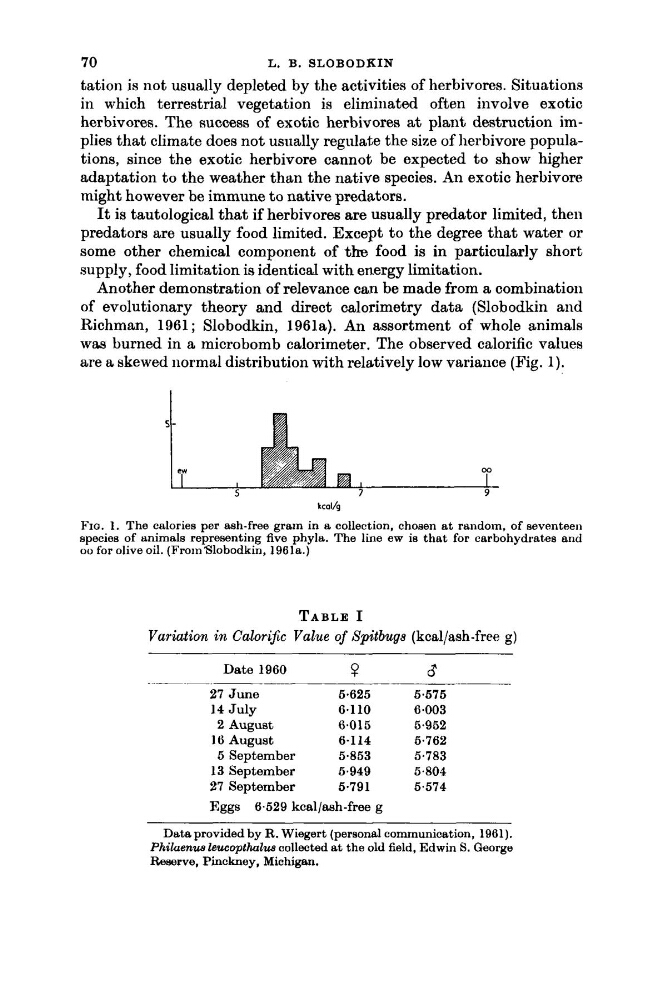
Another demonstration of relevance can be made from a combination
of evolutionary theory and direct calorimetry data (Slobodkin and
Richman, 1961 ; Slobodkin, 1961a). An assortment of whole animals
was burned in a microbomb calorimeter. The observed calorific values
are a skewed normal distribution with relatively low variance (Fig. 1).
kcal/g
FIG. 1. The calories per ash-free gram in a collection, chosen at random, of seventeen
species of animals representing five phyla. The line ew is that for carbohydrates and
oo for olive oil. (FromSlobodkin, 1961a.)
TABLE I
Variation in Calorijlc Value of Spitbugs (kcal/ash-free g)
Date 1960
?
6
27 June
5.625
5.575
14 July
6.1 10
6.003
2 August
6.015
5.952
16 August
6.1 14
5.762
5 September
5.853
5.783
13 September
5.949
5.804
27 September
6.791
5.574
Eggs 8.529 kcal/ash-free g
Data provided by R. Wiegert (personal communication, 1981).
Philaenus Zeucopthdua collected at the old field, Edwin 8. George
Reserve, Pinckney, Michigan.
L. B. SLOBODKIN
tation is not usually depleted by the activities of herbivores. Situations
in which terrestrial vegetation is eliminated often involve exotic
herbivores. The success of exotic herbivores at plant destruction implies that climate does not usually regulate the size of herbivore populations, since the exotic herbivore cannot be expected t o show higher
adaptation t o the weather than the native species. An exotic herbivore
might however be immune t o native predators.
It is tautological that if herbivores are usually predator limited, then
predators are usually food limited. Except t o the degree that water or
some other chemical component of the food is in particularly short
supply, food limitation is identical with energy limitation.
Another demonstration of relevance can be made from a combination
of evolutionary theory and direct calorimetry data (Slobodkin and
Richman, 1961 ; Slobodkin, 1961a). An assortment of whole animals
was burned in a microbomb calorimeter. The observed calorific values
are a skewed normal distribution with relatively low variance (Fig. 1).
kcal/g
FIG. 1. The calories per ash-free gram in a collection, chosen at random, of seventeen
species of animals representing five phyla. The line ew is that for carbohydrates and
oo for olive oil. (FromSlobodkin, 1961a.)
TABLE I
Variation in Calorijlc Value of Spitbugs (kcal/ash-free g)
Date 1960
?
6
27 June
5.625
5.575
14 July
6.1 10
6.003
2 August
6.015
5.952
16 August
6.1 14
5.762
5 September
5.853
5.783
13 September
5.949
5.804
27 September
6.791
5.574
Eggs 8.529 kcal/ash-free g
Data provided by R. Wiegert (personal communication, 1981).
Philaenus Zeucopthdua collected at the old field, Edwin 8. George
Reserve, Pinckney, Michigan.