

SUCCESSIVE APPROXIMATION I N DESCRIPTIVE ECOLOGY
89
what principles a classification of biocoenoses should develop. Sukachev
proposes one based on “development and the resultant complexity of
sociologic structure”. He maintains that a natural classification of
phytocoenoses must rest upon features which are involved in transformations of matter or energy.
At present it would seem most reasonable t o classify the biocoenose
by means of the dominant phytocoenose, using animals where necessary,
as part of the characterization, and treating those which migrate from
one phytocoenose to another aa transgressive elements.
B. PHYLOQENY O F PLANT COMMUNITIES
As the study of phylogeny has so much influenced taxonomy, it may
be useful t o look into its possible value in the study of vegetation. The
very great similarity that can sometimes be found between communities
which are far apart from one another is strong prima facie evidence for
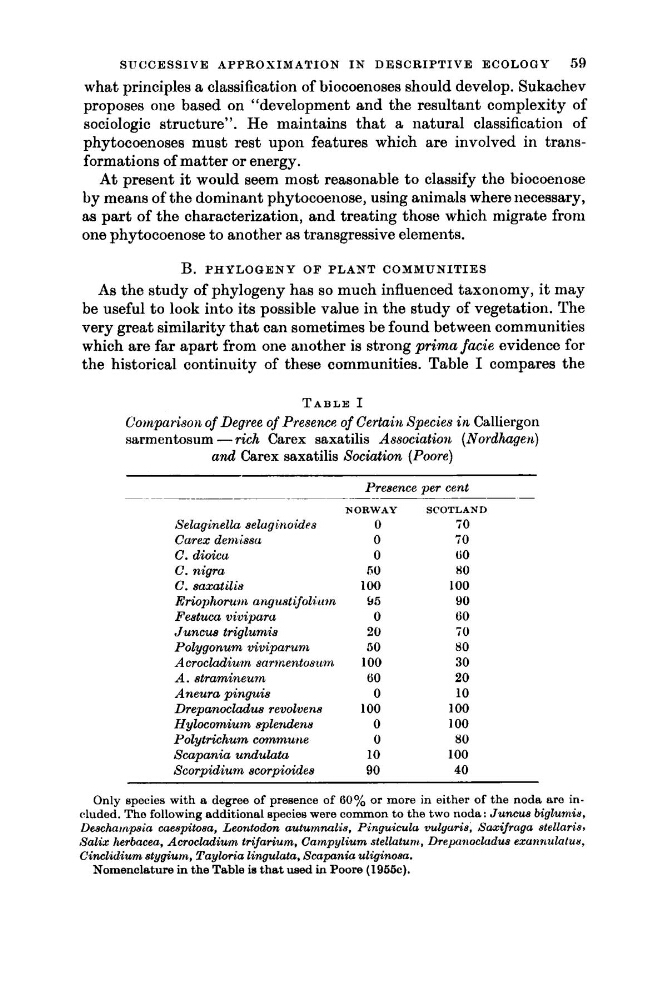
the historical continuity of these communities. Table I compares the
T A B L E I
Co,tqmrison of Degree of Presence of Certaiu Species i n Calliergon
sarmentosum - rich Carex saxatilis Association (Nordhuqen)
and Carex saxatilis Sociation (Poore)
Presence per cent
Selaginella selaginoidm
Carex deniisstt
C . dioicu
C . nigra
C . saxut il is
Eriophorutn angustifoliion
Featuca viuipuru
Juncua triglumis
Polygonum viviparuni
Acrocladiurn sarmentoszirn
A . stramineurn
Aneura pinguis
Drepanocladus revolvens
Hylocomium splendens
Polytrichum commune
Scapunia undulata
Scorpidium scorpioides
NORWAY
SCOTLAND
0
70
0
70
0
60
50
80
100
100
95
90
0
60
20
70
50
80
100
30
60
20
0
10
100
100
0
100
0
80
10
100
90
40
Only species with a degree of presence of BOq$ or more in either of the noda are included. The following additional species were common to the two noda : Juncus biglumia,
Deachatnpsia caespitosa, Leontodon auturnnulis, Pinguicula vulgaris, Saxifraga stellaris.
Salix herbacea, Acrocludium trifarium, Carnpylium stellatum, Drepanocladua exannulalua,
Cinclulium stygium, Tayloria linguluta, Scapania uliginosa.
Nomenclature in the Table is that used in Poore (1955~).
89
what principles a classification of biocoenoses should develop. Sukachev
proposes one based on “development and the resultant complexity of
sociologic structure”. He maintains that a natural classification of
phytocoenoses must rest upon features which are involved in transformations of matter or energy.
At present it would seem most reasonable t o classify the biocoenose
by means of the dominant phytocoenose, using animals where necessary,
as part of the characterization, and treating those which migrate from
one phytocoenose to another aa transgressive elements.
B. PHYLOQENY O F PLANT COMMUNITIES
As the study of phylogeny has so much influenced taxonomy, it may
be useful t o look into its possible value in the study of vegetation. The
very great similarity that can sometimes be found between communities
which are far apart from one another is strong prima facie evidence for
the historical continuity of these communities. Table I compares the
T A B L E I
Co,tqmrison of Degree of Presence of Certaiu Species i n Calliergon
sarmentosum - rich Carex saxatilis Association (Nordhuqen)
and Carex saxatilis Sociation (Poore)
Presence per cent
Selaginella selaginoidm
Carex deniisstt
C . dioicu
C . nigra
C . saxut il is
Eriophorutn angustifoliion
Featuca viuipuru
Juncua triglumis
Polygonum viviparuni
Acrocladiurn sarmentoszirn
A . stramineurn
Aneura pinguis
Drepanocladus revolvens
Hylocomium splendens
Polytrichum commune
Scapunia undulata
Scorpidium scorpioides
NORWAY
SCOTLAND
0
70
0
70
0
60
50
80
100
100
95
90
0
60
20
70
50
80
100
30
60
20
0
10
100
100
0
100
0
80
10
100
90
40
Only species with a degree of presence of BOq$ or more in either of the noda are included. The following additional species were common to the two noda : Juncus biglumia,
Deachatnpsia caespitosa, Leontodon auturnnulis, Pinguicula vulgaris, Saxifraga stellaris.
Salix herbacea, Acrocludium trifarium, Carnpylium stellatum, Drepanocladua exannulalua,
Cinclulium stygium, Tayloria linguluta, Scapania uliginosa.
Nomenclature in the Table is that used in Poore (1955~).