

18
A. MACFADYEN
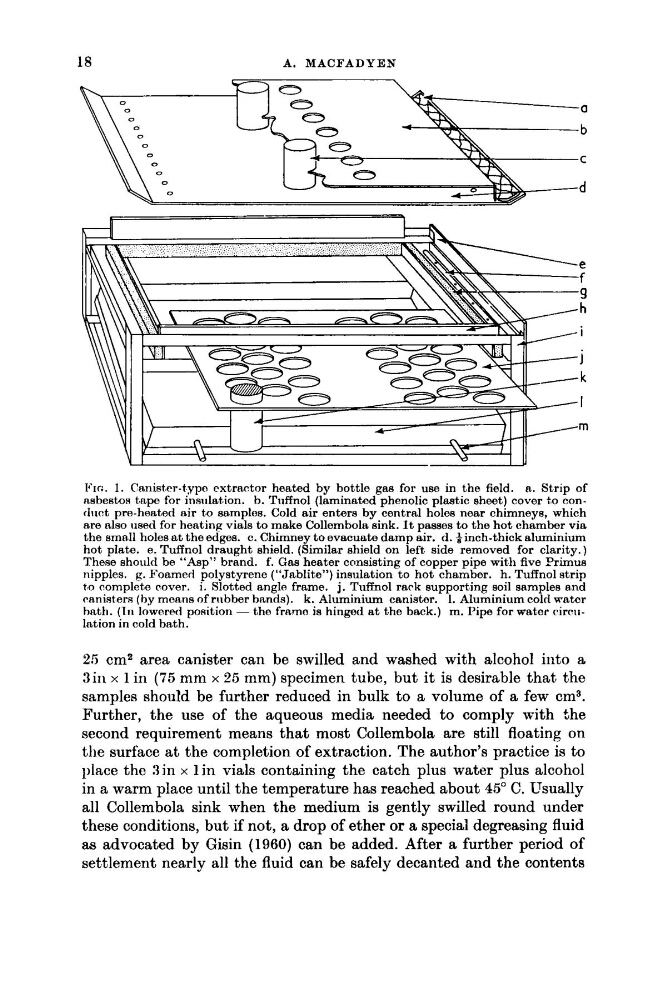
I k i . 1. Canist,er-t.gpe extractor heated by bottle gas for use in the field. a. Strip of
asbestos t,ape for insdataion. b. Tuffnol (laminated phenolic plastic sheet) cover t.0 con.
diict pre-heated a,ir t.0 samples. Cold air enters by central holes near chimneys, which
are also used for heating vials to make Collembola sink. It passes to the hot chamber via
the sma.11 holes at the edges. c. Chimney to evacuate damp air. d. +inch-thick aluminium
hot plate. e. Tuffnol draught shield. (Similar shield on left side removed for clarity.)
These should be “Asp” brand. f. Gas heater consisting of copper pipe with five Drimus
nipples. g. Foamed polystyrene (“Jablite”) insulation to hot chamber. h. Tuffnol strip
t.0 complete rover. i. Slotted angle frame. j. Tuffnol rark supporting soil samples and
ranist’ers (hy moans of rrtbber hands). k. Aluminium canister. 1. Aluminium cold water
bath. (In lowered poRition - the framo is hinged a t the back.) m. Pipe for water cirrulation in cold bath.
25 cm2 area canister can be swilled and washed with alcohol into a
3in x 1 in (75 mm x 25 mm) specimen tube, but it is desirable that! the
samples should be further reduced in bulk to a volume of a few cm3.
Further, the use of the aqueous media needed to comply with the
second requirement means that most Collembola are still floating on
the surface a t the completion of extraction. The author’s practice is to
place the 3 in x 1 in vials containing the catch plus water plus alcohol
in a warm place until the temperature has reached about 45” C. Usually
all Collembola sink when the medium is gently swilled round under
these conditions, but if not, a drop of ether or a special degreasing fluid
as advocated by Gisin (1960) can be added. After a further period of
settlement nearly all the fluid can be safely decanted and the contents
A. MACFADYEN
I k i . 1. Canist,er-t.gpe extractor heated by bottle gas for use in the field. a. Strip of
asbestos t,ape for insdataion. b. Tuffnol (laminated phenolic plastic sheet) cover t.0 con.
diict pre-heated a,ir t.0 samples. Cold air enters by central holes near chimneys, which
are also used for heating vials to make Collembola sink. It passes to the hot chamber via
the sma.11 holes at the edges. c. Chimney to evacuate damp air. d. +inch-thick aluminium
hot plate. e. Tuffnol draught shield. (Similar shield on left side removed for clarity.)
These should be “Asp” brand. f. Gas heater consisting of copper pipe with five Drimus
nipples. g. Foamed polystyrene (“Jablite”) insulation to hot chamber. h. Tuffnol strip
t.0 complete rover. i. Slotted angle frame. j. Tuffnol rark supporting soil samples and
ranist’ers (hy moans of rrtbber hands). k. Aluminium canister. 1. Aluminium cold water
bath. (In lowered poRition - the framo is hinged a t the back.) m. Pipe for water cirrulation in cold bath.
25 cm2 area canister can be swilled and washed with alcohol into a
3in x 1 in (75 mm x 25 mm) specimen tube, but it is desirable that! the
samples should be further reduced in bulk to a volume of a few cm3.
Further, the use of the aqueous media needed to comply with the
second requirement means that most Collembola are still floating on
the surface a t the completion of extraction. The author’s practice is to
place the 3 in x 1 in vials containing the catch plus water plus alcohol
in a warm place until the temperature has reached about 45” C. Usually
all Collembola sink when the medium is gently swilled round under
these conditions, but if not, a drop of ether or a special degreasing fluid
as advocated by Gisin (1960) can be added. After a further period of
settlement nearly all the fluid can be safely decanted and the contents