

SOIL ARTHROPOD SAMPLING
15
out and animals were forced to leave the medium largely through desiccation. Berlese was not concerned with quantitative results and made
no attempt to test the efficiency of the apparatus nor to apply any kind
of directional stimulus. Tullgren (1918) introduced the use of an electric
light bulb suspended above the funnel in place of the water jacket
largely as a matter of convenience and economy; there appears to have
been no intention to produce a heat gradient by this means. A large
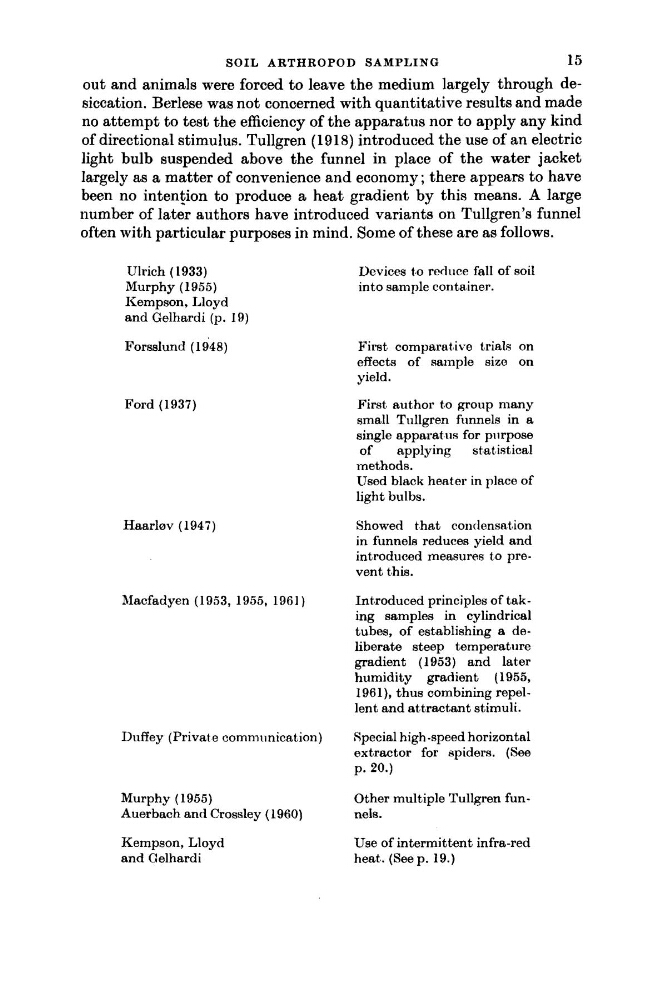
number of later authors have introduced variants on Tullgren’s funnel
often with particular purposes in mind. Some of these are as follows.
Ulrich (1933)
Murphy (1955)
Kempson, Lloyd
and Gelhardi (p. 19)
Forsslund (1948)
Ford (1937)
H a a r l ~ v (1947)
RIacfadyen (1953, 1955, 1961)
Duffey (Private communication)
Murphy (1955)
Auerbach and Crossley (1960)
Kempson, Lloyd
and Celhardi
Devices t.o reduce fall of soil
into sample container.
First comparative trials on
effects of sample size on
yield.
First author to group many
small Tullgren funnels in a
single apparatus for purpose
of
applying
stat istical
methods.
Used black heater in place of
light bulbs.
Showed that contlensat ion
in funnels reduces yield and
introduced measures to prevent this.
Introduced principles of taking samples in cylindrical
tubes, of establishing a deliberate steep temperature
gradient (1953) and later
humidity gradient (1955,
1961), thus combining repellent and attractant stimuli.
Special high -speed horizontal
extractor for apiders. (See
p. 20.)
Other multiple Tullgren funnels.
Use of intermittent infra-red
heat. (Seep. 19.)
15
out and animals were forced to leave the medium largely through desiccation. Berlese was not concerned with quantitative results and made
no attempt to test the efficiency of the apparatus nor to apply any kind
of directional stimulus. Tullgren (1918) introduced the use of an electric
light bulb suspended above the funnel in place of the water jacket
largely as a matter of convenience and economy; there appears to have
been no intention to produce a heat gradient by this means. A large
number of later authors have introduced variants on Tullgren’s funnel
often with particular purposes in mind. Some of these are as follows.
Ulrich (1933)
Murphy (1955)
Kempson, Lloyd
and Gelhardi (p. 19)
Forsslund (1948)
Ford (1937)
H a a r l ~ v (1947)
RIacfadyen (1953, 1955, 1961)
Duffey (Private communication)
Murphy (1955)
Auerbach and Crossley (1960)
Kempson, Lloyd
and Celhardi
Devices t.o reduce fall of soil
into sample container.
First comparative trials on
effects of sample size on
yield.
First author to group many
small Tullgren funnels in a
single apparatus for purpose
of
applying
stat istical
methods.
Used black heater in place of
light bulbs.
Showed that contlensat ion
in funnels reduces yield and
introduced measures to prevent this.
Introduced principles of taking samples in cylindrical
tubes, of establishing a deliberate steep temperature
gradient (1953) and later
humidity gradient (1955,
1961), thus combining repellent and attractant stimuli.
Special high -speed horizontal
extractor for apiders. (See
p. 20.)
Other multiple Tullgren funnels.
Use of intermittent infra-red
heat. (Seep. 19.)