

142
J. D. O V I N Q T O N
organic matter present, burning may continue for over two hours so that
soil conditions may be changed.
In a variety of British woodlands of from 18 to 47 years of age, the
amount of energy in the plant organic matter (exclusive of roots)
ranged from 22 t o 156 x 1010 cal per ha depending upon the tree species
and the development of the woodland (Ovington and Heitkamp,
1960). In neighbouring treeless areas the energy content of the vegetation is much smaller varying from 2 to 6 x 10¹⁰ cal per ha. Most of the
energy in woodland ecosystems is contained within the trees. The
maximum mean annual rate of energy accumulation recorded for these
woodlands was 7 x 10¹⁰ cal per ha for a young plantation of Picea
omorika, equivalent to about 1% of the incoming solar radiation, and
more than double the accretion of energy in Scots pine plantations of
similar age. In the older 47-year-old plantations, harvesting of the tree
boles has removed up t o 100 x 1010 cal per ha, i.e. just about one-eighth
of the incident solar radiation of a single year. Clear felling and complete harvesting of the boles would result in a total energy removal of
about 190 x 1010 cal per ha. Unfortunately no data are available of the
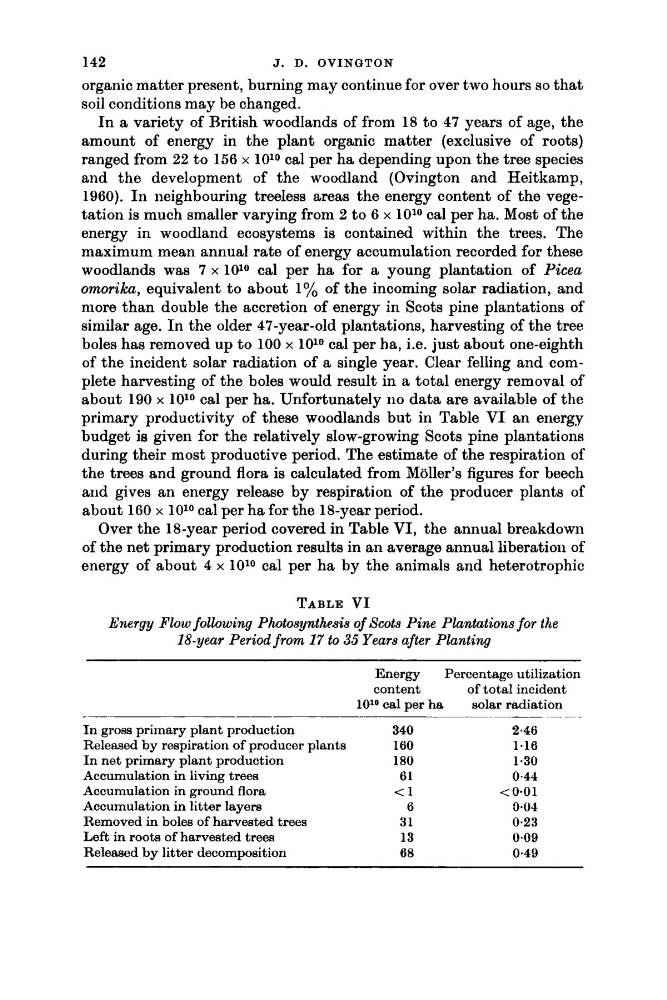
primary productivity of these woodlands but in Table V I an energy
budget is given for the relatively slow-growing Scots pine plantations
during their most productive period. The estimate of the respiration of
the trees and ground flora is calculated from M6ller's figures for beech
and gives an energy release by respiration of the producer plants of
about 160 x 1010 cal per ha for the 18-year period.
Over the 18-year period covered in Table VI, the annual breakdown
of the net primary production results in an average annual liberation of
energy of about 4 x 10¹⁰ cal per ha by the animals and heterotrophic
TABLE VI
Energy Flow following Photosynthesis of Scots Pine Plantations for the
18-year Period from 17 to 35 Years after Planting
Energy
Percentage utilization
content
of total incident
solar radiation
1010 cal per ha
In gross primary plant production
Released by respiration of producer plants
In net primary plant production
Accumulation in living trees
Accumulation in ground flora
Accumulation in litter layers
Removed in boles of harvested trees
Left in roots of harvested trees
Released by litter decomposition
340
160
180
61
< 1
6
31
13
68
2.46
1.16
1.30
0.44
<0.01
0.04
0.23
0.09
0.49
J. D. O V I N Q T O N
organic matter present, burning may continue for over two hours so that
soil conditions may be changed.
In a variety of British woodlands of from 18 to 47 years of age, the
amount of energy in the plant organic matter (exclusive of roots)
ranged from 22 t o 156 x 1010 cal per ha depending upon the tree species
and the development of the woodland (Ovington and Heitkamp,
1960). In neighbouring treeless areas the energy content of the vegetation is much smaller varying from 2 to 6 x 10¹⁰ cal per ha. Most of the
energy in woodland ecosystems is contained within the trees. The
maximum mean annual rate of energy accumulation recorded for these
woodlands was 7 x 10¹⁰ cal per ha for a young plantation of Picea
omorika, equivalent to about 1% of the incoming solar radiation, and
more than double the accretion of energy in Scots pine plantations of
similar age. In the older 47-year-old plantations, harvesting of the tree
boles has removed up t o 100 x 1010 cal per ha, i.e. just about one-eighth
of the incident solar radiation of a single year. Clear felling and complete harvesting of the boles would result in a total energy removal of
about 190 x 1010 cal per ha. Unfortunately no data are available of the
primary productivity of these woodlands but in Table V I an energy
budget is given for the relatively slow-growing Scots pine plantations
during their most productive period. The estimate of the respiration of
the trees and ground flora is calculated from M6ller's figures for beech
and gives an energy release by respiration of the producer plants of
about 160 x 1010 cal per ha for the 18-year period.
Over the 18-year period covered in Table VI, the annual breakdown
of the net primary production results in an average annual liberation of
energy of about 4 x 10¹⁰ cal per ha by the animals and heterotrophic
TABLE VI
Energy Flow following Photosynthesis of Scots Pine Plantations for the
18-year Period from 17 to 35 Years after Planting
Energy
Percentage utilization
content
of total incident
solar radiation
1010 cal per ha
In gross primary plant production
Released by respiration of producer plants
In net primary plant production
Accumulation in living trees
Accumulation in ground flora
Accumulation in litter layers
Removed in boles of harvested trees
Left in roots of harvested trees
Released by litter decomposition
340
160
180
61
< 1
6
31
13
68
2.46
1.16
1.30
0.44
<0.01
0.04
0.23
0.09
0.49