

98
L. B. SLOBODKIN
able that the total discrepancy between the input estimate and the
estimate of expenditures is only 0.1 6 kcal/m2/year. Ecological efficiency (mortality/ingestion) is 4.2% if all mortality is assumed due
to predators. I believe this to be as trustworthy an estimate a. s we
have for a field population. Dividing standing crop into ingestion provides a maximal estimate of maintenance cost of 38 cal/cal-year, or
assuming additivity of maintenance cost with time, 0-42 call4 cal-days
which is lower than that for Daphnia or Hydra but of the same order
of magnitude.
Englemann also attempted to compute ecological efficiences for
whole trophic levels (defining trophic level in the sense of our previous
discussion). The energy sources of the soil community are the corpses
and faeces deposited on the soil surface by the above-ground organisms.
The plant base of the subsoil community is the fungi. These are eaten
by herbivorous mites and collembolans and these in turn are consumed
by carnivorous mites. Other animal groups (for example nematodes)
occur but are not of quantitatively major significance. Englemann
pooled the available data for respiration, standing crop and food
habits of Collembola, Protozoa, Symphyla, Pauropoda, Japygidae
and the Oribatidae and followed the procedure of defining ecological
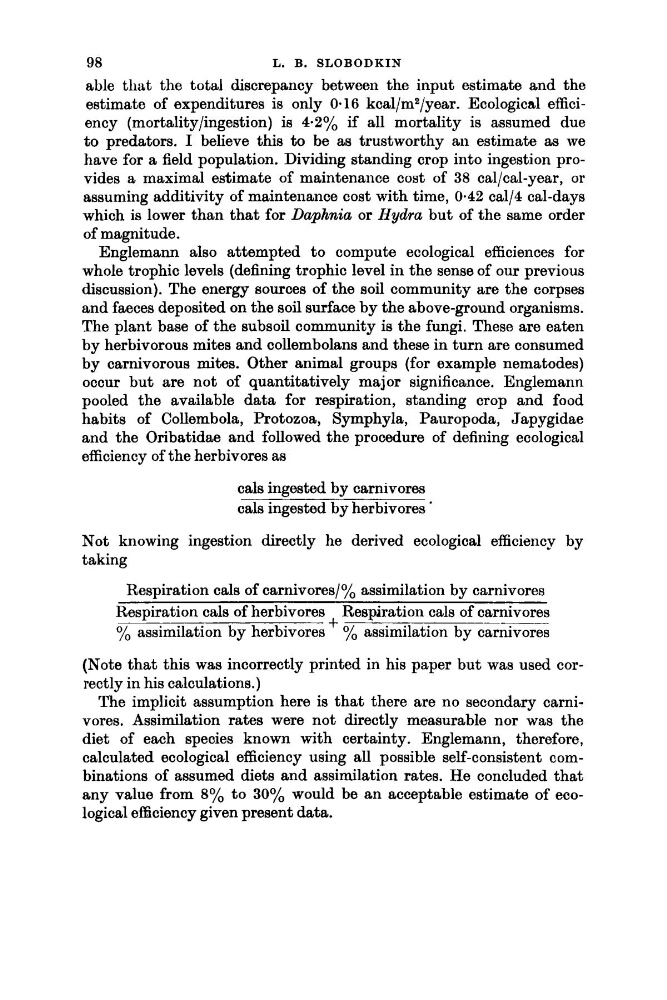
efficiency of the herbivores as
cals ingested by carnivores
cals ingested by herbivores *
Not knowing ingestion directly he derived ecological efficiency by
taking
Respiration cals of carnivores/% assimilation by carnivores
Respiration cals of herbivores Respiration cals of carnivores
yo assimilation by herbivores + % assimilation by carnivores
(Note that this was incorrectly printed in his paper but was used correctly in his calculations.)
The implicit assumption here is that there are no secondary carnivores. Assimilation rates were not directly measurable nor was the
diet of each species known with certainty. Englemann, therefore,
calculated ecological efficiency using all possible self-consistent combinations of assumed diets and assimilation rates. He concluded that
any value from 8% t o 30% would be an acceptable estimate of ecological efficiency given present data.
____
L. B. SLOBODKIN
able that the total discrepancy between the input estimate and the
estimate of expenditures is only 0.1 6 kcal/m2/year. Ecological efficiency (mortality/ingestion) is 4.2% if all mortality is assumed due
to predators. I believe this to be as trustworthy an estimate a. s we
have for a field population. Dividing standing crop into ingestion provides a maximal estimate of maintenance cost of 38 cal/cal-year, or
assuming additivity of maintenance cost with time, 0-42 call4 cal-days
which is lower than that for Daphnia or Hydra but of the same order
of magnitude.
Englemann also attempted to compute ecological efficiences for
whole trophic levels (defining trophic level in the sense of our previous
discussion). The energy sources of the soil community are the corpses
and faeces deposited on the soil surface by the above-ground organisms.
The plant base of the subsoil community is the fungi. These are eaten
by herbivorous mites and collembolans and these in turn are consumed
by carnivorous mites. Other animal groups (for example nematodes)
occur but are not of quantitatively major significance. Englemann
pooled the available data for respiration, standing crop and food
habits of Collembola, Protozoa, Symphyla, Pauropoda, Japygidae
and the Oribatidae and followed the procedure of defining ecological
efficiency of the herbivores as
cals ingested by carnivores
cals ingested by herbivores *
Not knowing ingestion directly he derived ecological efficiency by
taking
Respiration cals of carnivores/% assimilation by carnivores
Respiration cals of herbivores Respiration cals of carnivores
yo assimilation by herbivores + % assimilation by carnivores
(Note that this was incorrectly printed in his paper but was used correctly in his calculations.)
The implicit assumption here is that there are no secondary carnivores. Assimilation rates were not directly measurable nor was the
diet of each species known with certainty. Englemann, therefore,
calculated ecological efficiency using all possible self-consistent combinations of assumed diets and assimilation rates. He concluded that
any value from 8% t o 30% would be an acceptable estimate of ecological efficiency given present data.
____