

ENERGY IN ANIM.4L ECOLOGY
95
of animals were found in the spring but only 7 of these were of
sufficient quantity t o merit separate energy analysis.
The calorific determinations were made by a potassium perinanganate
reduction technique used originally by Ivlev, on a wet-weight basis.
Since most calorific determinations (Golley, 196 1 ; Slobodkin and
Richman, 1961) have been per dry-weight, these determinations are
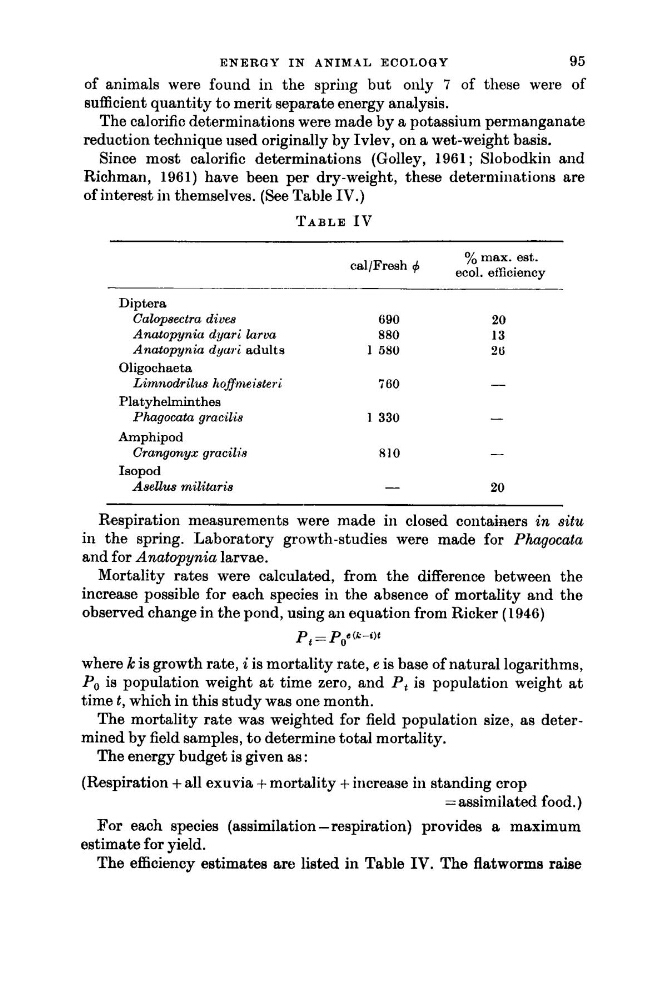
of interest in themselves. (See Table IV.)
TABLE I V
yo max. eat.
4
ecol. efficiency
Diptera
Calopsectra dives
Anatopynia dyari larva
Anatopynia dyori adults
Limnodrilus hoffrneisteri
Phagocata gracilis
Crangonyn gracilis
Asellus militaris
Oligochaeta
Platyhelminthes
Amphipod
Isopod
690
20
880
13
1 5 8 0
36
7 60
-
1 330
-
20
-
Respiration measurements were made in closed contakers in situ
in the spring. Laboratory growth-studies were made for Pitagocata
and for Anatopynia larvae.
Mortality rates were calculated, from the difference between the
increase possible for each species in the absence of mortality and the
observed change in the pond, using an equation from Ricker (1946)
where k is growth rate, i is mortality rate, e is base of natural logarithms,
Po is population weight at time zero, and P, is population weight a t
time t , which in this study was one month.
The mortality rate was weighted for field population size, as determined by field samples, to determine total mortality.
The energy budget is given as :
(Respiration +all exuvia + mortality + increase in standing crop
=assimilated food.)
For each species (assimilation -respiration) provides a maximum
The efficiency estimates are listed in Table IV. The flatworms raise
estimate for yield.
95
of animals were found in the spring but only 7 of these were of
sufficient quantity t o merit separate energy analysis.
The calorific determinations were made by a potassium perinanganate
reduction technique used originally by Ivlev, on a wet-weight basis.
Since most calorific determinations (Golley, 196 1 ; Slobodkin and
Richman, 1961) have been per dry-weight, these determinations are
of interest in themselves. (See Table IV.)
TABLE I V
yo max. eat.
4
ecol. efficiency
Diptera
Calopsectra dives
Anatopynia dyari larva
Anatopynia dyori adults
Limnodrilus hoffrneisteri
Phagocata gracilis
Crangonyn gracilis
Asellus militaris
Oligochaeta
Platyhelminthes
Amphipod
Isopod
690
20
880
13
1 5 8 0
36
7 60
-
1 330
-
20
-
Respiration measurements were made in closed contakers in situ
in the spring. Laboratory growth-studies were made for Pitagocata
and for Anatopynia larvae.
Mortality rates were calculated, from the difference between the
increase possible for each species in the absence of mortality and the
observed change in the pond, using an equation from Ricker (1946)
where k is growth rate, i is mortality rate, e is base of natural logarithms,
Po is population weight at time zero, and P, is population weight a t
time t , which in this study was one month.
The mortality rate was weighted for field population size, as determined by field samples, to determine total mortality.
The energy budget is given as :
(Respiration +all exuvia + mortality + increase in standing crop
=assimilated food.)
For each species (assimilation -respiration) provides a maximum
The efficiency estimates are listed in Table IV. The flatworms raise
estimate for yield.