

ENERQY I N ANIMAL ECOLOQY
93
is confirmed, it would tend t o indicate that morphological complexity
per se does not require large energy-expenditures but that the primary
energy cost in organisms is that associated with mechanical work.
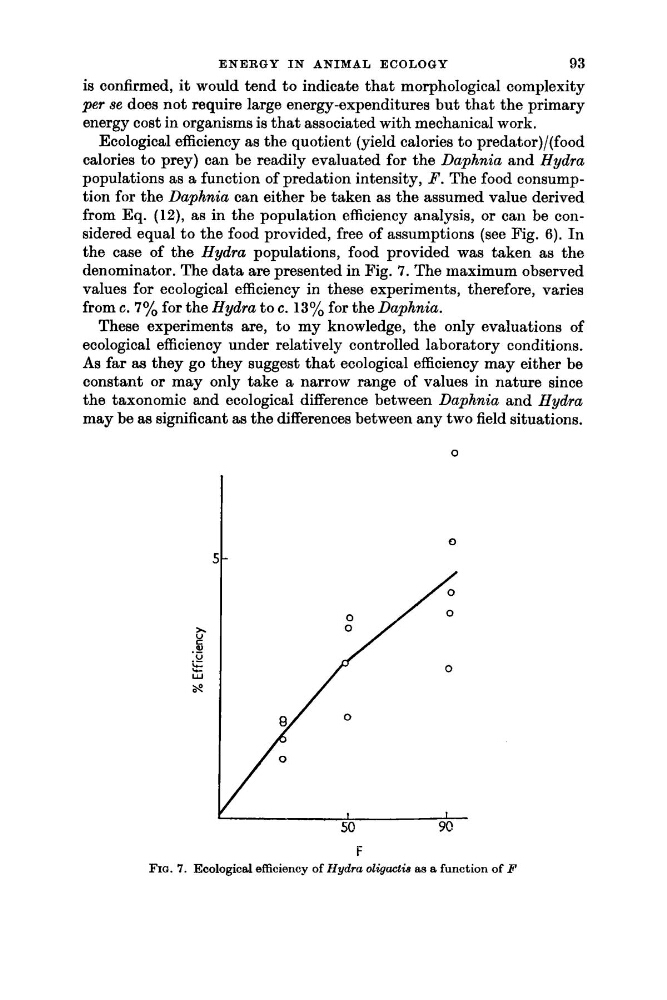
Ecological efficiency as the quotient (yield calories to predator)/(food
calories to prey) can be readily evaluated for the Daphnia and Hydra
populations as a function of predation intensity, F . The food consumption for the Daphnia can either be taken as the assumed value derived
from Eq. (12), as in the population efficiency analysis, or can be considered equal t o the food provided, free of assumptions (see Fig. 6). In
the case of the Hydra populations, food provided was taken as the
denominator. The data are presented in Fig. 7. The maximum observed
values for ecological efficiency in these experiments, therefore, varies
from c. 7% for the Hydra t o c. 13% for the Daphnia.
These experiments are, to my knowledge, the only evaluations of
ecological efficiency under relatively controlled laboratory conditions.
As far as they go they suggest that ecological efficiency may either be
constant or may only take a narrow range of values in nature since
the taxonomic and ecological difference between Daphnia and Hydra
may be as significant as the differences between any two field situations.
F
FIQ. I. Ecological efficiency of Hydra oligactis &s a function of F
93
is confirmed, it would tend t o indicate that morphological complexity
per se does not require large energy-expenditures but that the primary
energy cost in organisms is that associated with mechanical work.
Ecological efficiency as the quotient (yield calories to predator)/(food
calories to prey) can be readily evaluated for the Daphnia and Hydra
populations as a function of predation intensity, F . The food consumption for the Daphnia can either be taken as the assumed value derived
from Eq. (12), as in the population efficiency analysis, or can be considered equal t o the food provided, free of assumptions (see Fig. 6). In
the case of the Hydra populations, food provided was taken as the
denominator. The data are presented in Fig. 7. The maximum observed
values for ecological efficiency in these experiments, therefore, varies
from c. 7% for the Hydra t o c. 13% for the Daphnia.
These experiments are, to my knowledge, the only evaluations of
ecological efficiency under relatively controlled laboratory conditions.
As far as they go they suggest that ecological efficiency may either be
constant or may only take a narrow range of values in nature since
the taxonomic and ecological difference between Daphnia and Hydra
may be as significant as the differences between any two field situations.
F
FIQ. I. Ecological efficiency of Hydra oligactis &s a function of F