

90
L. B. SLOBODKIN
Po' x food supplied
p,
then assumed t o be
where Po was the size of a
population free from predation, with the same food supply as PF.
Clearly, population-size and yield are proportional t o food consumed,
all other things being equal. In the absence of predation, the relation
between population-size and energy consumed is given by Eq. (2)) the
constant of proportionality being the maintenance cost in units of
calories per calorie-day. In Daphnia populations a mean value for
maintenance cost derived from five populations is c = 1.69 call4 cal-days.
Omitting these five populations from further computations, an equation
of the form of Eq. (8) waa written for each of the twenty-two populations.
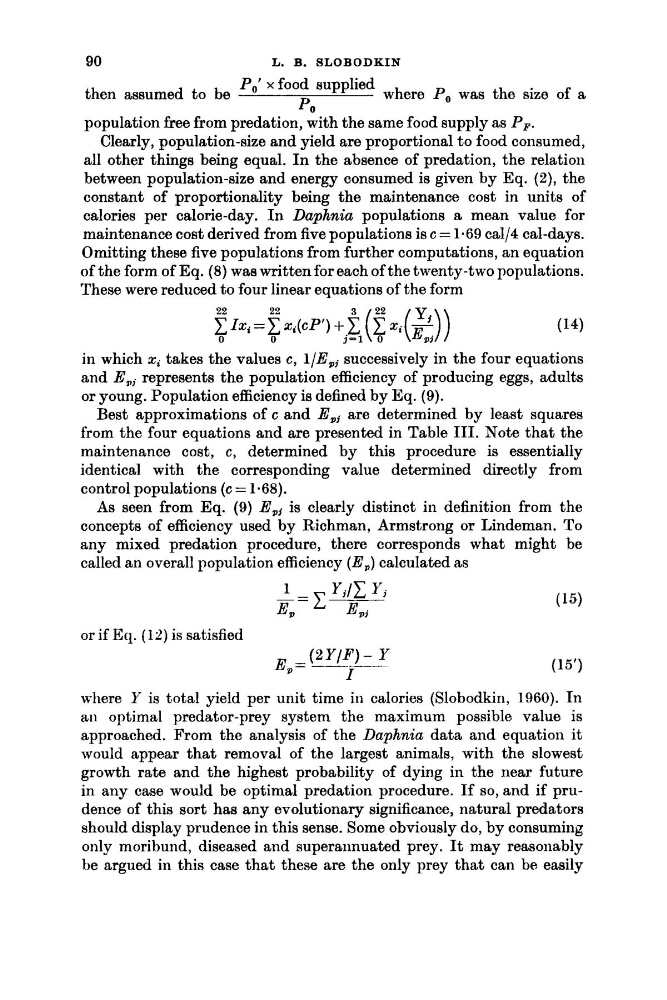
These were reduced to four linear equations of the form
0
0
in which xi takes the values c, l / E P j successively in the four equations
and Evj represents the population efficiency of producing eggs, adults
or young. Population efficiency is defined by Eq. (9).
Best approximations of c and EPj are determined by least squares
from the four equations and are presented in Table 111. Note that the
maintenance cost, c, determined by this procedure is essentially
identical with the corresponding value determined directly from
control populations (c = 1.68).
As seen from Eq. (9) E P j is clearly distinct in definition from the
concepts of efficiency used by Richman, Armstrong or Lindema.n. To
any mixed predation procedure, there corresponds what might be
called an overall population efficiency (E,) calculated as
or if Eq. (12) is satisfied
( 2 Y I F ) - Y
E,= _____
I
(15')
where Y is total yield per unit time in calories (Slobodkin, 1960). In
an optimal predator-prey system the maximum possible value is
approached. From the analysis of the Daphnia data and equation it
would appear that removal of the largest animals, with the slowest
growth rate and the highest probability of dying in the near future
in any case would be optimal predation procedure. If so,and if prudence of this sort has any evolutionary significance, natural predators
should display prudence in this sense. Some obviously do, by consuming
only moribund, diseased and superannuated prey. It may reasonably
be argued in this case that these are the only prey that can be easily
L. B. SLOBODKIN
Po' x food supplied
p,
then assumed t o be
where Po was the size of a
population free from predation, with the same food supply as PF.
Clearly, population-size and yield are proportional t o food consumed,
all other things being equal. In the absence of predation, the relation
between population-size and energy consumed is given by Eq. (2)) the
constant of proportionality being the maintenance cost in units of
calories per calorie-day. In Daphnia populations a mean value for
maintenance cost derived from five populations is c = 1.69 call4 cal-days.
Omitting these five populations from further computations, an equation
of the form of Eq. (8) waa written for each of the twenty-two populations.
These were reduced to four linear equations of the form
0
0
in which xi takes the values c, l / E P j successively in the four equations
and Evj represents the population efficiency of producing eggs, adults
or young. Population efficiency is defined by Eq. (9).
Best approximations of c and EPj are determined by least squares
from the four equations and are presented in Table 111. Note that the
maintenance cost, c, determined by this procedure is essentially
identical with the corresponding value determined directly from
control populations (c = 1.68).
As seen from Eq. (9) E P j is clearly distinct in definition from the
concepts of efficiency used by Richman, Armstrong or Lindema.n. To
any mixed predation procedure, there corresponds what might be
called an overall population efficiency (E,) calculated as
or if Eq. (12) is satisfied
( 2 Y I F ) - Y
E,= _____
I
(15')
where Y is total yield per unit time in calories (Slobodkin, 1960). In
an optimal predator-prey system the maximum possible value is
approached. From the analysis of the Daphnia data and equation it
would appear that removal of the largest animals, with the slowest
growth rate and the highest probability of dying in the near future
in any case would be optimal predation procedure. If so,and if prudence of this sort has any evolutionary significance, natural predators
should display prudence in this sense. Some obviously do, by consuming
only moribund, diseased and superannuated prey. It may reasonably
be argued in this case that these are the only prey that can be easily