

88
L. B. SLOBODKIN
energy ingested was determined from the calorific value of the Chhmydomonas and the observed feeding rate. Non-assimilated energy was
determined by difference. These determinations were made separately
on pre-adult Daphnia and reproductive Daphnia. In the pre-adult
animals, growth can be seen separate from reproduction.
Armstrong’s (1960) growth-efficiency estimates involve extrapolating
Richman’s data for the pre-reproductive period into adult life. Richnew protoplasm
energy consumed
man’s growth-efficiency is calculated either as
per unit
time which is the gross growth-efficiency or energy coefficient of
growth of the first order of Ivlev (1945) and Ricker (1946) or as
new protoplasm
per unit time which is the net
energy consumed - energy egested
growth-efficiency or energy coefficient of growth of the second order as
defined by these authors.
Gross growth-efficiency varies with algal concentration from 13%
at low algal concentration (2-5 + lo4 cells/cm3) t o 4% at high (10 f. 104
cells/cm3) but net growth-efficiency was constant at from 55% to 59%.
The speed of digestion was apparently limiting in this system. It seems
likely that with sufficient dilution of the food, efficiency would decrease, since the effort expended in filtration is constant while the
energy return from the filtration process is proportional t o food concentration (Armstrong, 1960 ; Slobodkin, 1954).
Growth-efficiency was low after attainment of reproductive age (less
than 14% gross or 4% net). Gross reproductive-efficiency was of the
same order as pre-adult growth-efficiency (c. 10-17%) and was similarly
dependent on algal concentration. Net reproductive efficiency, however, increased with feeding rate from 52% to 70%. The reasons for
this increase do not seem obvious unless we consider that a certain
constant amount of ingested food is relegated to maintenance of the
animal while the remainder is utilized for growth and reproduction.
This conforms with the generally accepted concepts of fiah growth
(Beverton and Holt, 1957).
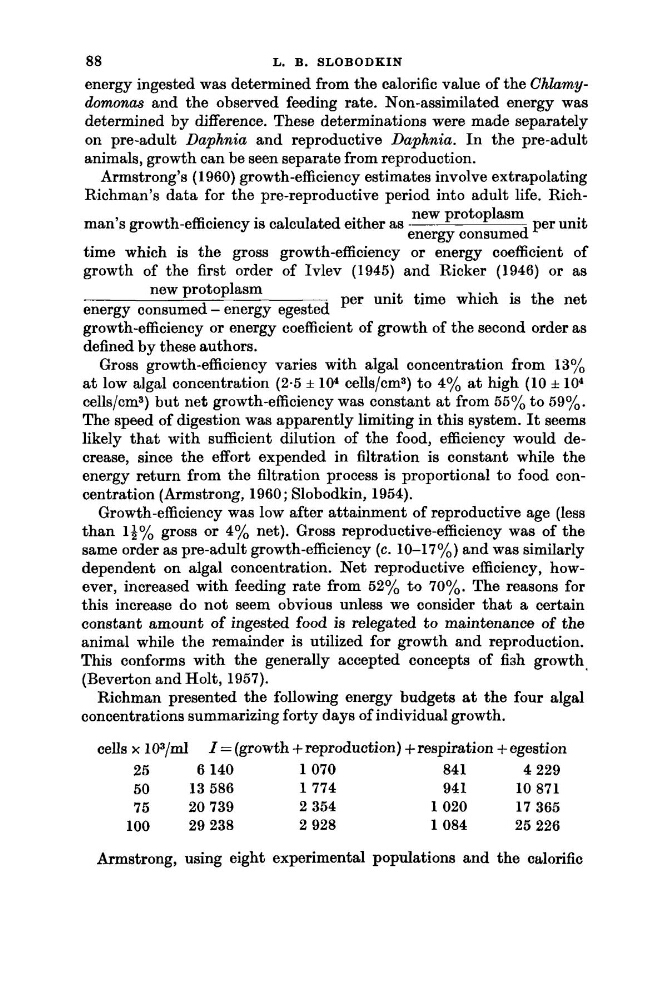
Richman presented the following energy budgets at the four algal
concentrations summarizing forty days of individual growth.
cells x 103/ml I = (growth +reproduction) +respiration + egestion
25
6 140
1 070
84 1
4 229
50
13 586
1 7 7 4
94 1
10 871
75
20 739
2 354
1 020
17 365
100
29238
2 928
1 084
25 226
Armstrong, using eight experimental populations and the calorific
L. B. SLOBODKIN
energy ingested was determined from the calorific value of the Chhmydomonas and the observed feeding rate. Non-assimilated energy was
determined by difference. These determinations were made separately
on pre-adult Daphnia and reproductive Daphnia. In the pre-adult
animals, growth can be seen separate from reproduction.
Armstrong’s (1960) growth-efficiency estimates involve extrapolating
Richman’s data for the pre-reproductive period into adult life. Richnew protoplasm
energy consumed
man’s growth-efficiency is calculated either as
per unit
time which is the gross growth-efficiency or energy coefficient of
growth of the first order of Ivlev (1945) and Ricker (1946) or as
new protoplasm
per unit time which is the net
energy consumed - energy egested
growth-efficiency or energy coefficient of growth of the second order as
defined by these authors.
Gross growth-efficiency varies with algal concentration from 13%
at low algal concentration (2-5 + lo4 cells/cm3) t o 4% at high (10 f. 104
cells/cm3) but net growth-efficiency was constant at from 55% to 59%.
The speed of digestion was apparently limiting in this system. It seems
likely that with sufficient dilution of the food, efficiency would decrease, since the effort expended in filtration is constant while the
energy return from the filtration process is proportional t o food concentration (Armstrong, 1960 ; Slobodkin, 1954).
Growth-efficiency was low after attainment of reproductive age (less
than 14% gross or 4% net). Gross reproductive-efficiency was of the
same order as pre-adult growth-efficiency (c. 10-17%) and was similarly
dependent on algal concentration. Net reproductive efficiency, however, increased with feeding rate from 52% to 70%. The reasons for
this increase do not seem obvious unless we consider that a certain
constant amount of ingested food is relegated to maintenance of the
animal while the remainder is utilized for growth and reproduction.
This conforms with the generally accepted concepts of fiah growth
(Beverton and Holt, 1957).
Richman presented the following energy budgets at the four algal
concentrations summarizing forty days of individual growth.
cells x 103/ml I = (growth +reproduction) +respiration + egestion
25
6 140
1 070
84 1
4 229
50
13 586
1 7 7 4
94 1
10 871
75
20 739
2 354
1 020
17 365
100
29238
2 928
1 084
25 226
Armstrong, using eight experimental populations and the calorific