

1. PENTOSE PHOSPHATE CYCLE
57
B. BIRDS
Subdivision of this category on the basis of the various tissues or of
different birds is not warranted, owing to the relative scarcity of published material on the pentose phosphate cycle activity in this class of
animals. In general, most of the studies have been carried out on
chickens, with an occasional mention of work done on pigeons and geese.
In pigeons, the smooth stomach muscles contain enzymes which will
convert G-6-P, 6-PG, and ribose-5-phosphate to lactate (372). Added
TPN
+ is reduced to TPNH in the presence of G-6-P and 6-PG, while
anaerobically triose phosphate and fructose-6-phosphate are formed from
ribose-5-phosphate in the presence of iodoacetate. In the thiaminedeficient pigeons, the liver transketolase activity is diminished to about
30% of the normal value (373). This activity could not be restored by
adding thiamine pyrophosphate or by adding thiamine pyrophosphate
plus Mg
++
.
When acetate-l-C
14 was fed to chicks, the ribose of the purine nucleotides of nucleic acids from the internal organs contains the radioactivity
mainly in the C-3 position, with lesser amounts in the C-l and C-2 positions (374). A condensation of a two-carbon fragment with a threecarbon fragment was postulated as the mechanism of formation of ribose.
Horecker and Mehler, however, imposed the action of transketolase and
transaldolase to explain this distribution of label (3).
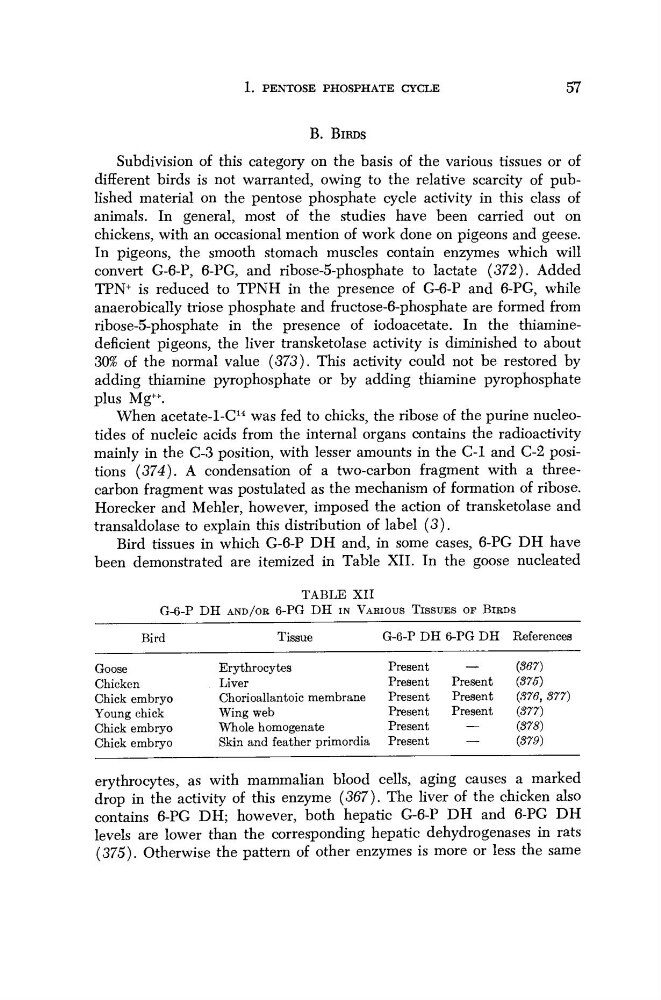
Bird tissues in which G-6-P DH and, in some cases, 6-PG DH have
been demonstrated are itemized in Table XII. In the goose nucleated
TABLE XII
G-6-P DH AND/OR 6-PG DH IN VARIOUS TISSUES OF BIRDS
Bird
Tissue
G-6-P DH 6-PG DH References
Goose
Erythrocytes
Present
—
(867)
Chicken
Liver
Present
Present
(875)
Chick embryo
Chorioallantoic membrane
Present
Present
(376, 877)
Young chick
Wing web
Present
Present
(377)
Chick embryo
Whole homogenate
Present
—
(378)
Chick embryo
Skin and feather primordia
Present
—
(379)
erythrocytes, as with mammalian blood cells, aging causes a marked
drop in the activity of this enzyme (367). The liver of the chicken also
contains 6-PG DH; however, both hepatic G-6-P DH and 6-PG DH
levels are lower than the corresponding hepatic dehydrogenases in rats
(375). Otherwise the pattern of other enzymes is more or less the same
57
B. BIRDS
Subdivision of this category on the basis of the various tissues or of
different birds is not warranted, owing to the relative scarcity of published material on the pentose phosphate cycle activity in this class of
animals. In general, most of the studies have been carried out on
chickens, with an occasional mention of work done on pigeons and geese.
In pigeons, the smooth stomach muscles contain enzymes which will
convert G-6-P, 6-PG, and ribose-5-phosphate to lactate (372). Added
TPN
+ is reduced to TPNH in the presence of G-6-P and 6-PG, while
anaerobically triose phosphate and fructose-6-phosphate are formed from
ribose-5-phosphate in the presence of iodoacetate. In the thiaminedeficient pigeons, the liver transketolase activity is diminished to about
30% of the normal value (373). This activity could not be restored by
adding thiamine pyrophosphate or by adding thiamine pyrophosphate
plus Mg
++
.
When acetate-l-C
14 was fed to chicks, the ribose of the purine nucleotides of nucleic acids from the internal organs contains the radioactivity
mainly in the C-3 position, with lesser amounts in the C-l and C-2 positions (374). A condensation of a two-carbon fragment with a threecarbon fragment was postulated as the mechanism of formation of ribose.
Horecker and Mehler, however, imposed the action of transketolase and
transaldolase to explain this distribution of label (3).
Bird tissues in which G-6-P DH and, in some cases, 6-PG DH have
been demonstrated are itemized in Table XII. In the goose nucleated
TABLE XII
G-6-P DH AND/OR 6-PG DH IN VARIOUS TISSUES OF BIRDS
Bird
Tissue
G-6-P DH 6-PG DH References
Goose
Erythrocytes
Present
—
(867)
Chicken
Liver
Present
Present
(875)
Chick embryo
Chorioallantoic membrane
Present
Present
(376, 877)
Young chick
Wing web
Present
Present
(377)
Chick embryo
Whole homogenate
Present
—
(378)
Chick embryo
Skin and feather primordia
Present
—
(379)
erythrocytes, as with mammalian blood cells, aging causes a marked
drop in the activity of this enzyme (367). The liver of the chicken also
contains 6-PG DH; however, both hepatic G-6-P DH and 6-PG DH
levels are lower than the corresponding hepatic dehydrogenases in rats
(375). Otherwise the pattern of other enzymes is more or less the same