

1. PENTOSE PHOSPHATE CYCLE
55
III and returns to normal, while G-6-P DH increases in periods IV and V.
On the other hand, 6-PG DH is low at the hyperplasia stage to the
preneoplastic hyperplasia stage. The workers concluded that the change
in the 6-PG DH activity shows the greatest degree of correlation with
the neoplastic stage as compared with the hyperplastic state.
16. Miscellaneous Tissues
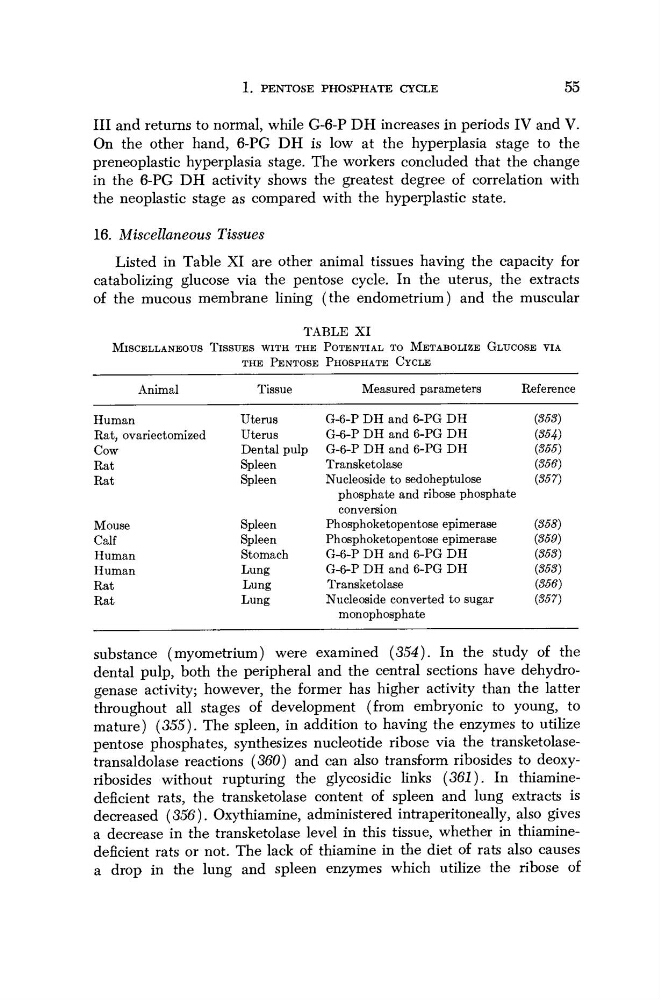
Listed in Table XI are other animal tissues having the capacity for
catabolizing glucose via the pentose cycle. In the uterus, the extracts
of the mucous membrane lining (the endometrium) and the muscular
TABLE XI
MISCELLANEOUS TISSUES WITH THE POTENTIAL TO METABOLIZE GLUCOSE VIA
THE PENTOSE PHOSPHATE CYCLE
Animal
Tissue
Measured parameters
Reference
Human
Uterus
G-6-P DH and 6-PG DH
(353)
Rat, ovariectomized
Uterus
G-6-P DH and 6-PG DH
($54)
Cow
Dental pulp G-6-P DH and 6-PG DH
(355)
Rat
Spleen
Transketolase
(356)
Rat
Spleen
Nucleoside to sedoheptulose
(357)
phosphate and ribose phosphate
conversion
Mouse
Spleen
Phosphoketopentose epimerase
(358)
Calf
Spleen
Phosphoketopentose epimerase
(359)
Human
Stomach
G-6-P DH and 6-PG DH
(353)
Human
Lung
G-6-P DH and 6-PG DH
(353)
Rat
Lung
Transketolase
(356)
Rat
Lung
Nucleoside converted to sugar
(357)
monophosphate
substance (myometrium) were examined (354). In the study of the
dental pulp, both the peripheral and the central sections have dehydrogenase activity; however, the former has higher activity than the latter
throughout all stages of development (from embryonic to young, to
mature) (355). The spleen, in addition to having the enzymes to utilize
pentose phosphates, synthesizes nucleotide ribose via the transketolasetransaldolase reactions (360) and can also transform ribosides to deoxyribosides without rupturing the glycosidic links (361). In thiaminedeficient rats, the transketolase content of spleen and lung extracts is
decreased (356). Oxythiamine, administered intraperitoneally, also gives
a decrease in the transketolase level in this tissue, whether in thiaminedeficient rats or not. The lack of thiamine in the diet of rats also causes
a drop in the lung and spleen enzymes which utilize the ribose of
55
III and returns to normal, while G-6-P DH increases in periods IV and V.
On the other hand, 6-PG DH is low at the hyperplasia stage to the
preneoplastic hyperplasia stage. The workers concluded that the change
in the 6-PG DH activity shows the greatest degree of correlation with
the neoplastic stage as compared with the hyperplastic state.
16. Miscellaneous Tissues
Listed in Table XI are other animal tissues having the capacity for
catabolizing glucose via the pentose cycle. In the uterus, the extracts
of the mucous membrane lining (the endometrium) and the muscular
TABLE XI
MISCELLANEOUS TISSUES WITH THE POTENTIAL TO METABOLIZE GLUCOSE VIA
THE PENTOSE PHOSPHATE CYCLE
Animal
Tissue
Measured parameters
Reference
Human
Uterus
G-6-P DH and 6-PG DH
(353)
Rat, ovariectomized
Uterus
G-6-P DH and 6-PG DH
($54)
Cow
Dental pulp G-6-P DH and 6-PG DH
(355)
Rat
Spleen
Transketolase
(356)
Rat
Spleen
Nucleoside to sedoheptulose
(357)
phosphate and ribose phosphate
conversion
Mouse
Spleen
Phosphoketopentose epimerase
(358)
Calf
Spleen
Phosphoketopentose epimerase
(359)
Human
Stomach
G-6-P DH and 6-PG DH
(353)
Human
Lung
G-6-P DH and 6-PG DH
(353)
Rat
Lung
Transketolase
(356)
Rat
Lung
Nucleoside converted to sugar
(357)
monophosphate
substance (myometrium) were examined (354). In the study of the
dental pulp, both the peripheral and the central sections have dehydrogenase activity; however, the former has higher activity than the latter
throughout all stages of development (from embryonic to young, to
mature) (355). The spleen, in addition to having the enzymes to utilize
pentose phosphates, synthesizes nucleotide ribose via the transketolasetransaldolase reactions (360) and can also transform ribosides to deoxyribosides without rupturing the glycosidic links (361). In thiaminedeficient rats, the transketolase content of spleen and lung extracts is
decreased (356). Oxythiamine, administered intraperitoneally, also gives
a decrease in the transketolase level in this tissue, whether in thiaminedeficient rats or not. The lack of thiamine in the diet of rats also causes
a drop in the lung and spleen enzymes which utilize the ribose of