

1. PENTOSE PHOSPHATE CYCLE
53
Wenner and Weinhouse estimated that the amount of glucose oxidized
to C0 2 via a non-EMP pathway is between 1 and 3% (203), while 94%
of the glucose is catabolized to lactate. Isotope studies showed that the
limiting factor for the operation of the pentose phosphate cycle in this
tumor is the availability of an electron acceptor (72). For example,
in vitro addition of methylene blue, menadione, or phenazine methosulfate to both suspensions of the tumor or to homogenates of the tumor
will stimulate the oxidation of glucose-l-C
14
, but has only slight effect
on the oxidation of glucose-6-C
14
. Furthermore, under anaerobic conditions, the oxidation of the former substrate is enhanced by the presence
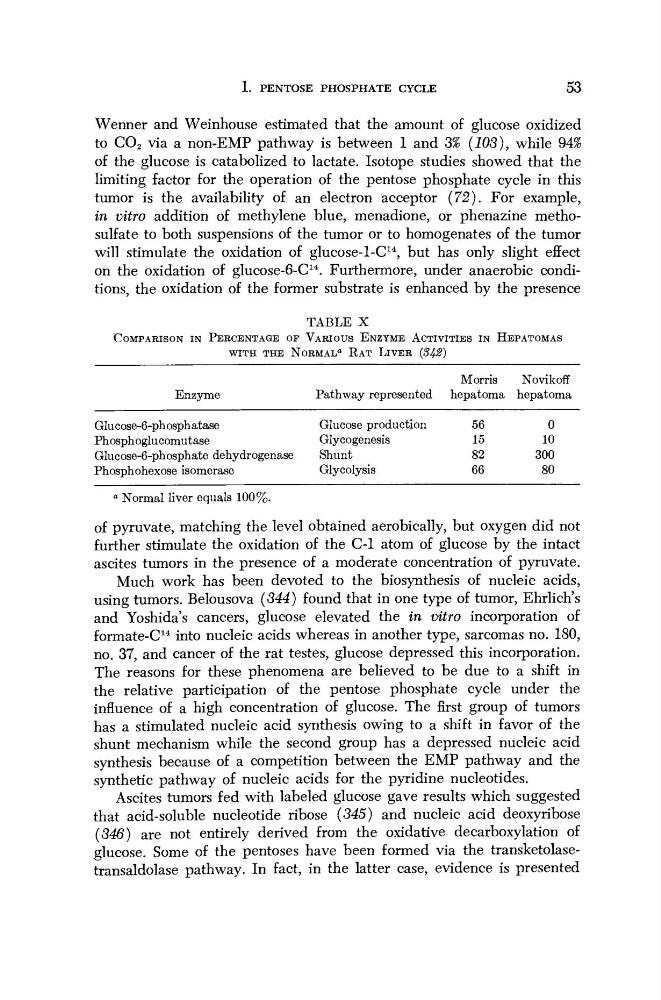
TABLE X
COMPARISON IN PERCENTAGE OF VARIOUS ENZYME ACTIVITIES IN HEPATOMAS
WITH THE NORMAL" RAT LIVER {342)
Morris
Novikoff
Enzyme
Pathway represented hepatoma hepatoma
Glucose-6-phosphatase
Glucose production
56
0
Phosphoglucomutase
Glycogenesis
15
10
Glucose-6-phosphate dehydrogenase
Shunt
82
300
Phosphohexose isomerase
Glycolysis
66
80
a Normal liver equals 100%.
of pyruvate, matching the level obtained aerobically, but oxygen did not
further stimulate the oxidation of the C-l atom of glucose by the intact
ascites tumors in the presence of a moderate concentration of pyruvate.
Much work has been devoted to the biosynthesis of nucleic acids,
using tumors. Belousova (344) found that in one type of tumor, Ehrlich's
and Yoshida's cancers, glucose elevated the in vitro incorporation of
formate-C
14 into nucleic acids whereas in another type, sarcomas no. 180,
no. 37, and cancer of the rat testes, glucose depressed this incorporation.
The reasons for these phenomena are believed to be due to a shift in
the relative participation of the pentose phosphate cycle under the
influence of a high concentration of glucose. The first group of tumors
has a stimulated nucleic acid synthesis owing to a shift in favor of the
shunt mechanism while the second group has a depressed nucleic acid
synthesis because of a competition between the EMP pathway and the
synthetic pathway of nucleic acids for the pyridine nucleotides.
Ascites tumors fed with labeled glucose gave results which suggested
that acid-soluble nucleotide ribose (345) and nucleic acid deoxyribose
(346) are not entirely derived from the oxidative decarboxylation of
glucose. Some of the pentoses have been formed via the transketolasetransaldolase pathway. In fact, in the latter case, evidence is presented
53
Wenner and Weinhouse estimated that the amount of glucose oxidized
to C0 2 via a non-EMP pathway is between 1 and 3% (203), while 94%
of the glucose is catabolized to lactate. Isotope studies showed that the
limiting factor for the operation of the pentose phosphate cycle in this
tumor is the availability of an electron acceptor (72). For example,
in vitro addition of methylene blue, menadione, or phenazine methosulfate to both suspensions of the tumor or to homogenates of the tumor
will stimulate the oxidation of glucose-l-C
14
, but has only slight effect
on the oxidation of glucose-6-C
14
. Furthermore, under anaerobic conditions, the oxidation of the former substrate is enhanced by the presence
TABLE X
COMPARISON IN PERCENTAGE OF VARIOUS ENZYME ACTIVITIES IN HEPATOMAS
WITH THE NORMAL" RAT LIVER {342)
Morris
Novikoff
Enzyme
Pathway represented hepatoma hepatoma
Glucose-6-phosphatase
Glucose production
56
0
Phosphoglucomutase
Glycogenesis
15
10
Glucose-6-phosphate dehydrogenase
Shunt
82
300
Phosphohexose isomerase
Glycolysis
66
80
a Normal liver equals 100%.
of pyruvate, matching the level obtained aerobically, but oxygen did not
further stimulate the oxidation of the C-l atom of glucose by the intact
ascites tumors in the presence of a moderate concentration of pyruvate.
Much work has been devoted to the biosynthesis of nucleic acids,
using tumors. Belousova (344) found that in one type of tumor, Ehrlich's
and Yoshida's cancers, glucose elevated the in vitro incorporation of
formate-C
14 into nucleic acids whereas in another type, sarcomas no. 180,
no. 37, and cancer of the rat testes, glucose depressed this incorporation.
The reasons for these phenomena are believed to be due to a shift in
the relative participation of the pentose phosphate cycle under the
influence of a high concentration of glucose. The first group of tumors
has a stimulated nucleic acid synthesis owing to a shift in favor of the
shunt mechanism while the second group has a depressed nucleic acid
synthesis because of a competition between the EMP pathway and the
synthetic pathway of nucleic acids for the pyridine nucleotides.
Ascites tumors fed with labeled glucose gave results which suggested
that acid-soluble nucleotide ribose (345) and nucleic acid deoxyribose
(346) are not entirely derived from the oxidative decarboxylation of
glucose. Some of the pentoses have been formed via the transketolasetransaldolase pathway. In fact, in the latter case, evidence is presented