

44
ν. g. pon
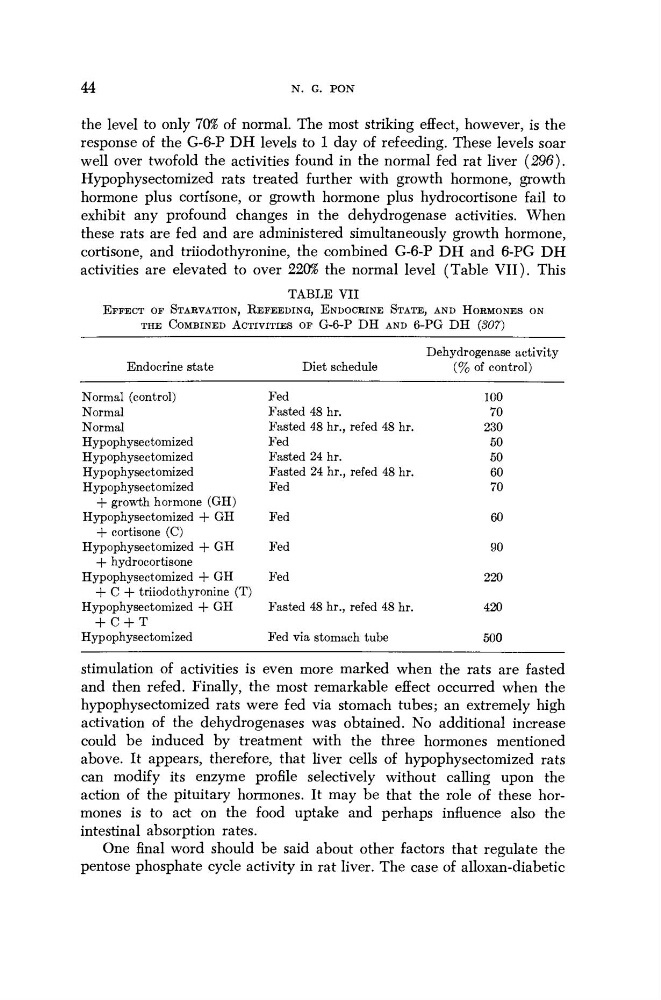
the level to only 70% of normal. The most striking effect, however, is the
response of the G-6-P DH levels to 1 day of refeeding. These levels soar
well over twofold the activities found in the normal fed rat liver (296).
Hypophysectomized rats treated further with growth hormone, growth
hormone plus cortisone, or growth hormone plus hydrocortisone fail to
exhibit any profound changes in the dehydrogenase activities. When
these rats are fed and are administered simultaneously growth hormone,
cortisone, and triiodothyronine, the combined G-6-P DH and 6-PG DH
activities are elevated to over 220% the normal level (Table VII). This
TABLE VII
EFFECT OF STARVATION, REFEEDING, ENDOCRINE STATE, AND HORMONES ON
THE COMBINED ACTIVITIES OF G-6-P DH AND 6-PG DH
(807)
Dehydrogenase activity
Endocrine state
Diet schedule
(% of control)
Normal (control)
Fed
100
Normal
Fasted 48 hr.
70
Normal
Fasted 48 hr., refed 48 hr.
230
Hypophysectomized
Fed
50
Hypophysectomized
Fasted 24 hr.
50
Hypophysectomized
Fasted 24 hr., refed 48 hr.
60
Hypophysectomized
Fed
70
+ growth hormone (GH)
Hypophysectomized + GH
Fed
60
+ cortisone (C)
Hypophysectomized + GH
Fed
90
+ hydrocortisone
Hypophysectomized + GH
Fed
220
+ C + triiodothyronine (T)
Hypophysectomized + GH
Fasted 48 hr., refed 48 hr.
420
+ C + T
Hypophysectomized
Fed via stomach tube
500
stimulation of activities is even more marked when the rats are fasted
and then refed. Finally, the most remarkable effect occurred when the
hypophysectomized rats were fed via stomach tubes; an extremely high
activation of the dehydrogenases was obtained. No additional increase
could be induced by treatment with the three hormones mentioned
above. It appears, therefore, that liver cells of hypophysectomized rats
can modify its enzyme profile selectively without calling upon the
action of the pituitary hormones. It may be that the role of these hormones is to act on the food uptake and perhaps influence also the
intestinal absorption rates.
One final word should be said about other factors that regulate the
pentose phosphate cycle activity in rat liver. The case of alloxan-diabetic
ν. g. pon
the level to only 70% of normal. The most striking effect, however, is the
response of the G-6-P DH levels to 1 day of refeeding. These levels soar
well over twofold the activities found in the normal fed rat liver (296).
Hypophysectomized rats treated further with growth hormone, growth
hormone plus cortisone, or growth hormone plus hydrocortisone fail to
exhibit any profound changes in the dehydrogenase activities. When
these rats are fed and are administered simultaneously growth hormone,
cortisone, and triiodothyronine, the combined G-6-P DH and 6-PG DH
activities are elevated to over 220% the normal level (Table VII). This
TABLE VII
EFFECT OF STARVATION, REFEEDING, ENDOCRINE STATE, AND HORMONES ON
THE COMBINED ACTIVITIES OF G-6-P DH AND 6-PG DH
(807)
Dehydrogenase activity
Endocrine state
Diet schedule
(% of control)
Normal (control)
Fed
100
Normal
Fasted 48 hr.
70
Normal
Fasted 48 hr., refed 48 hr.
230
Hypophysectomized
Fed
50
Hypophysectomized
Fasted 24 hr.
50
Hypophysectomized
Fasted 24 hr., refed 48 hr.
60
Hypophysectomized
Fed
70
+ growth hormone (GH)
Hypophysectomized + GH
Fed
60
+ cortisone (C)
Hypophysectomized + GH
Fed
90
+ hydrocortisone
Hypophysectomized + GH
Fed
220
+ C + triiodothyronine (T)
Hypophysectomized + GH
Fasted 48 hr., refed 48 hr.
420
+ C + T
Hypophysectomized
Fed via stomach tube
500
stimulation of activities is even more marked when the rats are fasted
and then refed. Finally, the most remarkable effect occurred when the
hypophysectomized rats were fed via stomach tubes; an extremely high
activation of the dehydrogenases was obtained. No additional increase
could be induced by treatment with the three hormones mentioned
above. It appears, therefore, that liver cells of hypophysectomized rats
can modify its enzyme profile selectively without calling upon the
action of the pituitary hormones. It may be that the role of these hormones is to act on the food uptake and perhaps influence also the
intestinal absorption rates.
One final word should be said about other factors that regulate the
pentose phosphate cycle activity in rat liver. The case of alloxan-diabetic