

1. PENTOSE PHOSPHATE CYCLE
39
via G-6-P DH would be between one-fifth and one-tenth that of glycolysis, the rate of the latter pathway being controlled by the next least
active enzyme, fructose-6-phosphate kinase. The conclusion would then
be that, as an alternate pathway of glucose metabolism, the oxidative
pentose phosphate cycle contributes between 10 and 20%. However, Katz
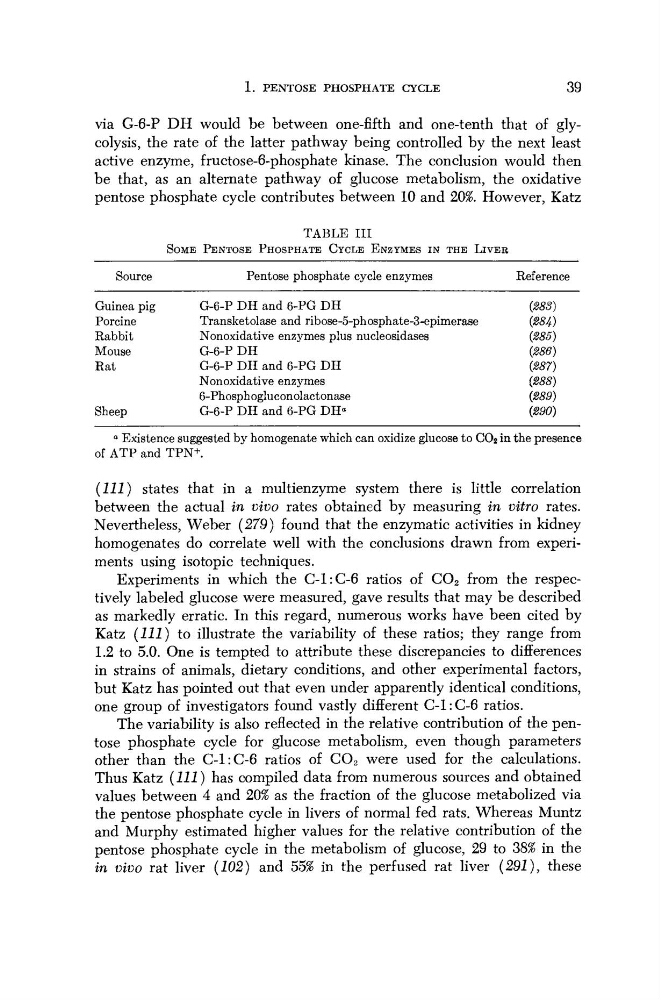
TABLE III
SOME PENTOSE PHOSPHATE CYCLE ENZYMES IN THE LIVER
Source
Pentose phosphate cycle enzymes
Reference
Guinea pig
G-6-P DH and 6-PG DH
(283)
Porcine
Transketolase and ribose-5-phosphate-3-epimerase
(m)
Rabbit
Nonoxidative enzymes plus nucleosidases
(285)
Mouse
G-6-P DH
(286)
Rat
G-6-P DH and 6-PG DH
(287)
Nonoxidative enzymes
(288)
6-Phosphogluconolactonase
(289)
Sheep
G-6-P DH and 6-PG DH°
(290)
a Existence suggested by homogenate which can oxidize glucose to CO2 in the presence
of ATP and TPN+.
(Ill)
states that in a multienzyme system there is little correlation
between the actual in vivo rates obtained by measuring in vitro rates.
Nevertheless, Weber (279) found that the enzymatic activities in kidney
homogenates do correlate well with the conclusions drawn from experiments using isotopic techniques.
Experiments in which the C-l:C-6 ratios of C0 2 from the respectively labeled glucose were measured, gave results that may be described
as markedly erratic. In this regard, numerous works have been cited by
Katz (111) to illustrate the variability of these ratios; they range from
1.2 to 5.0. One is tempted to attribute these discrepancies to differences
in strains of animals, dietary conditions, and other experimental factors,
but Katz has pointed out that even under apparently identical conditions,
one group of investigators found vastly different C-l:C-6 ratios.
The variability is also reflected in the relative contribution of the pentose phosphate cycle for glucose metabolism, even though parameters
other than the C-l:C-6 ratios of C0 2 were used for the calculations.
Thus Katz (111) has compiled data from numerous sources and obtained
values between 4 and 20% as the fraction of the glucose metabolized via
the pentose phosphate cycle in livers of normal fed rats. Whereas Müntz
and Murphy estimated higher values for the relative contribution of the
pentose phosphate cycle in the metabolism of glucose, 29 to 38% in the
in vivo rat liver (102) and 55% in the perfused rat liver (291), these
39
via G-6-P DH would be between one-fifth and one-tenth that of glycolysis, the rate of the latter pathway being controlled by the next least
active enzyme, fructose-6-phosphate kinase. The conclusion would then
be that, as an alternate pathway of glucose metabolism, the oxidative
pentose phosphate cycle contributes between 10 and 20%. However, Katz
TABLE III
SOME PENTOSE PHOSPHATE CYCLE ENZYMES IN THE LIVER
Source
Pentose phosphate cycle enzymes
Reference
Guinea pig
G-6-P DH and 6-PG DH
(283)
Porcine
Transketolase and ribose-5-phosphate-3-epimerase
(m)
Rabbit
Nonoxidative enzymes plus nucleosidases
(285)
Mouse
G-6-P DH
(286)
Rat
G-6-P DH and 6-PG DH
(287)
Nonoxidative enzymes
(288)
6-Phosphogluconolactonase
(289)
Sheep
G-6-P DH and 6-PG DH°
(290)
a Existence suggested by homogenate which can oxidize glucose to CO2 in the presence
of ATP and TPN+.
(Ill)
states that in a multienzyme system there is little correlation
between the actual in vivo rates obtained by measuring in vitro rates.
Nevertheless, Weber (279) found that the enzymatic activities in kidney
homogenates do correlate well with the conclusions drawn from experiments using isotopic techniques.
Experiments in which the C-l:C-6 ratios of C0 2 from the respectively labeled glucose were measured, gave results that may be described
as markedly erratic. In this regard, numerous works have been cited by
Katz (111) to illustrate the variability of these ratios; they range from
1.2 to 5.0. One is tempted to attribute these discrepancies to differences
in strains of animals, dietary conditions, and other experimental factors,
but Katz has pointed out that even under apparently identical conditions,
one group of investigators found vastly different C-l:C-6 ratios.
The variability is also reflected in the relative contribution of the pentose phosphate cycle for glucose metabolism, even though parameters
other than the C-l:C-6 ratios of C0 2 were used for the calculations.
Thus Katz (111) has compiled data from numerous sources and obtained
values between 4 and 20% as the fraction of the glucose metabolized via
the pentose phosphate cycle in livers of normal fed rats. Whereas Müntz
and Murphy estimated higher values for the relative contribution of the
pentose phosphate cycle in the metabolism of glucose, 29 to 38% in the
in vivo rat liver (102) and 55% in the perfused rat liver (291), these