

320
MAURICE WELSCH
A number of plant antibiotics also belong in this group: for instance,
the phenolic acids caffeic acid, from Helichrysum italicum, and anacardic
acid from Anacardium occidentale; or the quinones thymoquinone, from
Tetraclinis articulata, lupulon and lumulon, from Humulus lupulus.
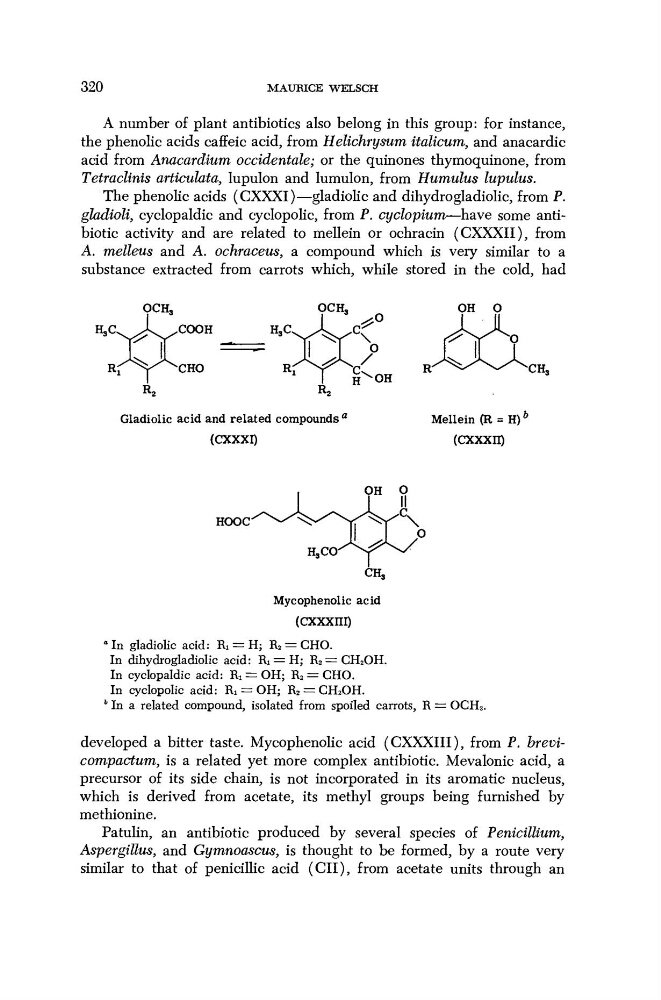
The phenolic acids (CXXXI)—gladiolic and dihydrogladiolic, from P.
gladioli, cyclopaldic and cyclopolic, from P. cyclopium—have some antibiotic activity and are related to mellein or ochracin (CXXXII), from
A. melleus and A. ochraceus, a compound which is very similar to a
substance extracted from carrots which, while stored in the cold, had
(CXXXI)
(CXXXII)
HOOC
Mycophenolic acid
(cxxxm)
a In gladiolic acid: Ri = H; R 2 = CHO.
In dihydrogladiolic acid: Ri = H; R 2 =CH 2 OH.
In cyclopaldic acid: Ri = OH; R 2 = CHO.
In cyclopolic acid: Ri = OH; R 2 = CH 2 OH.
6 In a related compound, isolated from spoiled carrots, R = OCH 3 .
developed a bitter taste. Mycophenolic acid (CXXXIII), from P. brevicompactum, is a related yet more complex antibiotic. Mevalonic acid, a
precursor of its side chain, is not incorporated in its aromatic nucleus,
which is derived from acetate, its methyl groups being furnished by
methionine.
Patulin, an antibiotic produced by several species of Penicillium,
Aspergillus, and Gymnoascus, is thought to be formed, by a route very
similar to that of penicillic acid (CII), from acetate units through an
MAURICE WELSCH
A number of plant antibiotics also belong in this group: for instance,
the phenolic acids caffeic acid, from Helichrysum italicum, and anacardic
acid from Anacardium occidentale; or the quinones thymoquinone, from
Tetraclinis articulata, lupulon and lumulon, from Humulus lupulus.
The phenolic acids (CXXXI)—gladiolic and dihydrogladiolic, from P.
gladioli, cyclopaldic and cyclopolic, from P. cyclopium—have some antibiotic activity and are related to mellein or ochracin (CXXXII), from
A. melleus and A. ochraceus, a compound which is very similar to a
substance extracted from carrots which, while stored in the cold, had
(CXXXI)
(CXXXII)
HOOC
Mycophenolic acid
(cxxxm)
a In gladiolic acid: Ri = H; R 2 = CHO.
In dihydrogladiolic acid: Ri = H; R 2 =CH 2 OH.
In cyclopaldic acid: Ri = OH; R 2 = CHO.
In cyclopolic acid: Ri = OH; R 2 = CH 2 OH.
6 In a related compound, isolated from spoiled carrots, R = OCH 3 .
developed a bitter taste. Mycophenolic acid (CXXXIII), from P. brevicompactum, is a related yet more complex antibiotic. Mevalonic acid, a
precursor of its side chain, is not incorporated in its aromatic nucleus,
which is derived from acetate, its methyl groups being furnished by
methionine.
Patulin, an antibiotic produced by several species of Penicillium,
Aspergillus, and Gymnoascus, is thought to be formed, by a route very
similar to that of penicillic acid (CII), from acetate units through an