

318
MAURICE WELSCH
Compared to sarcomycin, S t is much less active upon Staphylococcus
aureus but equally upon Micrococcus flavus, has no action upon Trichomonas, and shows about 50% of the antitumor effect. S 2 is about one-half
as active upon M. flavus and has only slight anticancer activity. S 3 is
about twice as active upon bacteria, has only a moderate effect upon
cancer cells and none upon Trichomonas. Sarcomycin can be prepared
by synthesis as well as analogs (286b), such as 3-methylene-4-oxocyclopentanecarboxylic acid and its methyl ester, and derivatives, such as
addition products with isoniazid or isonicotinic acid hydrazide. These
analogs and derivatives have antimicrobial and anticancer activity.
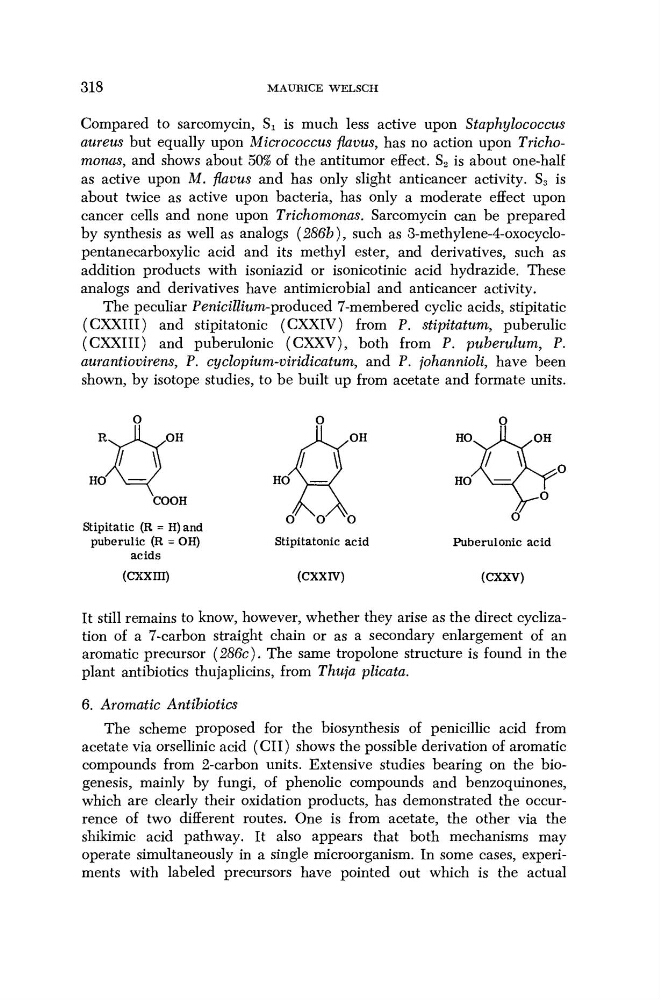
The peculiar Penicillium-iproduced 7-membered cyclic acids, stipitatic
(CXXIII) and stipitatonic (CXXIV) from P. stipitatum, puberulic
(CXXIII) and puberulonic (CXXV), both from P. puberulum, P.
aurantiovirens, P. cyclopium-viridicatum,
and P. johannioli, have been
shown, by isotope studies, to be built up from acetate and formate units.
COOH
Stipitatic (R = H) and
puberulic (R = OH)
acids
(cxxm)
OH
Ο'
Λ
ο'
v
O
Stipitatonic acid
(CXXIV)
Puberulonic acid
(CXXV)
It still remains to know, however, whether they arise as the direct cyclization of a 7-carbon straight chain or as a secondary enlargement of an
aromatic precursor (286c). The same tropolone structure is found in the
plant antibiotics thujaplicins, from Thuja plicata.
6. Aromatic Antibiotics
The scheme proposed for the biosynthesis of penicillic acid from
acetate via orsellinic acid (CII) shows the possible derivation of aromatic
compounds from 2-carbon units. Extensive studies bearing on the biogenesis, mainly by fungi, of phenolic compounds and benzoquinones,
which are clearly their oxidation products, has demonstrated the occurrence of two different routes. One is from acetate, the other via the
shikimic acid pathway. It also appears that both mechanisms may
operate simultaneously in a single microorganism. In some cases, experiments with labeled precursors have pointed out which is the actual
MAURICE WELSCH
Compared to sarcomycin, S t is much less active upon Staphylococcus
aureus but equally upon Micrococcus flavus, has no action upon Trichomonas, and shows about 50% of the antitumor effect. S 2 is about one-half
as active upon M. flavus and has only slight anticancer activity. S 3 is
about twice as active upon bacteria, has only a moderate effect upon
cancer cells and none upon Trichomonas. Sarcomycin can be prepared
by synthesis as well as analogs (286b), such as 3-methylene-4-oxocyclopentanecarboxylic acid and its methyl ester, and derivatives, such as
addition products with isoniazid or isonicotinic acid hydrazide. These
analogs and derivatives have antimicrobial and anticancer activity.
The peculiar Penicillium-iproduced 7-membered cyclic acids, stipitatic
(CXXIII) and stipitatonic (CXXIV) from P. stipitatum, puberulic
(CXXIII) and puberulonic (CXXV), both from P. puberulum, P.
aurantiovirens, P. cyclopium-viridicatum,
and P. johannioli, have been
shown, by isotope studies, to be built up from acetate and formate units.
COOH
Stipitatic (R = H) and
puberulic (R = OH)
acids
(cxxm)
OH
Ο'
Λ
ο'
v
O
Stipitatonic acid
(CXXIV)
Puberulonic acid
(CXXV)
It still remains to know, however, whether they arise as the direct cyclization of a 7-carbon straight chain or as a secondary enlargement of an
aromatic precursor (286c). The same tropolone structure is found in the
plant antibiotics thujaplicins, from Thuja plicata.
6. Aromatic Antibiotics
The scheme proposed for the biosynthesis of penicillic acid from
acetate via orsellinic acid (CII) shows the possible derivation of aromatic
compounds from 2-carbon units. Extensive studies bearing on the biogenesis, mainly by fungi, of phenolic compounds and benzoquinones,
which are clearly their oxidation products, has demonstrated the occurrence of two different routes. One is from acetate, the other via the
shikimic acid pathway. It also appears that both mechanisms may
operate simultaneously in a single microorganism. In some cases, experiments with labeled precursors have pointed out which is the actual