

1. PENTOSE PHOSPHATE CYCLE
19
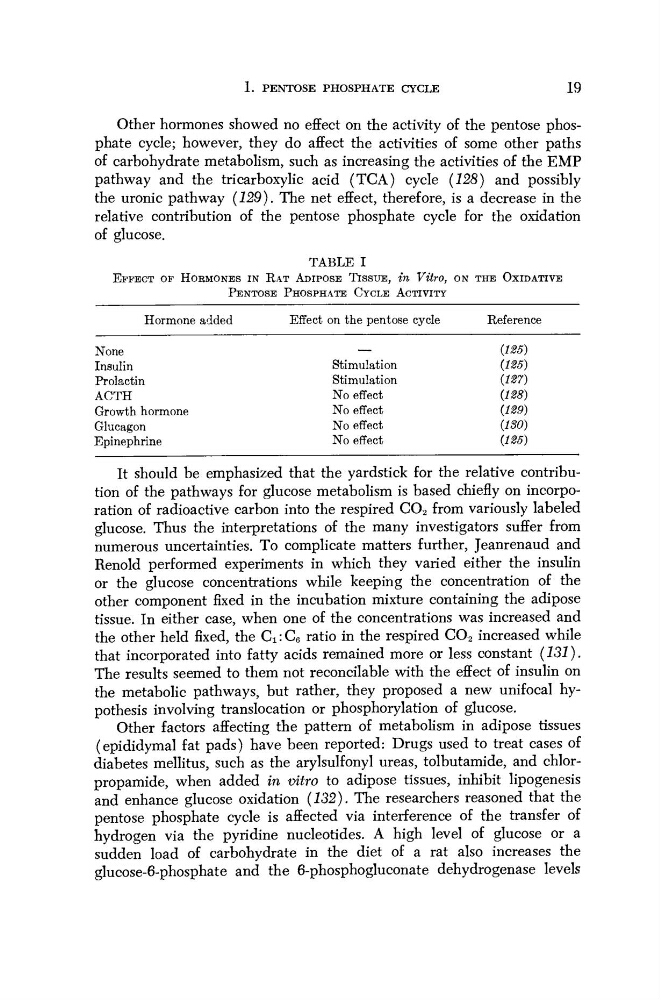
Other hormones showed no effect on the activity of the pentose phosphate cycle; however, they do affect the activities of some other paths
of carbohydrate metabolism, such as increasing the activities of the EMP
pathway and the tricarboxylic acid (TCA) cycle (128) and possibly
the uronic pathway (129). The net effect, therefore, is a decrease in the
relative contribution of the pentose phosphate cycle for the oxidation
of glucose.
TABLE I
EFFECT OF HORMONES IN RAT ADIPOSE TISSUE, in Vitro, ON THE OXIDATIVE
PENTOSE PHOSPHATE CYCLE ACTIVITY
Hormone added
Effect on the pentose cycle
Reference
None
—
Insulin
Stimulation
(125)
Prolactin
Stimulation
(127)
ACTH
No effect
(128)
Growth hormone
No effect
(129)
Glucagon
No effect
(130)
Epinephrine
No effect
(125)
It should be emphasized that the yardstick for the relative contribution of the pathways for glucose metabolism is based chiefly on incorporation of radioactive carbon into the respired C0 2 from variously labeled
glucose. Thus the interpretations of the many investigators suffer from
numerous uncertainties. To complicate matters further, Jeanrenaud and
Renold performed experiments in which they varied either the insulin
or the glucose concentrations while keeping the concentration of the
other component fixed in the incubation mixture containing the adipose
tissue. In either case, when one of the concentrations was increased and
the other held fixed, the Ci: C 6 ratio in the respired C0 2 increased while
that incorporated into fatty acids remained more or less constant (131).
The results seemed to them not reconcilable with the effect of insulin on
the metabolic pathways, but rather, they proposed a new unifocal hypothesis involving translocation or phosphorylation of glucose.
Other factors affecting the pattern of metabolism in adipose tissues
(epididymal fat pads) have been reported: Drugs used to treat cases of
diabetes mellitus, such as the arylsulfonyl ureas, tolbutamide, and chlorpropamide, when added in vitro to adipose tissues, inhibit lipogenesis
and enhance glucose oxidation (132). The researchers reasoned that the
pentose phosphate cycle is affected via interference of the transfer of
hydrogen via the pyridine nucleotides. A high level of glucose or a
sudden load of carbohydrate in the diet of a rat also increases the
glucose-6-phosphate and the 6-phosphogluconate dehydrogenase levels
19
Other hormones showed no effect on the activity of the pentose phosphate cycle; however, they do affect the activities of some other paths
of carbohydrate metabolism, such as increasing the activities of the EMP
pathway and the tricarboxylic acid (TCA) cycle (128) and possibly
the uronic pathway (129). The net effect, therefore, is a decrease in the
relative contribution of the pentose phosphate cycle for the oxidation
of glucose.
TABLE I
EFFECT OF HORMONES IN RAT ADIPOSE TISSUE, in Vitro, ON THE OXIDATIVE
PENTOSE PHOSPHATE CYCLE ACTIVITY
Hormone added
Effect on the pentose cycle
Reference
None
—
Insulin
Stimulation
(125)
Prolactin
Stimulation
(127)
ACTH
No effect
(128)
Growth hormone
No effect
(129)
Glucagon
No effect
(130)
Epinephrine
No effect
(125)
It should be emphasized that the yardstick for the relative contribution of the pathways for glucose metabolism is based chiefly on incorporation of radioactive carbon into the respired C0 2 from variously labeled
glucose. Thus the interpretations of the many investigators suffer from
numerous uncertainties. To complicate matters further, Jeanrenaud and
Renold performed experiments in which they varied either the insulin
or the glucose concentrations while keeping the concentration of the
other component fixed in the incubation mixture containing the adipose
tissue. In either case, when one of the concentrations was increased and
the other held fixed, the Ci: C 6 ratio in the respired C0 2 increased while
that incorporated into fatty acids remained more or less constant (131).
The results seemed to them not reconcilable with the effect of insulin on
the metabolic pathways, but rather, they proposed a new unifocal hypothesis involving translocation or phosphorylation of glucose.
Other factors affecting the pattern of metabolism in adipose tissues
(epididymal fat pads) have been reported: Drugs used to treat cases of
diabetes mellitus, such as the arylsulfonyl ureas, tolbutamide, and chlorpropamide, when added in vitro to adipose tissues, inhibit lipogenesis
and enhance glucose oxidation (132). The researchers reasoned that the
pentose phosphate cycle is affected via interference of the transfer of
hydrogen via the pyridine nucleotides. A high level of glucose or a
sudden load of carbohydrate in the diet of a rat also increases the
glucose-6-phosphate and the 6-phosphogluconate dehydrogenase levels