

5. ANTIBIOSIS AND ANTIBIOTICS
305
antibiotics—acetomycin (C), from S. ramulosus, and PA-147 (CI)
(261b) from Streptomyces sp., is possibly similar.
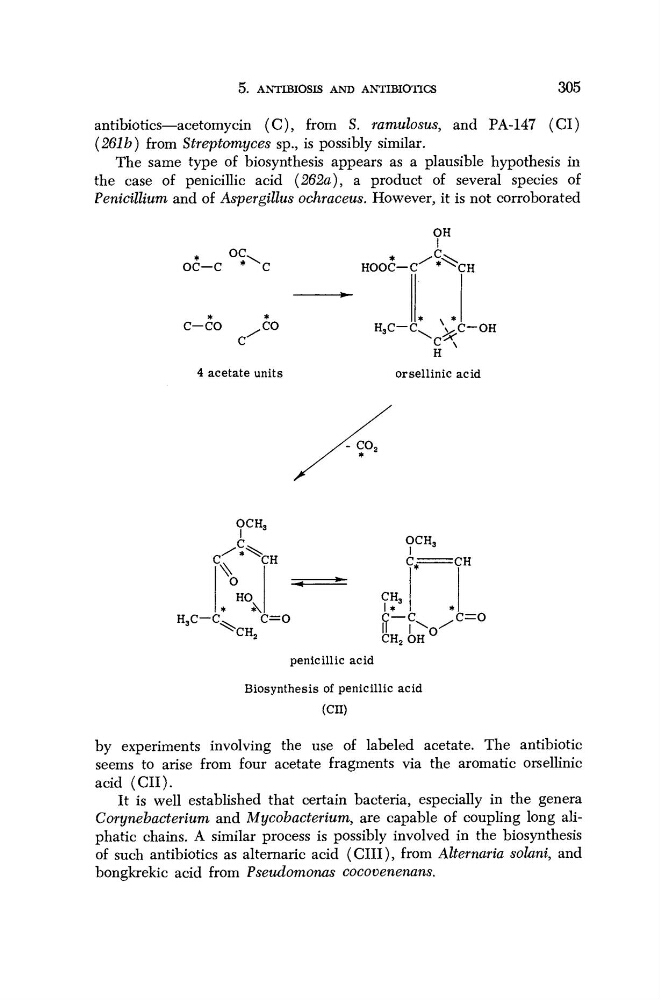
The same type of biosynthesis appears as a plausible hypothesis in
the case of penicillic acid (262a), a product of several species of
Penicillium and of Aspergillus ochraceus. However, it is not corroborated
OC—c * c
C—CO
.CO
4 acetate units
HOOC— C
OH
I
CH
H 3 C—C. VC-OH
C^\
Η
orsellinic acid
OCH 3
.c.
CH
Ο
HO
*\
OCH 3
ι
3
c= =CH
c=o
CH,
CH 3
I.
8
c—c
.c=o
II I
CH 2 OH
penicillic acid
Biosynthesis of penicillic acid
(CII)
by experiments involving the use of labeled acetate. The antibiotic
seems to arise from four acetate fragments via the aromatic orsellinic
acid (CII).
It is well established that certain bacteria, especially in the genera
Corynebacterium and Mycobacterium, are capable of coupling long aliphatic chains. A similar process is possibly involved in the biosynthesis
of such antibiotics as alternaric acid (CIII), from Alternaria solani, and
bongkrekic acid from Pseudomonas
cocovenenans.
305
antibiotics—acetomycin (C), from S. ramulosus, and PA-147 (CI)
(261b) from Streptomyces sp., is possibly similar.
The same type of biosynthesis appears as a plausible hypothesis in
the case of penicillic acid (262a), a product of several species of
Penicillium and of Aspergillus ochraceus. However, it is not corroborated
OC—c * c
C—CO
.CO
4 acetate units
HOOC— C
OH
I
CH
H 3 C—C. VC-OH
C^\
Η
orsellinic acid
OCH 3
.c.
CH
Ο
HO
*\
OCH 3
ι
3
c= =CH
c=o
CH,
CH 3
I.
8
c—c
.c=o
II I
CH 2 OH
penicillic acid
Biosynthesis of penicillic acid
(CII)
by experiments involving the use of labeled acetate. The antibiotic
seems to arise from four acetate fragments via the aromatic orsellinic
acid (CII).
It is well established that certain bacteria, especially in the genera
Corynebacterium and Mycobacterium, are capable of coupling long aliphatic chains. A similar process is possibly involved in the biosynthesis
of such antibiotics as alternaric acid (CIII), from Alternaria solani, and
bongkrekic acid from Pseudomonas
cocovenenans.