

5. ANTIBIOSIS AND ANTIBIOTICS
291
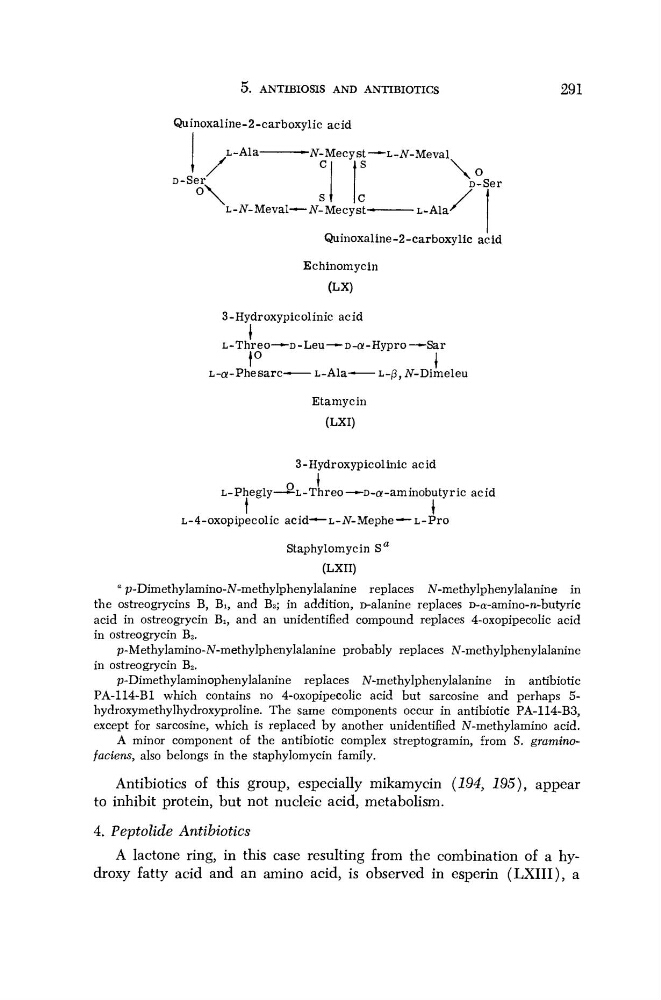
Quinoxaline-2-carboxylic acid
Echinomycin
(LX)
Etamycin
(LXI)
Staphylomycin S
a
(LXII)
a p-Dimethylamino-N-methylphenylalanine replaces N-methylphenylalanine in
the ostreogrycins B, Bi, and B 3 ; in addition, D-alanine replaces D-a-amino-n-butyric
acid in ostreogrycin Bi, and an unidentified compound replaces 4-oxopipecolic acid
in ostreogrycin B 3 .
p-Methylamino-N-methylphenylalanine probably replaces N-methylphenylalanine
in ostreogrycin B 2 .
p-Dimethylaminophenylalanine replaces N-methylphenylalanine in antibiotic
PA-114-B1 which contains no 4-oxopipecolic acid but sarcosine and perhaps 5hydroxymethylhydroxyproline. The same components occur in antibiotic PA-114-B3,
except for sarcosine, which is replaced by another unidentified N-methylamino acid.
A minor component of the antibiotic complex streptogramin, from S. graminofaciens, also belongs in the staphylomycin family.
Antibiotics of this group, especially mikamycin {194, 195), appear
to inhibit protein, but not nucleic acid, metabolism.
4. Peptolide Antibiotics
A lactone ring, in this case resulting from the combination of a hydroxy fatty acid and an amino acid, is observed in esperin (LXIII), a
291
Quinoxaline-2-carboxylic acid
Echinomycin
(LX)
Etamycin
(LXI)
Staphylomycin S
a
(LXII)
a p-Dimethylamino-N-methylphenylalanine replaces N-methylphenylalanine in
the ostreogrycins B, Bi, and B 3 ; in addition, D-alanine replaces D-a-amino-n-butyric
acid in ostreogrycin Bi, and an unidentified compound replaces 4-oxopipecolic acid
in ostreogrycin B 3 .
p-Methylamino-N-methylphenylalanine probably replaces N-methylphenylalanine
in ostreogrycin B 2 .
p-Dimethylaminophenylalanine replaces N-methylphenylalanine in antibiotic
PA-114-B1 which contains no 4-oxopipecolic acid but sarcosine and perhaps 5hydroxymethylhydroxyproline. The same components occur in antibiotic PA-114-B3,
except for sarcosine, which is replaced by another unidentified N-methylamino acid.
A minor component of the antibiotic complex streptogramin, from S. graminofaciens, also belongs in the staphylomycin family.
Antibiotics of this group, especially mikamycin {194, 195), appear
to inhibit protein, but not nucleic acid, metabolism.
4. Peptolide Antibiotics
A lactone ring, in this case resulting from the combination of a hydroxy fatty acid and an amino acid, is observed in esperin (LXIII), a