

280
MAURICE WELSCH
antibiotic activity of its own. Its N-methyl derivative, pyrrothine, is
obtained, under the same conditions, from the three other antibiotics.
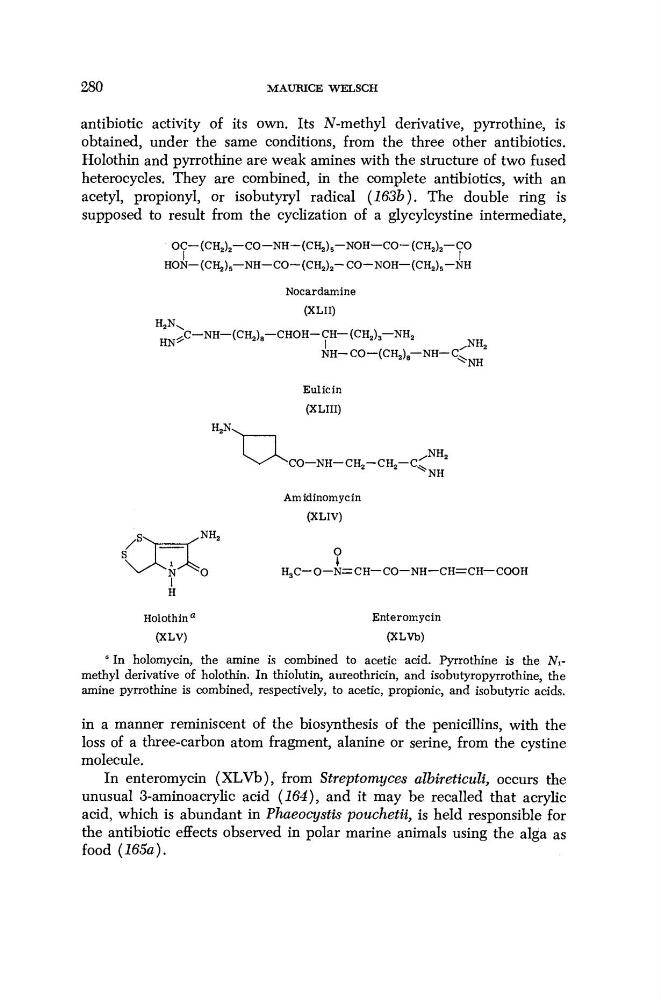
Holothin and pyrrothine are weak amines with the structure of two fused
heterocycles. They are combined, in the complete antibiotics, with an
acetyl, propionyl, or isobutyryl radical (163b).
The double ring is
supposed to result from the cyclization of a glycylcystine intermediate,
OC—(CH 2 ) 2 —CO—NH—(CH2) 5 —NOH—CO—(CH 2 ) 2 —CO
HON—(CH^g—NH—CO—(CH 2 ) 2 — CO—NOH—(CH 2 ) 5 —NH
Nocardamine
(XLII)
H 2 N^
C-NH-(CH 2 ) 8 -CHOH-CH-(CH 2 ) 3 -NH 2
ilJN
I
^^"2
NH- CO-(CH 2 ) 8 -NH- C^ NH
Eulicin
(XLIII)
H,N.
CO—NH— CH 2 —CH 2 — CC
Amidinomycin
(XLIV)
S\
/NH 2
H,C—Ο—N=CH—CO—NH—CH=:CH— COOH
Holothin
a
Enteromycin
(XLV)
(XLVb)
a In holomycin, the amine is combined to acetic acid. Pyrrothine is the Nimethyl derivative of holothin. In thiolutin, aureothricin, and isobutyropyrrothine, the
amine pyrrothine is combined, respectively, to acetic, propionic, and isobutyric acids.
in a manner reminiscent of the biosynthesis of the penicillins, with the
loss of a three-carbon atom fragment, alanine or serine, from the cystine
molecule.
In enteromycin (XLVb), from Streptomyces albireticuli, occurs the
unusual 3-aminoacrylic acid (164), and it may be recalled that acrylic
acid, which is abundant in Phaeocystis pouchetii, is held responsible for
the antibiotic effects observed in polar marine animals using the alga as
food (165a).
MAURICE WELSCH
antibiotic activity of its own. Its N-methyl derivative, pyrrothine, is
obtained, under the same conditions, from the three other antibiotics.
Holothin and pyrrothine are weak amines with the structure of two fused
heterocycles. They are combined, in the complete antibiotics, with an
acetyl, propionyl, or isobutyryl radical (163b).
The double ring is
supposed to result from the cyclization of a glycylcystine intermediate,
OC—(CH 2 ) 2 —CO—NH—(CH2) 5 —NOH—CO—(CH 2 ) 2 —CO
HON—(CH^g—NH—CO—(CH 2 ) 2 — CO—NOH—(CH 2 ) 5 —NH
Nocardamine
(XLII)
H 2 N^
C-NH-(CH 2 ) 8 -CHOH-CH-(CH 2 ) 3 -NH 2
ilJN
I
^^"2
NH- CO-(CH 2 ) 8 -NH- C^ NH
Eulicin
(XLIII)
H,N.
CO—NH— CH 2 —CH 2 — CC
Amidinomycin
(XLIV)
S\
/NH 2
H,C—Ο—N=CH—CO—NH—CH=:CH— COOH
Holothin
a
Enteromycin
(XLV)
(XLVb)
a In holomycin, the amine is combined to acetic acid. Pyrrothine is the Nimethyl derivative of holothin. In thiolutin, aureothricin, and isobutyropyrrothine, the
amine pyrrothine is combined, respectively, to acetic, propionic, and isobutyric acids.
in a manner reminiscent of the biosynthesis of the penicillins, with the
loss of a three-carbon atom fragment, alanine or serine, from the cystine
molecule.
In enteromycin (XLVb), from Streptomyces albireticuli, occurs the
unusual 3-aminoacrylic acid (164), and it may be recalled that acrylic
acid, which is abundant in Phaeocystis pouchetii, is held responsible for
the antibiotic effects observed in polar marine animals using the alga as
food (165a).