

278
MAURICE WELSCH
pensable as a building block for the biosynthesis of their cell wall, e.g.,
diaminopimelic acid (130, 131) or lysine (132). Protoplast formation
also occurs when galactose-sensitive mutants of Salmonella are submitted
to the action of the sugar (133). All these observations are examples of
unbalanced growth
(134-138a).
Spheroplasts, whatever may be their origin, are thought to be the
starting point of the L cycle of bacteria (112,138b,
139a,b).
Although many biochemical effects produced by penicillin were
reported earlier (140-142),
it is widely accepted today that inhibition
of cell wall synthesis truly represents the primary lesion responsible for
antibiotic activity (143-149),
inasmuch as many of the effects are not
observed in media of high enough osmotic pressure (150). There is also
a parallelism between the concentrations respectively needed to promote
the conversion into spheroplasts and to inhibit the growth of a large
number of species of widely different sensitivity (112).
However, it must be acknowledged that the theory now in favor does
not explain all the known facts (151), for instance, the relative resistance
of some highly aerobic nonpenicillinase-producing staphylococci (152).
Penicillin-promoted bacteriolysis has been explained by the induction
of a particular enzyme (153), and it has been suggested that the conversion into spheroplasts is preceded by a more fundamental lethal action
(154, 155).
Closely related to the natural penicillin known as cephalosporin Ν is
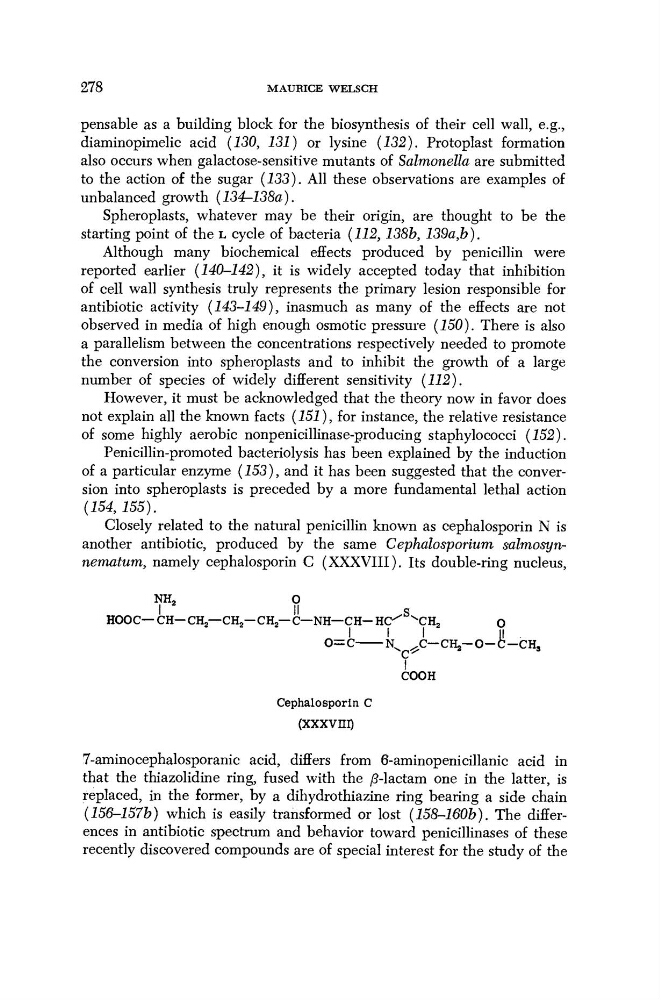
another antibiotic, produced by the same Cephalosporium salmosynnematum, namely cephalosporin C (XXXVIII). Its double-ring nucleus,
NH 2
Ο
I
II
s
HOOC—CH—CH—CH 2
—CH 2
—C—NH—CH-HC^
V
CH 2
Ο
III
u .
0=C
^C—CR,—0-C-CH s
I
COOH
Cephalosporin C
(xxxvni)
7-aminocephalosporanic acid, differs from 6-aminopenicillanic acid in
that the thiazolidine ring, fused with the /^-lactam one in the latter, is
replaced, in the former, by a dihydrothiazine ring bearing a side chain
(156-157b) which is easily transformed or lost (158-160b).
The differences in antibiotic spectrum and behavior toward penicillinases of these
recently discovered compounds are of special interest for the study of the
MAURICE WELSCH
pensable as a building block for the biosynthesis of their cell wall, e.g.,
diaminopimelic acid (130, 131) or lysine (132). Protoplast formation
also occurs when galactose-sensitive mutants of Salmonella are submitted
to the action of the sugar (133). All these observations are examples of
unbalanced growth
(134-138a).
Spheroplasts, whatever may be their origin, are thought to be the
starting point of the L cycle of bacteria (112,138b,
139a,b).
Although many biochemical effects produced by penicillin were
reported earlier (140-142),
it is widely accepted today that inhibition
of cell wall synthesis truly represents the primary lesion responsible for
antibiotic activity (143-149),
inasmuch as many of the effects are not
observed in media of high enough osmotic pressure (150). There is also
a parallelism between the concentrations respectively needed to promote
the conversion into spheroplasts and to inhibit the growth of a large
number of species of widely different sensitivity (112).
However, it must be acknowledged that the theory now in favor does
not explain all the known facts (151), for instance, the relative resistance
of some highly aerobic nonpenicillinase-producing staphylococci (152).
Penicillin-promoted bacteriolysis has been explained by the induction
of a particular enzyme (153), and it has been suggested that the conversion into spheroplasts is preceded by a more fundamental lethal action
(154, 155).
Closely related to the natural penicillin known as cephalosporin Ν is
another antibiotic, produced by the same Cephalosporium salmosynnematum, namely cephalosporin C (XXXVIII). Its double-ring nucleus,
NH 2
Ο
I
II
s
HOOC—CH—CH—CH 2
—CH 2
—C—NH—CH-HC^
V
CH 2
Ο
III
u .
0=C
^C—CR,—0-C-CH s
I
COOH
Cephalosporin C
(xxxvni)
7-aminocephalosporanic acid, differs from 6-aminopenicillanic acid in
that the thiazolidine ring, fused with the /^-lactam one in the latter, is
replaced, in the former, by a dihydrothiazine ring bearing a side chain
(156-157b) which is easily transformed or lost (158-160b).
The differences in antibiotic spectrum and behavior toward penicillinases of these
recently discovered compounds are of special interest for the study of the