

182
ERNEST SCHOFFENIELS
In
out
in
(11)
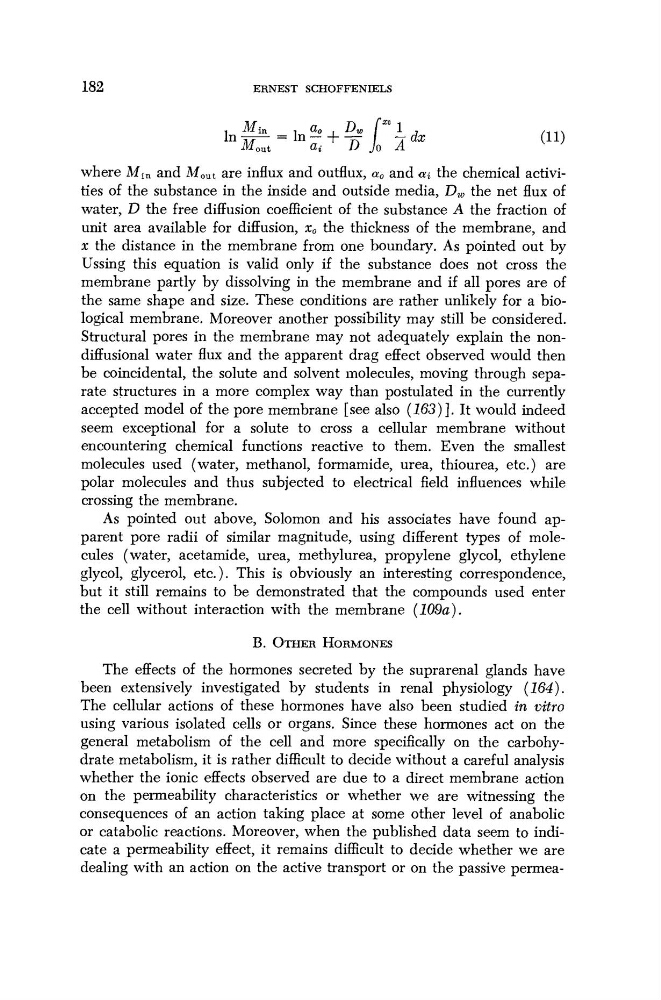
where M in and M out are influx and outflux, a 0 and ai the chemical activities of the substance in the inside and outside media, D w the net flux of
water, D the free diffusion coefficient of the substance A the fraction of
unit area available for diffusion, x 0 the thickness of the membrane, and
χ the distance in the membrane from one boundary. As pointed out by
Ussing this equation is valid only if the substance does not cross the
membrane partly by dissolving in the membrane and if all pores are of
the same shape and size. These conditions are rather unlikely for a biological membrane. Moreover another possibility may still be considered.
Structural pores in the membrane may not adequately explain the nondiffusional water flux and the apparent drag effect observed would then
be coincidental, the solute and solvent molecules, moving through separate structures in a more complex way than postulated in the currently
accepted model of the pore membrane [see also (163)]. It would indeed
seem exceptional for a solute to cross a cellular membrane without
encountering chemical functions reactive to them. Even the smallest
molecules used (water, methanol, formamide, urea, thiourea, etc.) are
polar molecules and thus subjected to electrical field influences while
crossing the membrane.
As pointed out above, Solomon and his associates have found apparent pore radii of similar magnitude, using different types of molecules (water, acetamide, urea, methylurea, propylene glycol, ethylene
glycol, glycerol, etc.). This is obviously an interesting correspondence,
but it still remains to be demonstrated that the compounds used enter
the cell without interaction with the membrane (109a).
The effects of the hormones secreted by the suprarenal glands have
been extensively investigated by students in renal physiology
(164).
The cellular actions of these hormones have also been studied in vitro
using various isolated cells or organs. Since these hormones act on the
general metabolism of the cell and more specifically on the carbohydrate metabolism, it is rather difficult to decide without a careful analysis
whether the ionic effects observed are due to a direct membrane action
on the permeability characteristics or whether we are witnessing the
consequences of an action taking place at some other level of anabolic
or catabolic reactions. Moreover, when the published data seem to indicate a permeability effect, it remains difficult to decide whether we are
dealing with an action on the active transport or on the passive permeaB. OTHER HORMONES
ERNEST SCHOFFENIELS
In
out
in
(11)
where M in and M out are influx and outflux, a 0 and ai the chemical activities of the substance in the inside and outside media, D w the net flux of
water, D the free diffusion coefficient of the substance A the fraction of
unit area available for diffusion, x 0 the thickness of the membrane, and
χ the distance in the membrane from one boundary. As pointed out by
Ussing this equation is valid only if the substance does not cross the
membrane partly by dissolving in the membrane and if all pores are of
the same shape and size. These conditions are rather unlikely for a biological membrane. Moreover another possibility may still be considered.
Structural pores in the membrane may not adequately explain the nondiffusional water flux and the apparent drag effect observed would then
be coincidental, the solute and solvent molecules, moving through separate structures in a more complex way than postulated in the currently
accepted model of the pore membrane [see also (163)]. It would indeed
seem exceptional for a solute to cross a cellular membrane without
encountering chemical functions reactive to them. Even the smallest
molecules used (water, methanol, formamide, urea, thiourea, etc.) are
polar molecules and thus subjected to electrical field influences while
crossing the membrane.
As pointed out above, Solomon and his associates have found apparent pore radii of similar magnitude, using different types of molecules (water, acetamide, urea, methylurea, propylene glycol, ethylene
glycol, glycerol, etc.). This is obviously an interesting correspondence,
but it still remains to be demonstrated that the compounds used enter
the cell without interaction with the membrane (109a).
The effects of the hormones secreted by the suprarenal glands have
been extensively investigated by students in renal physiology
(164).
The cellular actions of these hormones have also been studied in vitro
using various isolated cells or organs. Since these hormones act on the
general metabolism of the cell and more specifically on the carbohydrate metabolism, it is rather difficult to decide without a careful analysis
whether the ionic effects observed are due to a direct membrane action
on the permeability characteristics or whether we are witnessing the
consequences of an action taking place at some other level of anabolic
or catabolic reactions. Moreover, when the published data seem to indicate a permeability effect, it remains difficult to decide whether we are
dealing with an action on the active transport or on the passive permeaB. OTHER HORMONES