

156
ERNEST SCHOFFENIELS
The equilibrium potential for CI is given by Eq. 5.
TP -
R T
lr,
^
(δ)
Equations 4 and 5 express the equality between the diffusion potential
due to Κ and Na leaks and the equilibrium potential for CI, and thus
explain the mechanism by which the intracellular concentration in CI is
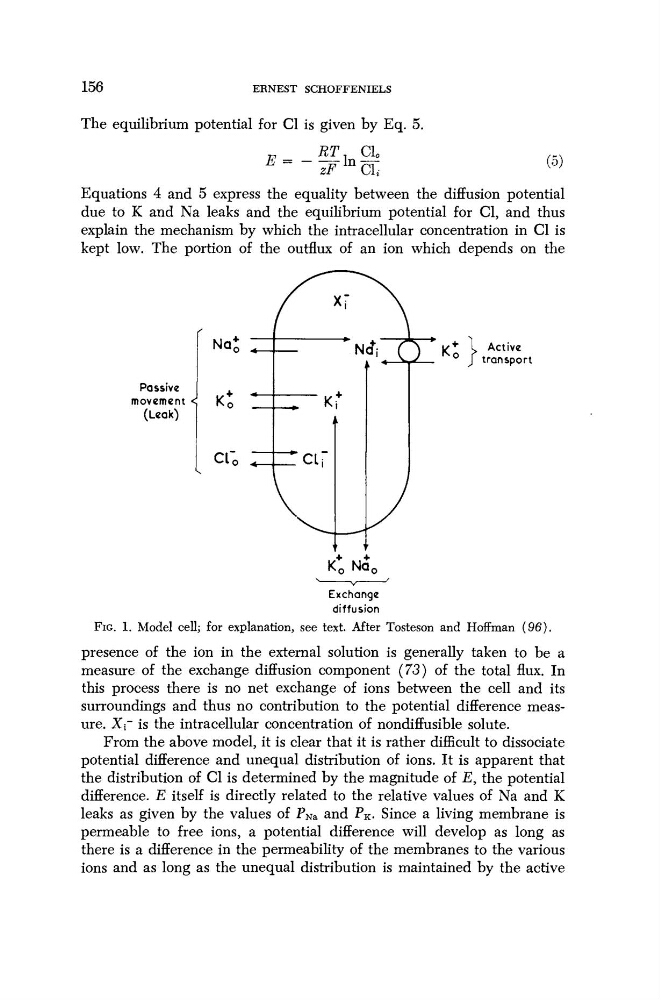
kept low. The portion of the outflux of an ion which depends on the
Passive
movement <,
(Leak)
CI"
" Clj
K
+ o}
Active
transport
K 0 Na 0
N
ν
'
Exchange
diffusion
FIG. 1. Model cell; for explanation, see text. After Tosteson and Hoffman (96).
presence of the ion in the external solution is generally taken to be a
measure of the exchange diffusion component (73) of the total flux. In
this process there is no net exchange of ions between the cell and its
surroundings and thus no contribution to the potential difference measure. Χχ" is the intracellular concentration of nondiffusible solute.
From the above model, it is clear that it is rather difficult to dissociate
potential difference and unequal distribution of ions. It is apparent that
the distribution of CI is determined by the magnitude of E, the potential
difference. Ε itself is directly related to the relative values of Na and Κ
leaks as given by the values of P Na and P K . Since a living membrane is
permeable to free ions, a potential difference will develop as long as
there is a difference in the permeability of the membranes to the various
ions and as long as the unequal distribution is maintained by the active
ERNEST SCHOFFENIELS
The equilibrium potential for CI is given by Eq. 5.
TP -
R T
lr,
^
(δ)
Equations 4 and 5 express the equality between the diffusion potential
due to Κ and Na leaks and the equilibrium potential for CI, and thus
explain the mechanism by which the intracellular concentration in CI is
kept low. The portion of the outflux of an ion which depends on the
Passive
movement <,
(Leak)
CI"
" Clj
K
+ o}
Active
transport
K 0 Na 0
N
ν
'
Exchange
diffusion
FIG. 1. Model cell; for explanation, see text. After Tosteson and Hoffman (96).
presence of the ion in the external solution is generally taken to be a
measure of the exchange diffusion component (73) of the total flux. In
this process there is no net exchange of ions between the cell and its
surroundings and thus no contribution to the potential difference measure. Χχ" is the intracellular concentration of nondiffusible solute.
From the above model, it is clear that it is rather difficult to dissociate
potential difference and unequal distribution of ions. It is apparent that
the distribution of CI is determined by the magnitude of E, the potential
difference. Ε itself is directly related to the relative values of Na and Κ
leaks as given by the values of P Na and P K . Since a living membrane is
permeable to free ions, a potential difference will develop as long as
there is a difference in the permeability of the membranes to the various
ions and as long as the unequal distribution is maintained by the active