

3. CELLULAR ASPECTS OF ACTIVE TRANSPORT
153
saturation kinetics, indicate that binding with graded affinities to a
limited number of binding sites is involved (75).
The L-cell strain fibroblasts of mouse connective tissue origin, has
been used to study sugar accumulation. They take up galactose and
glucose against a concentration gradient. Glucose uptake is inhibited by
galactose, 2-deoxyglucose, phloridzin, and phloretin (76).
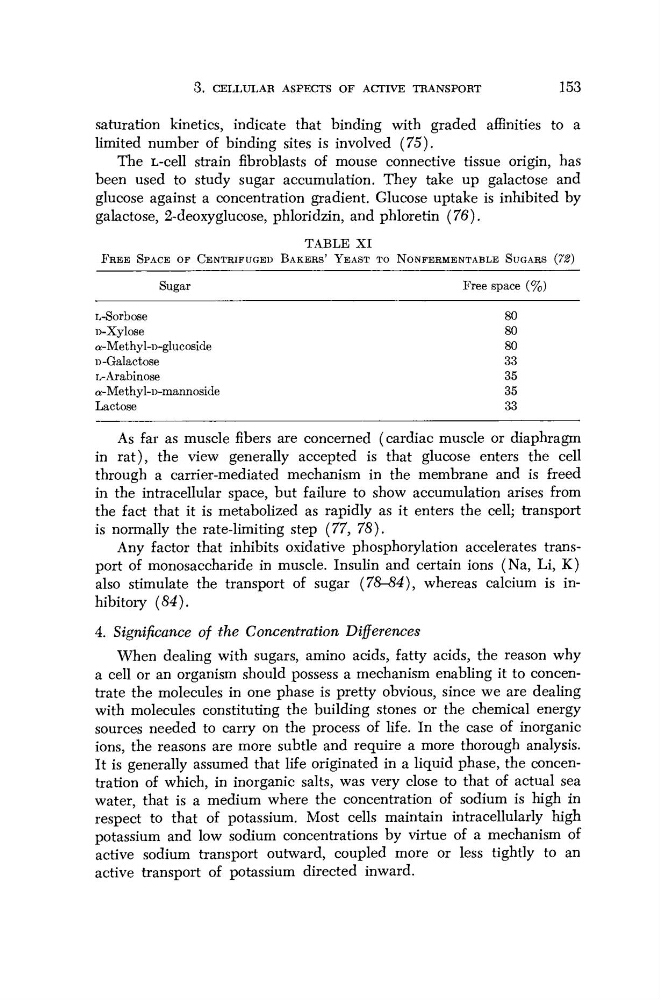
FREE SPACE OF CENTRIFUGED BAKERS' YEAST TO NONFERMENTABLE SUGARS (72)
As far as muscle fibers are concerned (cardiac muscle or diaphragm
in rat), the view generally accepted is that glucose enters the cell
through a carrier-mediated mechanism in the membrane and is freed
in the intracellular space, but failure to show accumulation arises from
the fact that it is metabolized as rapidly as it enters the cell; transport
is normally the rate-limiting step (77, 78).
Any factor that inhibits oxidative phosphorylation accelerates transport of monosaccharide in muscle. Insulin and certain ions (Na, Li, K)
also stimulate the transport of sugar (78-84),
whereas calcium is inhibitory (84).
4. Significance of the Concentration
Differences
When dealing with sugars, amino acids, fatty acids, the reason why
a cell or an organism should possess a mechanism enabling it to concentrate the molecules in one phase is pretty obvious, since we are dealing
with molecules constituting the building stones or the chemical energy
sources needed to carry on the process of life. In the case of inorganic
ions, the reasons are more subtle and require a more thorough analysis.
It is generally assumed that life originated in a liquid phase, the concentration of which, in inorganic salts, was very close to that of actual sea
water, that is a medium where the concentration of sodium is high in
respect to that of potassium. Most cells maintain intracellularly high
potassium and low sodium concentrations by virtue of a mechanism of
active sodium transport outward, coupled more or less tightly to an
active transport of potassium directed inward.
TABLE XI
Sugar
Free space (%)
L-Sorbose
D-Xylose
a-Methyl-D-glucoside
D-Galactose
L-Arabinose
a-Methyl-D-mannoside
Lactose
80
80
80
33
35
35
33
153
saturation kinetics, indicate that binding with graded affinities to a
limited number of binding sites is involved (75).
The L-cell strain fibroblasts of mouse connective tissue origin, has
been used to study sugar accumulation. They take up galactose and
glucose against a concentration gradient. Glucose uptake is inhibited by
galactose, 2-deoxyglucose, phloridzin, and phloretin (76).
FREE SPACE OF CENTRIFUGED BAKERS' YEAST TO NONFERMENTABLE SUGARS (72)
As far as muscle fibers are concerned (cardiac muscle or diaphragm
in rat), the view generally accepted is that glucose enters the cell
through a carrier-mediated mechanism in the membrane and is freed
in the intracellular space, but failure to show accumulation arises from
the fact that it is metabolized as rapidly as it enters the cell; transport
is normally the rate-limiting step (77, 78).
Any factor that inhibits oxidative phosphorylation accelerates transport of monosaccharide in muscle. Insulin and certain ions (Na, Li, K)
also stimulate the transport of sugar (78-84),
whereas calcium is inhibitory (84).
4. Significance of the Concentration
Differences
When dealing with sugars, amino acids, fatty acids, the reason why
a cell or an organism should possess a mechanism enabling it to concentrate the molecules in one phase is pretty obvious, since we are dealing
with molecules constituting the building stones or the chemical energy
sources needed to carry on the process of life. In the case of inorganic
ions, the reasons are more subtle and require a more thorough analysis.
It is generally assumed that life originated in a liquid phase, the concentration of which, in inorganic salts, was very close to that of actual sea
water, that is a medium where the concentration of sodium is high in
respect to that of potassium. Most cells maintain intracellularly high
potassium and low sodium concentrations by virtue of a mechanism of
active sodium transport outward, coupled more or less tightly to an
active transport of potassium directed inward.
TABLE XI
Sugar
Free space (%)
L-Sorbose
D-Xylose
a-Methyl-D-glucoside
D-Galactose
L-Arabinose
a-Methyl-D-mannoside
Lactose
80
80
80
33
35
35
33