

138
ERNEST SCHOFFENIELS
bility field is still, for obvious reasons, at the purely descriptive "morphological" phase, and thus essentially concerned with the determination of
the permeability characteristics of a living membrane. In some tissues
we already have a little information concerning the functional structure
of a living membrane, i.e., the way some of the functions so far identified
are organized and distributed in the membrane. But we still lack some
of the most fundamental knowledge enabling us to present a coherent
picture of the membrane integrated in the cell functioning as an independent unit. However, in a limited number of cases, we are beginning
to have enough knowledge to enable us to discuss the possible relationships existing between the various permeability characteristics of a
membrane and the general metabolism of the cell.
We shall thus formulate some general concepts emerging from the
comparative study of membrane permeability and shall attempt to correlate them with some aspects of the metabolism of the cell taken as a
living unit.
II. The Permeability Characteristics of a Living Membrane
A. ORIGIN OF THE CONCENTRATION DIFFERENCE EXISTING BETWEEN TWO
LIQUID PHASES SEPARATED BY A LIVING MEMBRANE
1. Inorganic Ions
The difference in composition between two liquid phases separated
by a living membrane may generally be explained by any combination
of diffusion force, electric field, solvent drag, or active transport. By
active transport one generally defines a transfer that cannot be accounted
for by physical forces only. In order to characterize the behavior of an
ion, one has therefore to relate the fluxes of the species under study to
the various physical forces mentioned. Thus, for an ion moving across a
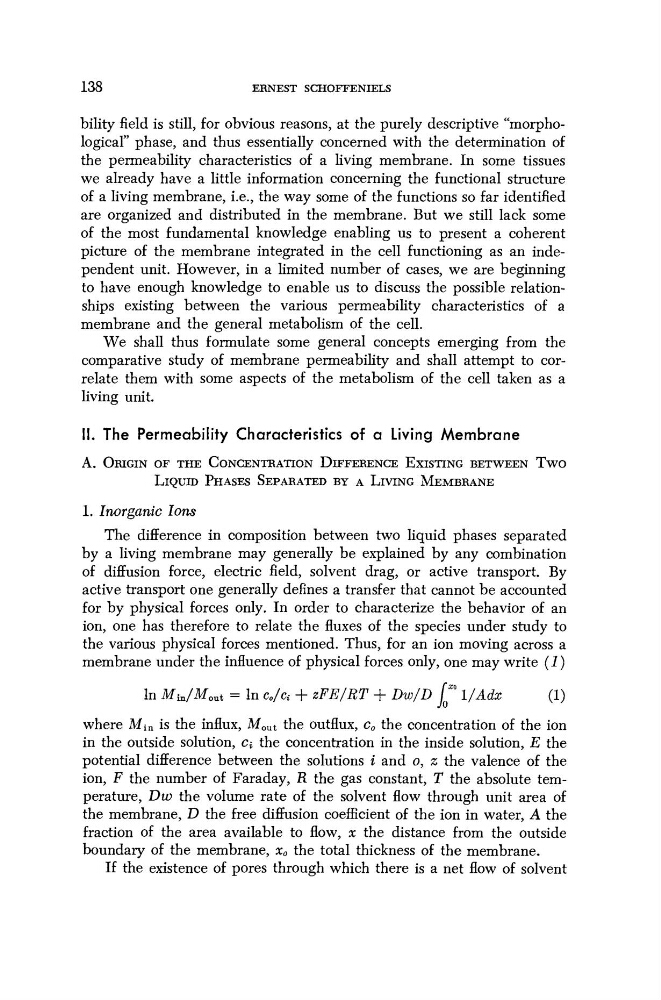
membrane under the influence of physical forces only, one may write (I)
In M in /M OVLt
= In c 0 /d + zFE/RT + Dw/D f" 1/Adx
(1)
where M IN is the influx, M out the outflux, c 0 the concentration of the ion
in the outside solution, d the concentration in the inside solution, Ε the
potential difference between the solutions / and ο, ζ the valence of the
ion, F the number of Faraday, R the gas constant, Γ the absolute temperature, Dw the volume rate of the solvent flow through unit area of
the membrane, D the free diffusion coefficient of the ion in water, A the
fraction of the area available to flow, χ the distance from the outside
boundary of the membrane, x 0 the total thickness of the membrane.
If the existence of pores through which there is a net flow of solvent
ERNEST SCHOFFENIELS
bility field is still, for obvious reasons, at the purely descriptive "morphological" phase, and thus essentially concerned with the determination of
the permeability characteristics of a living membrane. In some tissues
we already have a little information concerning the functional structure
of a living membrane, i.e., the way some of the functions so far identified
are organized and distributed in the membrane. But we still lack some
of the most fundamental knowledge enabling us to present a coherent
picture of the membrane integrated in the cell functioning as an independent unit. However, in a limited number of cases, we are beginning
to have enough knowledge to enable us to discuss the possible relationships existing between the various permeability characteristics of a
membrane and the general metabolism of the cell.
We shall thus formulate some general concepts emerging from the
comparative study of membrane permeability and shall attempt to correlate them with some aspects of the metabolism of the cell taken as a
living unit.
II. The Permeability Characteristics of a Living Membrane
A. ORIGIN OF THE CONCENTRATION DIFFERENCE EXISTING BETWEEN TWO
LIQUID PHASES SEPARATED BY A LIVING MEMBRANE
1. Inorganic Ions
The difference in composition between two liquid phases separated
by a living membrane may generally be explained by any combination
of diffusion force, electric field, solvent drag, or active transport. By
active transport one generally defines a transfer that cannot be accounted
for by physical forces only. In order to characterize the behavior of an
ion, one has therefore to relate the fluxes of the species under study to
the various physical forces mentioned. Thus, for an ion moving across a
membrane under the influence of physical forces only, one may write (I)
In M in /M OVLt
= In c 0 /d + zFE/RT + Dw/D f" 1/Adx
(1)
where M IN is the influx, M out the outflux, c 0 the concentration of the ion
in the outside solution, d the concentration in the inside solution, Ε the
potential difference between the solutions / and ο, ζ the valence of the
ion, F the number of Faraday, R the gas constant, Γ the absolute temperature, Dw the volume rate of the solvent flow through unit area of
the membrane, D the free diffusion coefficient of the ion in water, A the
fraction of the area available to flow, χ the distance from the outside
boundary of the membrane, x 0 the total thickness of the membrane.
If the existence of pores through which there is a net flow of solvent