

2. CHITIN AND MUCOSUBSTANCES
123
Hörnums, collagen occurs (175) in subcuticular tissue, and in the barnacle Lepas in the peduncle. In general however, collagen where present is
associated with fibrous structures and there is little evidence for a-chitincollagen interactions. In the brachiopod Linguh, /?-chitin is thought to
occur in association with collagen. In arthropods, it is the cuticular protein interacting with chitin that does not appear to be collagenous, and
this finding is supported by the absence of the characteristic amino acid,
hydroxyproline, in chitinous glycoproteins (4). These should, however,
be regarded as tentative conclusions until more detailed results are available on the precise structure of these cuticular proteins. Collagen-chitin
distribution has been reviewed by Rudall (101).
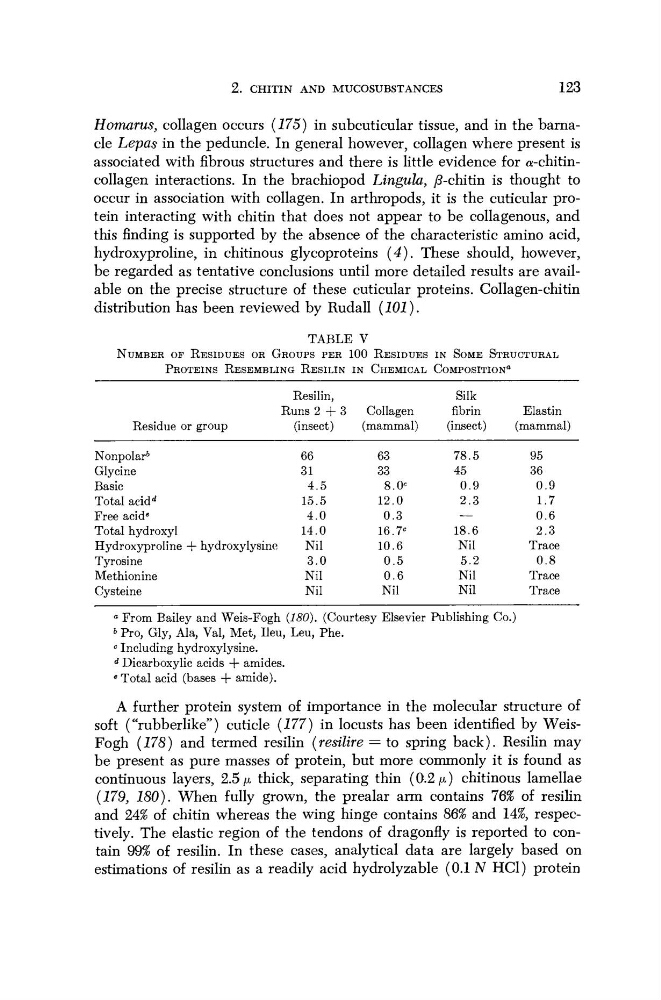
TABLE V
NUMBER OF RESIDUES OR GROUPS PER 100 RESIDUES IN SOME STRUCTURAL
PROTEINS RESEMBLING RESILIN IN CHEMICAL COMPOSITION
0
Resilin,
Silk
Runs 2+3
Collagen
fibrin
Elastin
Residue or group
(insect)
(mammal)
(insect)
(mammal)
Nonpolar
6
66
63
78.5
95
Glycine
31
33
45
36
Basic
4.5
8.0
C
0.9
0.9
Total acid*"
15.5
12.0
2.3
1.7
Free acid
e
4.0
0.3
—
0.6
Total hydroxyl
14.0
16.7
C
18.6
2.3
Hydroxyproline + hydroxylysine
Nil
10.6
Nil
Trace
Tyrosine
3.0
0.5
5.2
0.8
Methionine
Nil
0.6
Nil
Trace
Cysteine
Nil
Nil
Nil
Trace
° From Bailey and Weis-Fogh (180). (Courtesy Elsevier Publishing Co.)
6 Pro, Gly, Ala, Val, Met, lieu, Leu, Phe.
c Including hydroxylysine.
d Dicarboxylic acids + amides.
e Total acid (bases + amide).
A further protein system of importance in the molecular structure of
soft ("rubberlike") cuticle (177) in locusts has been identified by WeisFogh (178) and termed resilin (resilire — to spring back). Resilin may
be present as pure masses of protein, but more commonly it is found as
continuous layers, 2.5μ thick, separating thin (0.2μ) chitinous lamellae
(179, 180). When fully grown, the prealar arm contains 76% of resilin
and 24% of chitin whereas the wing hinge contains 86% and 14%, respectively. The elastic region of the tendons of dragonfly is reported to contain 99% of resilin. In these cases, analytical data are largely based on
estimations of resilin as a readily acid hydrolyzable (0.1 Ν HCl) protein
123
Hörnums, collagen occurs (175) in subcuticular tissue, and in the barnacle Lepas in the peduncle. In general however, collagen where present is
associated with fibrous structures and there is little evidence for a-chitincollagen interactions. In the brachiopod Linguh, /?-chitin is thought to
occur in association with collagen. In arthropods, it is the cuticular protein interacting with chitin that does not appear to be collagenous, and
this finding is supported by the absence of the characteristic amino acid,
hydroxyproline, in chitinous glycoproteins (4). These should, however,
be regarded as tentative conclusions until more detailed results are available on the precise structure of these cuticular proteins. Collagen-chitin
distribution has been reviewed by Rudall (101).
TABLE V
NUMBER OF RESIDUES OR GROUPS PER 100 RESIDUES IN SOME STRUCTURAL
PROTEINS RESEMBLING RESILIN IN CHEMICAL COMPOSITION
0
Resilin,
Silk
Runs 2+3
Collagen
fibrin
Elastin
Residue or group
(insect)
(mammal)
(insect)
(mammal)
Nonpolar
6
66
63
78.5
95
Glycine
31
33
45
36
Basic
4.5
8.0
C
0.9
0.9
Total acid*"
15.5
12.0
2.3
1.7
Free acid
e
4.0
0.3
—
0.6
Total hydroxyl
14.0
16.7
C
18.6
2.3
Hydroxyproline + hydroxylysine
Nil
10.6
Nil
Trace
Tyrosine
3.0
0.5
5.2
0.8
Methionine
Nil
0.6
Nil
Trace
Cysteine
Nil
Nil
Nil
Trace
° From Bailey and Weis-Fogh (180). (Courtesy Elsevier Publishing Co.)
6 Pro, Gly, Ala, Val, Met, lieu, Leu, Phe.
c Including hydroxylysine.
d Dicarboxylic acids + amides.
e Total acid (bases + amide).
A further protein system of importance in the molecular structure of
soft ("rubberlike") cuticle (177) in locusts has been identified by WeisFogh (178) and termed resilin (resilire — to spring back). Resilin may
be present as pure masses of protein, but more commonly it is found as
continuous layers, 2.5μ thick, separating thin (0.2μ) chitinous lamellae
(179, 180). When fully grown, the prealar arm contains 76% of resilin
and 24% of chitin whereas the wing hinge contains 86% and 14%, respectively. The elastic region of the tendons of dragonfly is reported to contain 99% of resilin. In these cases, analytical data are largely based on
estimations of resilin as a readily acid hydrolyzable (0.1 Ν HCl) protein