

2. CHITIN AND MUCOSUBSTANCES
121
lithium thiocyanate by fractional precipitation contain both chitin and
peptides. In no case was protein-free chitin obtained.
The amino acids retained even after alkali treatment of chitin (Lucilla
cuprina) could be isolated after acidic hydrolysis. These were identified provisionally as aspartic acid and histidine, and it is suggested that
these may be involved in the chitin-protein bonds. Glycoproteins are
found with both a- and /^chitin. Results of analyses of the amino acid
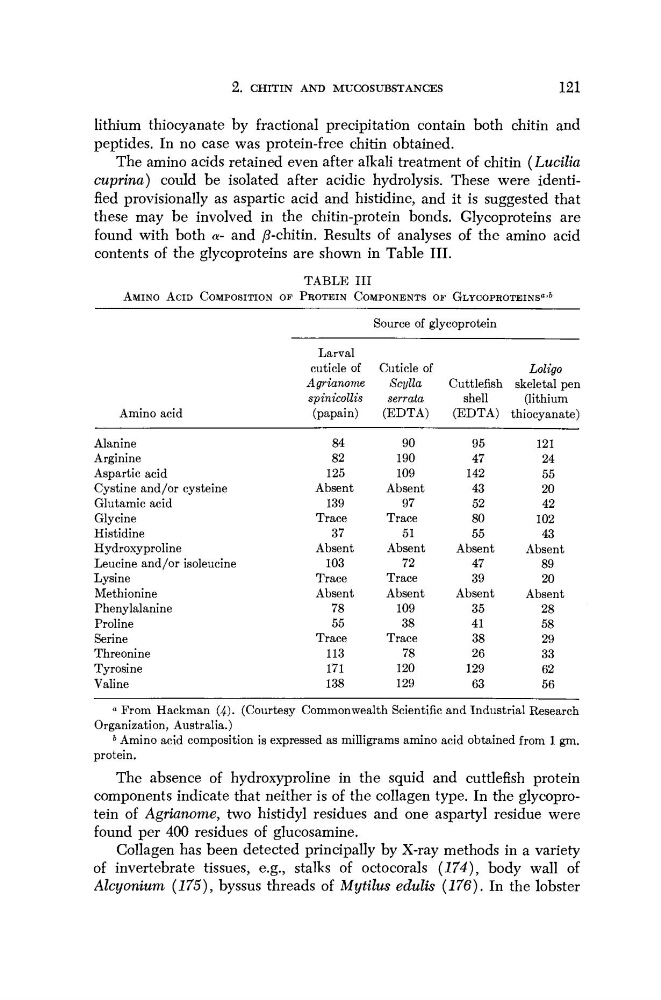
contents of the glycoproteins are shown in Table III.
TABLE III
AMINO ACID COMPOSITION OF PROTEIN COMPONENTS OF GLYCOPROTEINS
0
'
6
Source of glycoprotein
Larval
cuticle of
Cuticle of
Loligo
Agrianome
Scylla
Cuttlefish skeletal pen
spinicollis
serrata
shell
(lithium
Amino acid
(papain)
(EDTA)
(EDTA) thiocyanate)
Alanine
84
90
95
121
Arginine
82
190
47
24
Aspartic acid
125
109
142
55
Cystine and/or cysteine
Absent
Absent
43
20
Glutamic acid
139
97
52
42
Glycine
Trace
Trace
80
102
Histidine
37
51
55
43
Hydroxyproline
Absent
Absent
Absent
Absent
Leucine and/or isoleucine
103
72
47
89
Lysine
Trace
Trace
39
20
Methionine
Absent
Absent
Absent
Absent
Phenylalanine
78
109
35
28
Proline
55
38
41
58
Serine
Trace
Trace
38
29
Threonine
113
78
26
33
Tyrosine
171
120
129
62
Valine
138
129
63
56
a From Hackman (4). (Courtesy Commonwealth Scientific and Industrial Research
Organization, Australia.)
h Amino acid composition is expressed as milligrams amino acid obtained from 1 gm.
protein.
The absence of hydroxyproline in the squid and cuttlefish protein
components indicate that neither is of the collagen type. In the glycoprotein of Agrianome, two histidyl residues and one aspartyl residue were
found per 400 residues of glucosamine.
Collagen has been detected principally by X-ray methods in a variety
of invertebrate tissues, e.g., stalks of octocorals (174), body wall of
Alcyonium (175), byssus threads of Mytilus edulis (176). In the lobster
121
lithium thiocyanate by fractional precipitation contain both chitin and
peptides. In no case was protein-free chitin obtained.
The amino acids retained even after alkali treatment of chitin (Lucilla
cuprina) could be isolated after acidic hydrolysis. These were identified provisionally as aspartic acid and histidine, and it is suggested that
these may be involved in the chitin-protein bonds. Glycoproteins are
found with both a- and /^chitin. Results of analyses of the amino acid
contents of the glycoproteins are shown in Table III.
TABLE III
AMINO ACID COMPOSITION OF PROTEIN COMPONENTS OF GLYCOPROTEINS
0
'
6
Source of glycoprotein
Larval
cuticle of
Cuticle of
Loligo
Agrianome
Scylla
Cuttlefish skeletal pen
spinicollis
serrata
shell
(lithium
Amino acid
(papain)
(EDTA)
(EDTA) thiocyanate)
Alanine
84
90
95
121
Arginine
82
190
47
24
Aspartic acid
125
109
142
55
Cystine and/or cysteine
Absent
Absent
43
20
Glutamic acid
139
97
52
42
Glycine
Trace
Trace
80
102
Histidine
37
51
55
43
Hydroxyproline
Absent
Absent
Absent
Absent
Leucine and/or isoleucine
103
72
47
89
Lysine
Trace
Trace
39
20
Methionine
Absent
Absent
Absent
Absent
Phenylalanine
78
109
35
28
Proline
55
38
41
58
Serine
Trace
Trace
38
29
Threonine
113
78
26
33
Tyrosine
171
120
129
62
Valine
138
129
63
56
a From Hackman (4). (Courtesy Commonwealth Scientific and Industrial Research
Organization, Australia.)
h Amino acid composition is expressed as milligrams amino acid obtained from 1 gm.
protein.
The absence of hydroxyproline in the squid and cuttlefish protein
components indicate that neither is of the collagen type. In the glycoprotein of Agrianome, two histidyl residues and one aspartyl residue were
found per 400 residues of glucosamine.
Collagen has been detected principally by X-ray methods in a variety
of invertebrate tissues, e.g., stalks of octocorals (174), body wall of
Alcyonium (175), byssus threads of Mytilus edulis (176). In the lobster