

104
P. W. KENT
cellulose, equal numbers of molecular chains are arranged in opposite
directions, but in this case, each chain was paired with one running in
the opposite sense (Fig. 6).
-C = I9.25A(001)
FIG. 6. The chitin space lattice as determined by Meyer and Pankow (67). Arrows
indicate the alternation in direction of chains. (Courtesy Helvetica Chimica Acta.)
A reexamination of α-chitin (alkali treated) from Homarus amencanus by Carlstrom (95), confirming the general molecular dispositions
discovered by Meyer and Pankow, resulted in a new model (Fig. 7)
taking account of the bonding of side groups. The macrostructure of
1800
1600
1400
1200
FREQUENCY
cm:'
1000
800
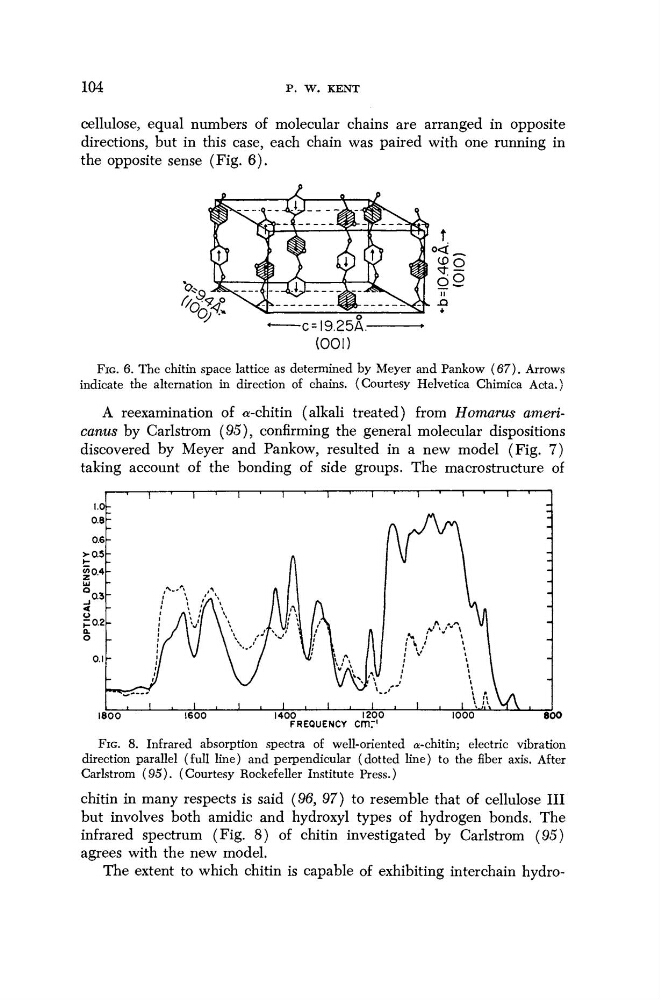
FIG. 8. Infrared absorption spectra of well-oriented α-chitin; electric vibration
direction parallel (full line) and perpendicular (dotted line) to the fiber axis. After
Carlstrom (95). (Courtesy Rockefeller Institute Press.)
chitin in many respects is said (96, 97) to resemble that of cellulose III
but involves both amidic and hydroxyl types of hydrogen bonds. The
infrared spectrum (Fig. 8) of chitin investigated by Carlstrom (95)
agrees with the new model.
The extent to which chitin is capable of exhibiting interchain hydro-
P. W. KENT
cellulose, equal numbers of molecular chains are arranged in opposite
directions, but in this case, each chain was paired with one running in
the opposite sense (Fig. 6).
-C = I9.25A(001)
FIG. 6. The chitin space lattice as determined by Meyer and Pankow (67). Arrows
indicate the alternation in direction of chains. (Courtesy Helvetica Chimica Acta.)
A reexamination of α-chitin (alkali treated) from Homarus amencanus by Carlstrom (95), confirming the general molecular dispositions
discovered by Meyer and Pankow, resulted in a new model (Fig. 7)
taking account of the bonding of side groups. The macrostructure of
1800
1600
1400
1200
FREQUENCY
cm:'
1000
800
FIG. 8. Infrared absorption spectra of well-oriented α-chitin; electric vibration
direction parallel (full line) and perpendicular (dotted line) to the fiber axis. After
Carlstrom (95). (Courtesy Rockefeller Institute Press.)
chitin in many respects is said (96, 97) to resemble that of cellulose III
but involves both amidic and hydroxyl types of hydrogen bonds. The
infrared spectrum (Fig. 8) of chitin investigated by Carlstrom (95)
agrees with the new model.
The extent to which chitin is capable of exhibiting interchain hydro-