

1. FATTY ACID OCCURRENCE AND DISTRIBUTION
77
years. Human hair fatty acid composition has likewise only recently
been satisfactorily described. The advent of gas-liquid Chromatographie
techniques has permitted the determination of the fatty acid composition of the sebum from a number of other species where the collection
of sufficient material for the application of the hitherto available techniques for the determination of fatty acid composition had proved to be
an obstacle.
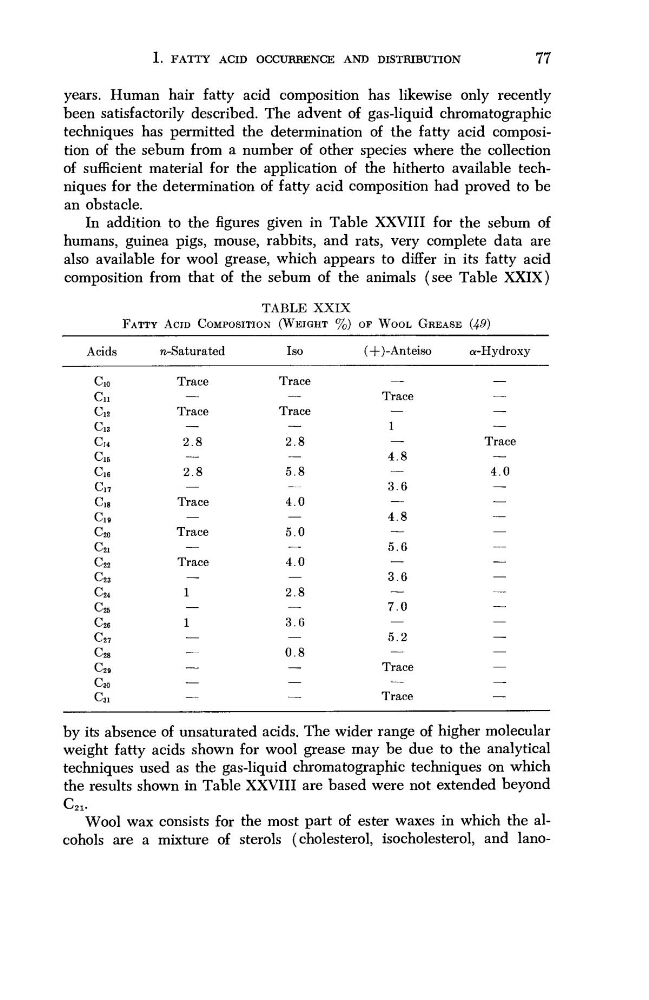
In addition to the figures given in Table XXVIII for the sebum of
humans, guinea pigs, mouse, rabbits, and rats, very complete data are
also available for wool grease, which appears to differ in its fatty acid
composition from that of the sebum of the animals (see Table XXIX)
TABLE XXIX
FATTY ACID COMPOSITION (WEIGHT %) OF WOOL GREASE (49)
Acids
Cio
Cn
Ci2
Cl3
C]4
Cl5
Cl6
Cl7
Cl8
C19
C20
C21
C22
C23
C24
C25
C26
C27
C28
C29
C30
C31
n-Saturated
Trace
—
Trace
—
2.8
—
2.8
—
Trace
—
Trace
—
Trace
—
1
—
1
—
—
—
—
Iso
Trace
—
Trace
—
2.8
—
5.8
—
4.0
—
5.0
—
4.0
—
2.8
—
3.6
—
0.8
—
—
(+)-Anteiso
—
Trace
—
1
—
4.8
—
3.6
—
4.8
—
5.6
—
3.6
—
7.0
—
5.2
—
Trace
Trace
a-Hydroxy
—
—
—
Trace
—
4.0
—
—
—
—
—
—
—
—
—
—
—
—
—
—
by its absence of unsaturated acids. The wider range of higher molecular
weight fatty acids shown for wool grease may be due to the analytical
techniques used as the gas-liquid Chromatographie techniques on which
the results shown in Table XXVIII are based were not extended beyond
Wool wax consists for the most part of ester waxes in which the alcohols are a mixture of sterols (cholesterol, isocholesterol, and lano-
77
years. Human hair fatty acid composition has likewise only recently
been satisfactorily described. The advent of gas-liquid Chromatographie
techniques has permitted the determination of the fatty acid composition of the sebum from a number of other species where the collection
of sufficient material for the application of the hitherto available techniques for the determination of fatty acid composition had proved to be
an obstacle.
In addition to the figures given in Table XXVIII for the sebum of
humans, guinea pigs, mouse, rabbits, and rats, very complete data are
also available for wool grease, which appears to differ in its fatty acid
composition from that of the sebum of the animals (see Table XXIX)
TABLE XXIX
FATTY ACID COMPOSITION (WEIGHT %) OF WOOL GREASE (49)
Acids
Cio
Cn
Ci2
Cl3
C]4
Cl5
Cl6
Cl7
Cl8
C19
C20
C21
C22
C23
C24
C25
C26
C27
C28
C29
C30
C31
n-Saturated
Trace
—
Trace
—
2.8
—
2.8
—
Trace
—
Trace
—
Trace
—
1
—
1
—
—
—
—
Iso
Trace
—
Trace
—
2.8
—
5.8
—
4.0
—
5.0
—
4.0
—
2.8
—
3.6
—
0.8
—
—
(+)-Anteiso
—
Trace
—
1
—
4.8
—
3.6
—
4.8
—
5.6
—
3.6
—
7.0
—
5.2
—
Trace
Trace
a-Hydroxy
—
—
—
Trace
—
4.0
—
—
—
—
—
—
—
—
—
—
—
—
—
—
by its absence of unsaturated acids. The wider range of higher molecular
weight fatty acids shown for wool grease may be due to the analytical
techniques used as the gas-liquid Chromatographie techniques on which
the results shown in Table XXVIII are based were not extended beyond
Wool wax consists for the most part of ester waxes in which the alcohols are a mixture of sterols (cholesterol, isocholesterol, and lano-