

710
R. H. THOMSON
OH
^
OCH(<^|CH 2 CH==CMe 2
Me(CH==CH) 3 V^
OH
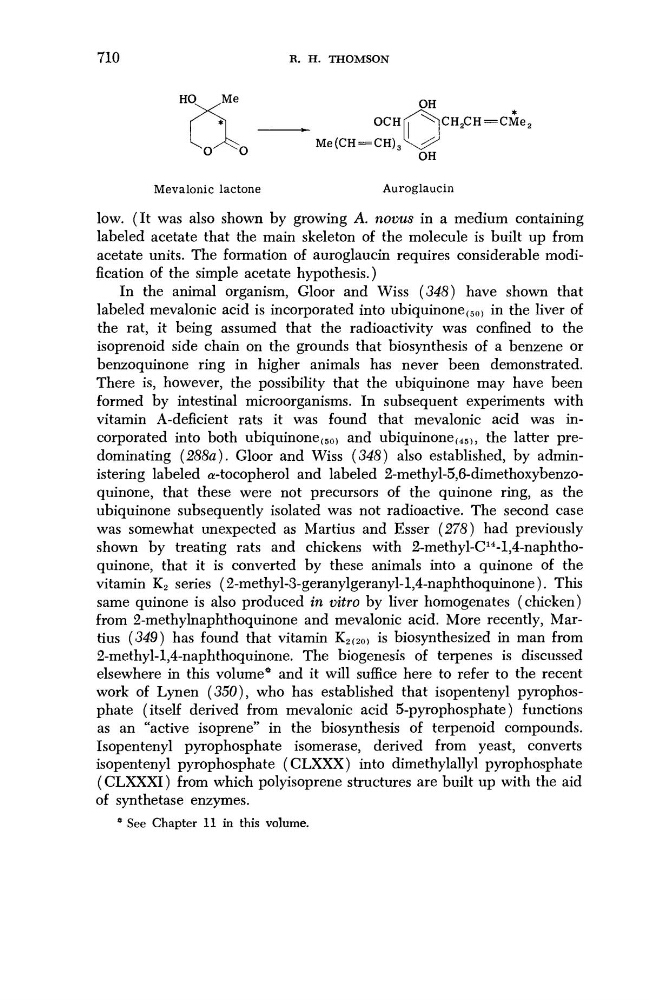
Mevalonic lactone
Auroglaucin
low. (It was also shown by growing A. novus in a medium containing
labeled acetate that the main skeleton of the molecule is built up from
acetate units. The formation of auroglaucin requires considerable modification of the simple acetate hypothesis.)
In the animal organism, Gloor and Wiss (348) have shown that
labeled mevalonic acid is incorporated into ubiquinone (50 ) in the liver of
the rat, it being assumed that the radioactivity was confined to the
isoprenoid side chain on the grounds that biosynthesis of a benzene or
benzoquinone ring in higher animals has never been demonstrated.
There is, however, the possibility that the ubiquinone may have been
formed by intestinal microorganisms. In subsequent experiments with
vitamin A-deficient rats it was found that mevalonic acid was incorporated into both ubiquinone (50 ) and ubiquinone ( 45 ), the latter predominating (288a). Gloor and Wiss (348) also established, by administering labeled α-tocopherol and labeled 2-methyl-5,6-dimethoxybenzoquinone, that these were not precursors of the quinone ring, as the
ubiquinone subsequently isolated was not radioactive. The second case
was somewhat unexpected as Martius and Esser (278) had previously
shown by treating rats and chickens with 2-methyl-C
14 -l,4-naphthoquinone, that it is converted by these animals into a quinone of the
vitamin K 2 series (2-methyl-3-geranylgeranyl-l,4-naphthoquinone). This
same quinone is also produced in vitro by liver homogenates (chicken)
from 2-methylnaphthoquinone and mevalonic acid. More recently, Martius (349) has found that vitamin K 2(2 o) is biosynthesized in man from
2-methyl-l,4-naphthoquinone. The biogenesis of terpenes is discussed
elsewhere in this volume* and it will suffice here to refer to the recent
work of Lynen (350), who has established that isopentenyl pyrophosphate (itself derived from mevalonic acid 5-pyrophosphate) functions
as an "active isoprene" in the biosynthesis of terpenoid compounds.
Isopentenyl pyrophosphate isomerase, derived from yeast, converts
isopentenyl pyrophosphate (CLXXX) into dimethylallyl pyrophosphate
(CLXXXI) from which polyisoprene structures are built up with the aid
of synthetase enzymes.
* See Chapter 11 in this volume.
HO^^Me