

708
B. H. THOMSON
H0 2 C
[O] [O]
CO,Me
Et —CO
c^ c
σ
c
c
c
c
c
c
o
o
o
o
(CLXXVI)
(77-Pyrromycinone )
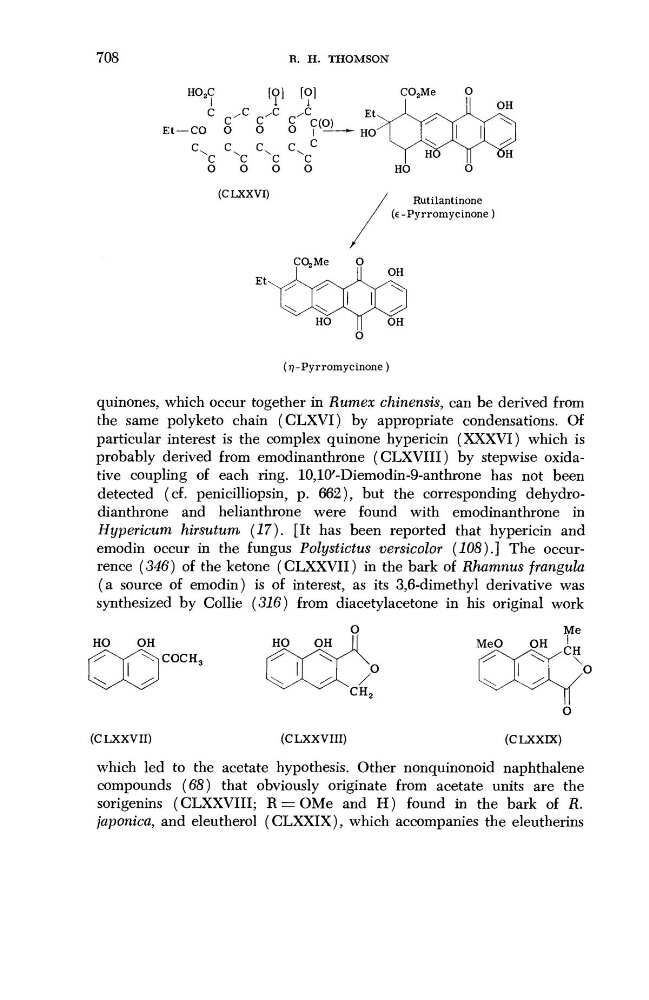
quinones, which occur together in Rumex chinensis, can be derived from
the same polyketo chain (CLXVI) by appropriate condensations. Of
particular interest is the complex quinone hypericin (XXXVI) which is
probably derived from emodinanthrone (CLXVIII) by stepwise oxidative coupling of each ring. 10,10'-Diemodin-9-anthrone has not been
detected (cf. penicilliopsin, p. 662), but the corresponding dehydrodianthrone and helianthrone were found with emodinanthrone in
Hypericum hirsutum (17). [It has been reported that hypericin and
emodin occur in the fungus Polystictus versicolor (108).] The occurrence (346) of the ketone (CLXXVII) in the bark of Rhamnus frangula
(a source of emodin) is of interest, as its 3,6-dimethyl derivative was
synthesized by Collie (316) from diacetylacetone in his original work
HO
OH
HO
OH
COCH,
Me
MeO
OH
(CLXXVII)
(CLXXVIII)
(CLXXIX)
which led to the acetate hypothesis. Other nonquinonoid naphthalene
compounds (68) that obviously originate from acetate units are the
sorigenins (CLXXVIII; R = OMe and H) found in the bark of R.
japonica, and eleutherol (CLXXIX), which accompanies the eleutherins