

676
ΓΗΟΗ
HOHC
CHOH
t
HOHC^ /CHOH
CHOH
O
HOHC^ XHOH
I
I
o=a „c=o
CHOH
Inositol
(CXXXIII)
(CXXXIV)
o
Η
°ίί
ΗΟ^
OH
-^-,ΟΗ
^JoH
OH
1
ΗΟ Γι
HOli
T
1
il
OH
J)oH
T
o
(CXXXV)
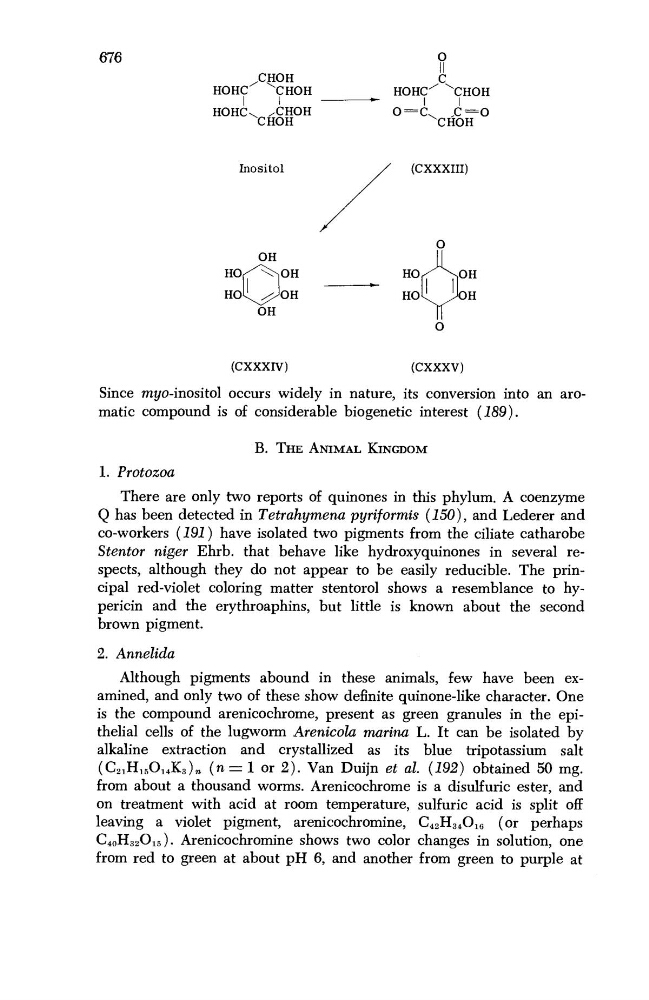
Since mt/o-inositol occurs widely in nature, its conversion into an aromatic compound is of considerable biogenetic interest (189).
B. THE ANIMAL KINGDOM
1. Protozoa
There are only two reports of quinones in this phylum. A coenzyme
Q has been detected in Tetrahymena pyriformis (150), and Lederer and
co-workers (191) have isolated two pigments from the ciliate catharobe
Stentor niger Ehrb. that behave like hydroxyquinones in several respects, although they do not appear to be easily reducible. The principal red-violet coloring matter stentorol shows a resemblance to hypericin and the erythroaphins, but little is known about the second
brown pigment.
2. Annelida
Although pigments abound in these animals, few have been examined, and only two of these show definite quinone-like character. One
is the compound arenicochrome, present as green granules in the epithelial cells of the lugworm ArenicoL· marina L. It can be isolated by
alkaline extraction and crystallized as its blue tripotassium salt
(C 21 H 15 0 14 K3)n (n = 1 or 2). Van Duijn et al. (192) obtained 50 mg.
from about a thousand worms. Arenicochrome is a disulfuric ester, and
on treatment with acid at room temperature, sulfuric acid is split off
leaving a violet pigment, arenicochromine, C 4 2H 34 Oi 6 (or perhaps
C40H32O15). Arenicochromine shows two color changes in solution, one
from red to green at about pH 6, and another from green to purple at