

12. QUINONES: STRUCTURE AND DISTRIBUTION
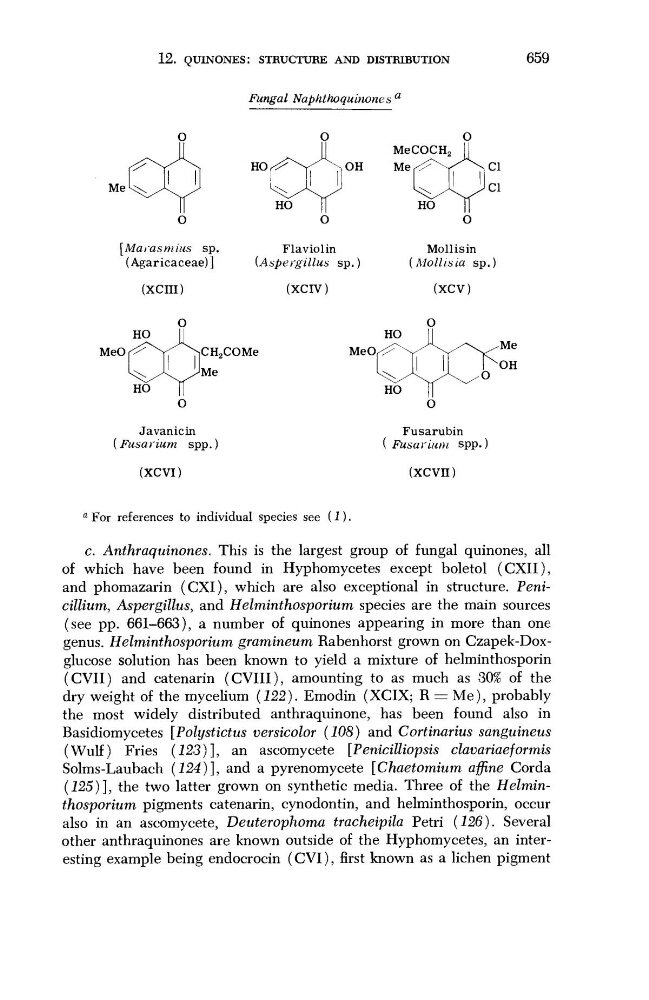
Fungal
Naphthoquinones
a
659
[Marasmius
sp.
(Agaricaceae)]
OH
Flaviolin
(Aspergillus
sp.)
MeO
(XCIV)
MeCOCH ;
Me
Mollisin
(Mollisia
sp.)
(XCV)
MeO,
Javanicin
(Fusarium spp.)
(XCVI)
Fusarubin
( Fusarium
spp.)
(XCVII)
a For references to individual species see (1).
c. Anthraquinones. This is the largest group of fungal quinones, all
of which have been found in Hyphomycetes except boletol (CXII),
and phomazarin (CXI), which are also exceptional in structure. Penicillium, Aspergillus, and Helminthosporium species are the main sources
(see pp. 661-663), a number of quinones appearing in more than one
genus. Helminthosporium gramineum Rabenhorst grown on Czapek-Doxglucose solution has been known to yield a mixture of helminthosporin
(CVII) and catenarin (CVIII), amounting to as much as 30% of the
dry weight of the mycelium (122). Emodin (XCIX; R = Me), probably
the most widely distributed anthraquinone, has been found also in
Basidiomycetes [Polystictus versicolor (108) and Cortinarius sanguineus
(Wulf) Fries (123)], an ascomycete [Penicilliopsis
chvariaeformis
Solms-Laubach (124)], and a pyrenomycete [Chaetomium affine Corda
(125)], the two latter grown on synthetic media. Three of the Helminthosporium pigments catenarin, cynodontin, and helminthosporin, occur
also in an ascomycete, Deuterophoma tracheipila Petri (126). Several
other anthraquinones are known outside of the Hyphomycetes, an interesting example being endocrocin (CVI), first known as a lichen pigment