

12. QUINONES: STRUCTURE AND DISTRIBUTION
653
CHMe 2
CHMe 2
CHMe 2
CHMe 2
Me
(LXX)
(LXXI)
(LXXII)
(LXXIII)
(LXXIV)
(LXXV)
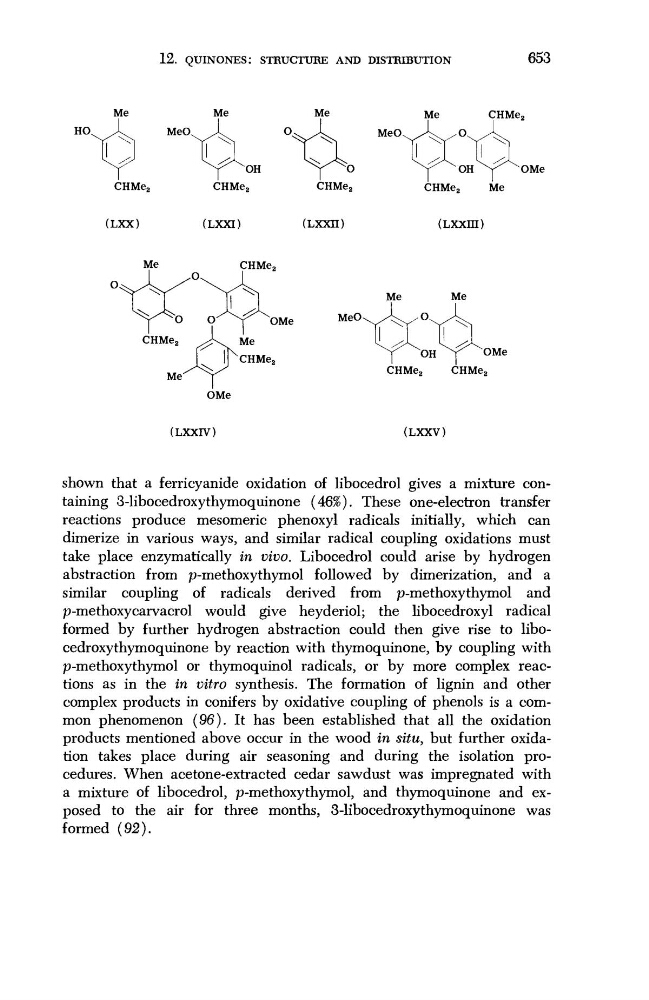
shown that a ferricyanide oxidation of libocedrol gives a mixture containing 3-libocedroxy thymoquinone (46%). These one-electron transfer
reactions produce mesomeric phenoxyl radicals initially, which can
dimerize in various ways, and similar radical coupling oxidations must
take place enzymatically in vivo. Libocedrol could arise by hydrogen
abstraction from p-methoxythymol followed by dimerization, and a
similar coupling of radicals derived from p-methoxythymol and
p-methoxycarvacrol would give heyderiol; the libocedroxyl radical
formed by further hydrogen abstraction could then give rise to libocedroxythymoquinone by reaction with thymoquinone, by coupling with
p-methoxythymol or thymoquinol radicals, or by more complex reactions as in the in vitro synthesis. The formation of lignin and other
complex products in conifers by oxidative coupling of phenols is a common phenomenon (96). It has been established that all the oxidation
products mentioned above occur in the wood in situ, but further oxidation takes place during air seasoning and during the isolation procedures. When acetone-extracted cedar sawdust was impregnated with
a mixture of libocedrol, p-methoxythymol, and thymoquinone and exposed to the air for three months, 3-libocedroxythymoquinone was
formed (92).