

12. QUINONES: STRUCTURE AND DISTRIBUTION
651
OH
COCH=CH —Ph
Me
Merf ^|(CH 2 CH=CCH 2 )
Mel
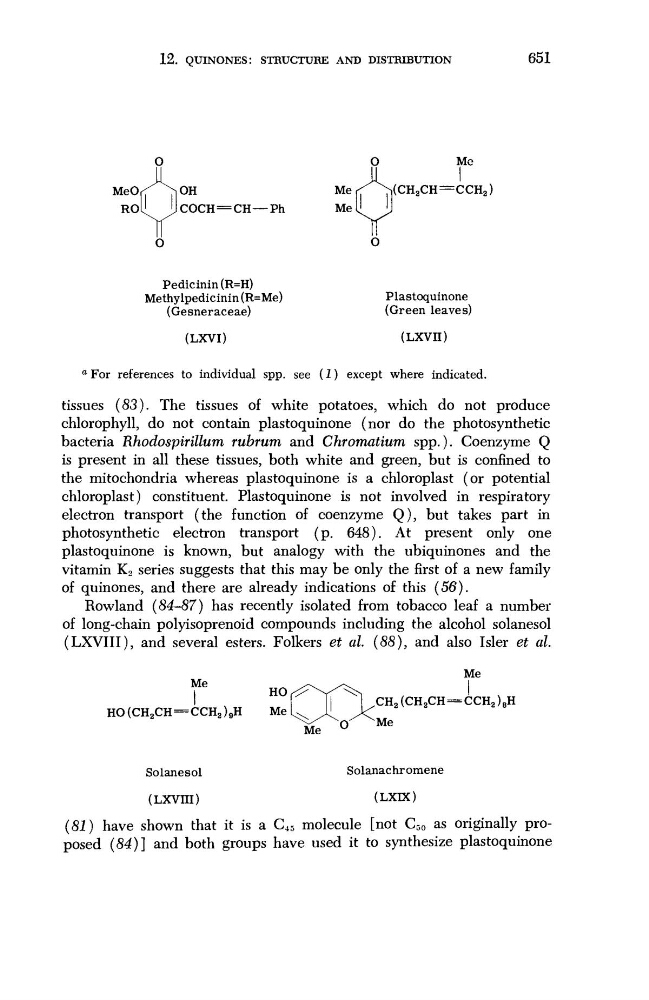
Pedicinin(R=H)
Methylpedicinin (R=Me)
(Gesneraceae)
(LXVI)
Plastoquinone
(Green leaves)
(LXVII)
a For references to individual spp. see (1) except where indicated.
tissues (83). The tissues of white potatoes, which do not produce
chlorophyll, do not contain plastoquinone (nor do the photosynthetic
bacteria Rhodospirillum rubrum and Chromatium spp.). Coenzyme Q
is present in all these tissues, both white and green, but is confined to
the mitochondria whereas plastoquinone is a chloroplast (or potential
chloroplast) constituent. Plastoquinone is not involved in respiratory
electron transport (the function of coenzyme Q), but takes part in
photosynthetic electron transport (p. 648). At present only one
plastoquinone is known, but analogy with the ubiquinones and the
vitamin K 2 series suggests that this may be only the first of a new family
of quinones, and there are already indications of this (56).
Rowland (84-87) has recently isolated from tobacco leaf a number
of long-chain polyisoprenoid compounds including the alcohol solanesol
(LXVIII), and several esters. Folkers et al. (88), and also Isler et al.
Me
I
HO(CH 2 CH=CCH 2 ) 9 H
HO
Me
Me
O
Me
,CH 2 (CH 2 CH==CCH 2 ) 8 H
^Me
Solanesol
(LXVni)
Solanachromene
(LXDO
(81) have shown that it is a C 45 molecule [not C 50 as originally proposed (84)] and both groups have used it to synthesize plastoquinone