

638
R. H. THOMSON
Anthraquinones in the Rubiaceae
a (continued)
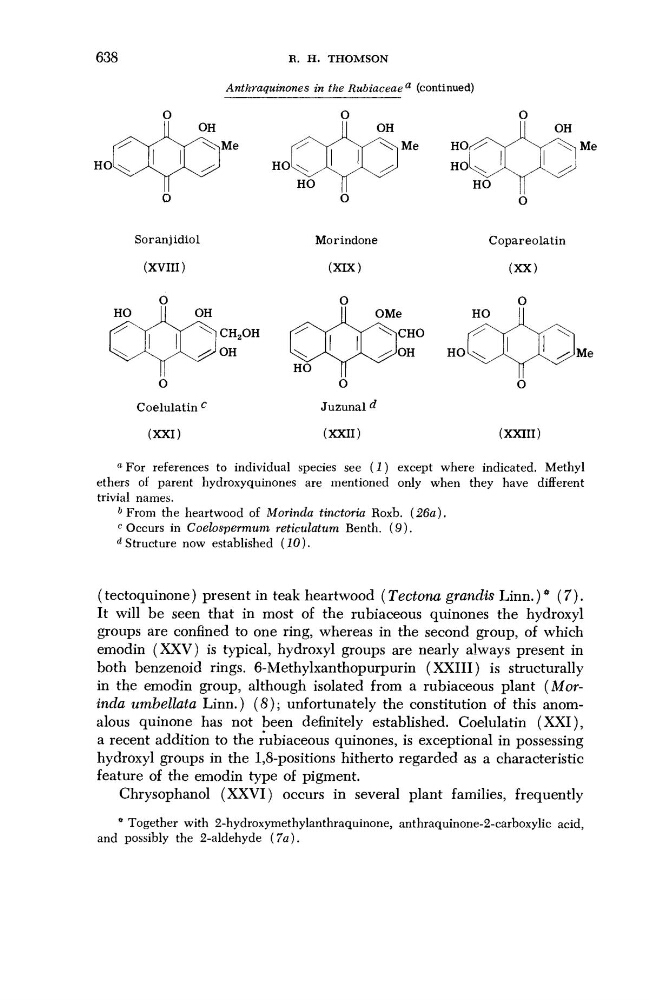
Soranjidiol
Morindone
Copareolatin
(XVIII)
(XIX)
(XX)
o
o
o
Coelulatin
c
Juzunal ^
(XXI)
(XXII)
(XXIII)
a For references to individual species see (I) except where indicated. Methyl
ethers of parent hydroxyquinones are mentioned only when they have different
trivial names.
0 From the heart wood of Morinda tinctoria Roxb. (26a).
c Occurs in Coelospermum reticulatum Benth. (9).
d Structure now established (10).
(tectoquinone) present in teak heartwood (Tectona grandis Linn.)* (7).
It will be seen that in most of the rubiaceous quinones the hydroxyl
groups are confined to one ring, whereas in the second group, of which
emodin (XXV) is typical, hydroxyl groups are nearly always present in
both benzenoid rings. 6-Methylxanthopurpurin (XXIII) is structurally
in the emodin group, although isolated from a rubiaceous plant (Morinda umbellata Linn.) (8); unfortunately the constitution of this anomalous quinone has not been definitely established. Coelulatin (XXI),
a recent addition to the rubiaceous quinones, is exceptional in possessing
hydroxyl groups in the 1,8-positions hitherto regarded as a characteristic
feature of the emodin type of pigment.
Chrysophanol (XXVI) occurs in several plant families, frequently
* Together with 2-hydroxymethylanthraquinone, anthraquinone-2-carboxylic acid,
and possibly the 2-aldehyde (7a).