

11. TERPENOIDS: METABOLISM
625
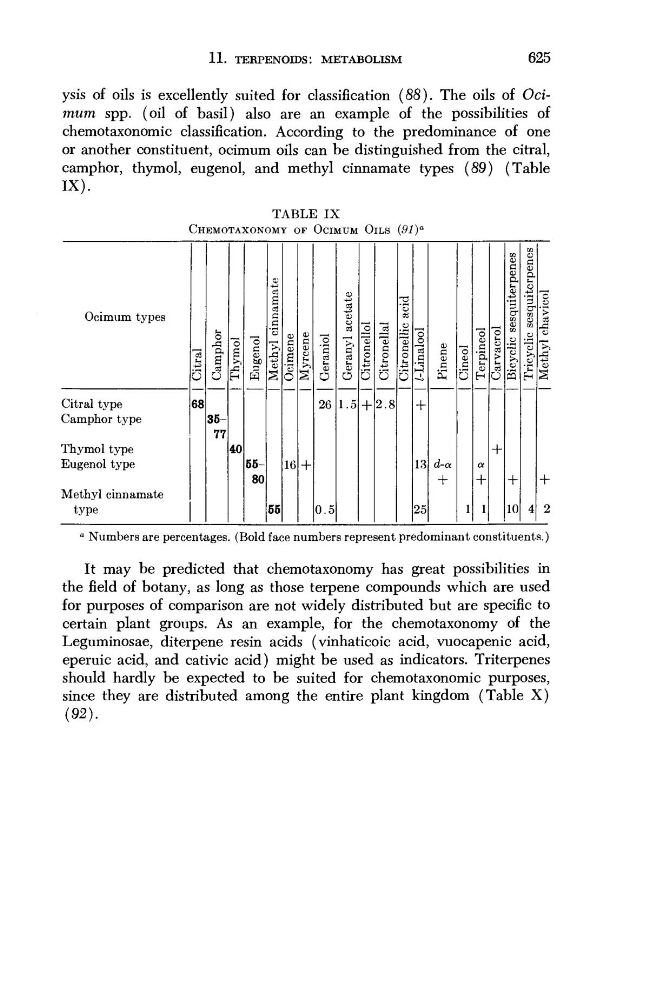
ysis of oils is excellently suited for classification (88). The oils of Ocimum spp. (oil of basil) also are an example of the possibilities of
chemotaxonomic classification. According to the predominance of one
or another constituent, ocimum oils can be distinguished from the citral,
camphor, thymol, eugenol, and methyl cinnamate types (89) (Table
IX).
TABLE IX
CHEMOTAXONOMY OF OCIMUM OILS
(91)
a
Ocimum types
Citral type
Camphor type
Thymol type
Eugenol type
Methyl cinnamate
type
55
0.5
+
10
a Numbers are percentages. (Bold face numbers represent predominant constituents.)
It may be predicted that chemotaxonomy has great possibilities in
the field of botany, as long as those terpene compounds which are used
for purposes of comparison are not widely distributed but are specific to
certain plant groups. As an example, for the chemotaxonomy of the
Leguminosae, diterpene resin acids (vinhaticoic acid, vuocapenic acid,
eperuic acid, and cativic acid) might be used as indicators. Triterpenes
should hardly be expected to be suited for chemotaxonomic purposes,
since they are distributed among the entire plant kingdom (Table X)
(92).
—
g
s
e
1 Citral
1 Camphor
1 Thymol
1 Eugenol
Methyl cinnamate
Ocimene
Myrcene
1 Geraniol
Geranyl acetate
Citronellol
Citronellal
1 Citronellic acid
1 /-Linalool
Pinene
1 Cineol
1 Terpineol
1 Carvacrol
1 Bicyclic sesquiterpene
1 Tricyclic sesquiterpen
1 Methyl chavicol
68
26 1.5
2.8
+
3577
40
+
5516
+
13 d-a
a
80
+ + + +
55
0.5
25
1 1
10 4 2