

11. TERPENOIDS: METABOLISM
621
the green algae as well as in very many higher plants; they have hardly
any taxonomic value. More useful in this regard are the rarer terpenoid
compounds. Thus, azulogenous guaianolides are typical constituents of
the Compositae. For the classification of Podocarpus and Dacrydium
species Erdtman has chosen certain predominant diterpene compounds
(Table IV) (83); for the classification of the Cupressaceae, he has
chosen thujaplicins, mono- and sesquiterpene compounds (Table V)
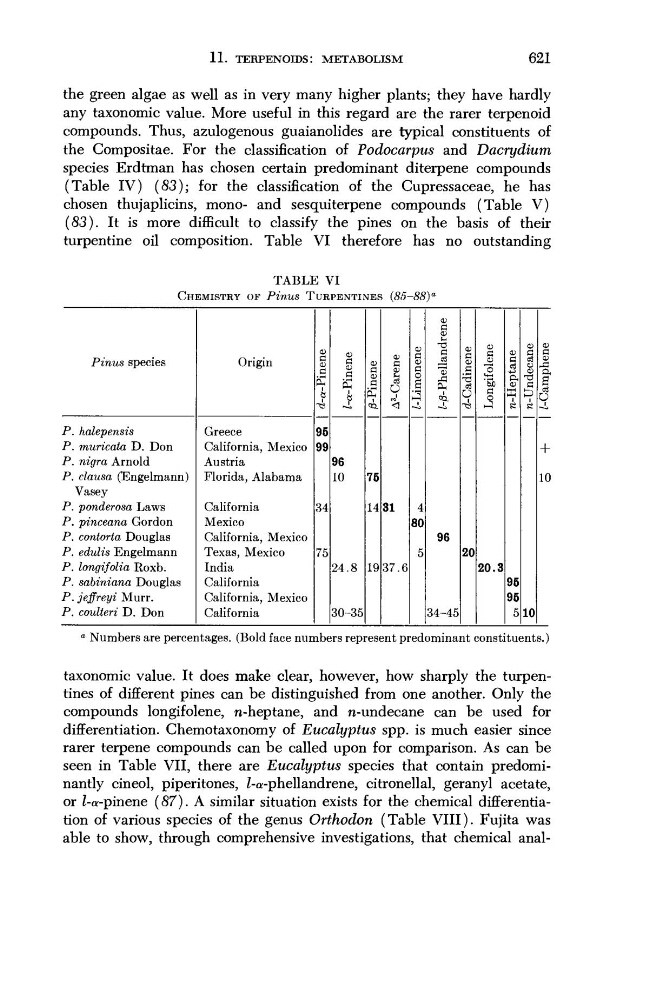
(S3). It is more difficult to classify the pines on the basis of their
turpentine oil composition. Table VI therefore has no outstanding
TABLE VI
CHEMISTRY OF Pinus TURPENTINES (85-88)
a
Pinus species
P. halepensis
P. muricata D. Don
P. nigra Arnold
P. clausa (Engelmann)
Vasey
P. ponderosa Laws
P. pinceana Gordon
P. contorta Douglas
P. edulis Engelmann
P. longifolia Roxb.
P. sahiniana Douglas
P. jeffreyi Murr.
P. coulteri D. Don
Origin
Greece
California, Mexico
Austria
Florida, Alabama
California
Mexico
California, Mexico
Texas, Mexico
India
California
California, Mexico
California
a
03
Ö
1
95
99
34
75
03
a
03
Ö
s
1
96
10
24.8
30-35
Ö
Ö
s
75
14
19
03
Ö
α>
o3
O
<
31
37.6
c
a
o
B
'3
4
80
5
<υ
Ö
%
1
1
96
34-45
G
a
Ü
1
20
03
Ö
"o
' So
o
20.3
03
Ö
03
03
έ
95
95
5
03
Ö
CO
Ü
03
Ö
P
έ
10
03
a
03
a
s
o3
o
1
+
10
a Numbers are percentages. (Bold face numbers represent predominant constituents.)
taxonomic value. It does make clear, however, how sharply the turpentines of different pines can be distinguished from one another. Only the
compounds longifolene, n-heptane, and n-undecane can be used for
differentiation. Chemotaxonomy of Eucalyptus spp. is much easier since
rarer terpene compounds can be called upon for comparison. As can be
seen in Table VII, there are Eucalyptus species that contain predominantly cineol, piperitones, Ζ-α-phellandrene, citronellal, geranyl acetate,
or Z-a-pinene (87). A similar situation exists for the chemical differentiation of various species of the genus Orthodon (Table VIII). Fujita was
able to show, through comprehensive investigations, that chemical anal-