

11. TERPENOIDS: METABOLISM
599
rings, and other rearrangements. These are distinguished principally in
ring C.
The resin acids of pine, such as dextropimaric acid and abietic acid,
according to a hypothesis of Sandermann (33) and Hasselstrom (34)
as well as of Ruzicka (2) and Wenkert (35), are formed from a common parent substance (XVI-XVIII) (cf. Fig. 4). This theory has meanwhile been confirmed in Finns sylvestris L. with the use of tagged dimethylacrylic acid (36). The carbon skeleton of vinhaticoic acid (XX)
could be formed from the same basic skeleton by way of a cyclic carbonium ion (XIX). According to a very interesting theory by Wenkert
(35), the skeleton of phyllocladene (XXIII) is formed from the cation
(XXII) and that of atisine (XXV) from the cation (XXIV). The latter
cation can be formed from (XII) through a hydride shift (35, 38). In
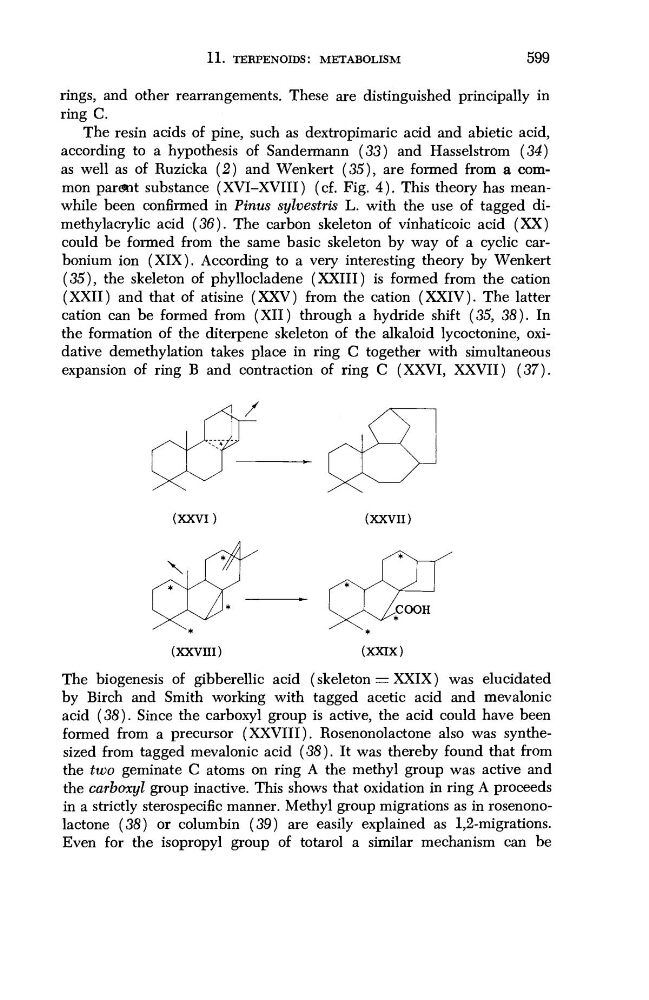
the formation of the diterpene skeleton of the alkaloid lycoctonine, oxidative demethylation takes place in ring C together with simultaneous
expansion of ring B and contraction of ring C (XXVI, XXVII) (37).
(XXVI)
(XXVII)
(XXVIII)
(XXIX)
The biogenesis of gibberellic acid (skeleton = XXIX) was elucidated
by Birch and Smith working with tagged acetic acid and mevalonic
acid (38). Since the carboxyl group is active, the acid could have been
formed from a precursor (XXVIII). Rosenonolactone also was synthesized from tagged mevalonic acid (38). It was thereby found that from
the two geminate C atoms on ring A the methyl group was active and
the carboxyl group inactive. This shows that oxidation in ring A proceeds
in a strictly sterospecific manner. Methyl group migrations as in rosenonolactone (38) or columbin (39) are easily explained as 1,2-migrations.
Even for the isopropyl group of totarol a similar mechanism can be