

11. TERPENOIDS: METABOLISM
597
II. Ring Closures and Rearrangements
According to Ruzicka's biogenetic "isoprene rule," which has been
confirmed by the results of Bloch as well as Lynen, primarily geraniol,
farnesol, and geranylgeraniol are formed. In the biologic system, according to fundamental considerations of Ruzicka and co-workers, especially Eschenmoser (2-5), these aliphatic parent compounds are folded,
under the influence of cyclizing ferments, from their structural equilibrium in the direction of a form that is thermodynamically stable and
suited for coupled cyclization. Thereupon ring closure takes place with
the help of an ionic or radical mechanism.
The relationships for sesquiterpenes are illustrated in Fig. 2 (28).
Similar to ring closures, rearrangements are also stereospecific (28).
Certain enzyme systems produce folded forms optimal for Wagner's
rearrangements, 1,2-migrations of methyl groups and H atoms, as well
as H eliminations. In the irregularly constructed terpene compounds
thus obtained, the originally regular structure is often barely recognizable. This is even more likely when the biogenetic formulation is used
rather than the classic one. This is evident from Fig. 3, in which all the
important ring systems of the terpenes and sesquiterpenes have been
fitted into the biogenetic basic structure without regard to very important steric relationships. In this manner of writing, the biogenesis of
tricothecin is more clearly illustrated than in the usual formulation
(Chapter 3, this volume). Experiments with 2-C
14 -mevalonic acid had
shown that the methyl group on C-5 is radioactive (29). This finding
can be explained only by two methyl group migrations, namely the
original inactive methyl group from 5 to 6 and the active geminate one
from 1 to 5 (29). Many statements regarding the biogenesis of terpenes
and sesquiterpenes are for the present still hypothetical, e.g., carquejol
(30), thujic acid and thujaplicin (31). According to another hypothesis,
the n-heptane occurring to an extent of 95% in the "terpentene oil" of
Pinus jeffreyi and Finns sabiniana has a terpenoid origin. Thus it could
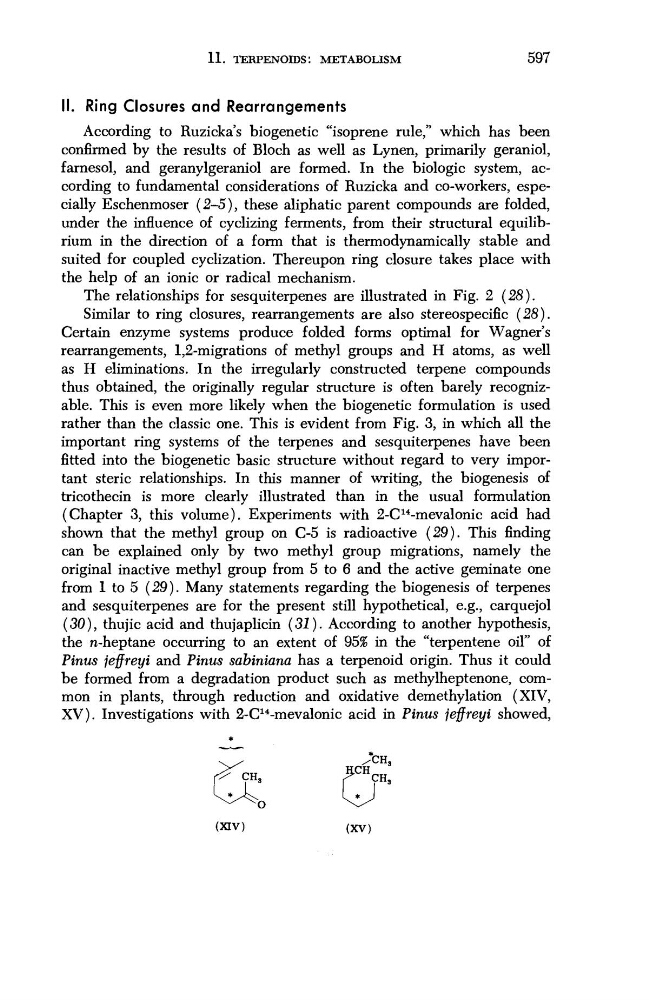
be formed from a degradation product such as methylheptenone, common in plants, through reduction and oxidative demethylation (XIV,
XV). Investigations with 2-C
14 -mevalonic acid in Pinus jeffreyi showed,
(XIV)
(XV)