

46
F. B. SHORLAND
acid is present in small amounts only, linoleic acid frequently forms
more than 50%, but sometimes oleic acid predominates.
Botanical families represented include Betulaceae, Fagaceae,
Juglandaceae, Hippocastanaceae, Ulmaceae, Olacaceae, Vitaceae, Papaveraceae, Passifloraceae, Typhaceae, Compositae, Solanaceae, Pedaliaceae, Scrophulariaciae, Plantaginaceae, Dipsaceae, Asclepiadaceae,
Staphyleaceae, Myrtaceae, Urticaceae, Theaceae, Oleaceae, and
Proteaceae.
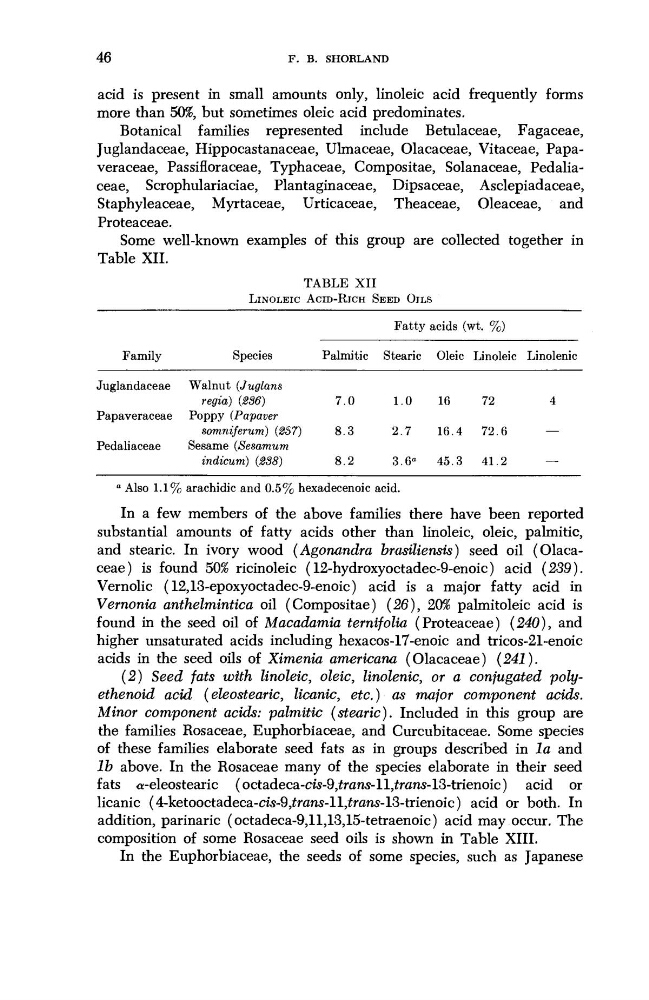
Some well-known examples of this group are collected together in
Table XII.
TABLE XII
LINOLEIC ACID-RICH SEED OILS
Fatty acids (wt. %)
Family
Species
Palmitic Stearic Oleic Linoleic Linolenic
Juglandaceae
Walnut (Juglans
regia) {236)
7.0
1.0
16
72
4
Papaveraceae
Poppy (Papaver
somniferum) (237)
8.3
2.7
16.4
72.6
—
Pedaliaceae
Sesame (Sesamum
indicum) (238)
8.2
3.6
a
45.3
41.2
—
a Also 1.1% arachidic and 0.5% hexadecenoic acid.
In a few members of the above families there have been reported
substantial amounts of fatty acids other than linoleic, oleic, palmitic,
and stearic. In ivory wood (Agonandra brasiliensis) seed oil (Olacaceae) is found 50% ricinoleic (12-hydroxyoctadec-9-enoic) acid (239).
Vernolic (12,13-epoxyoctadec-9-enoic) acid is a major fatty acid in
Vernonia anthelmintica oil (Compositae) (26), 20% palmitoleic acid is
found in the seed oil of Macadamia ternifolia (Proteaceae) (240), and
higher unsaturated acids including hexacos-17-enoic and tricos-21-enoic
acids in the seed oils of Ximenia americana (Olacaceae) (241).
(2) Seed fats with linoleic, oleic, linolenic, or a conjugated polyethenoid acid (eleostearic, licanic, etc.) as major component acids.
Minor component acids: palmitic (stearic). Included in this group are
the families Rosaceae, Euphorbiaceae, and Curcubitaceae. Some species
of these families elaborate seed fats as in groups described in la and
lb above. In the Rosaceae many of the species elaborate in their seed
fats α-eleostearic (octadeca-ds-9,£rans-ll,frans-13-trienoic)
acid or
licanic (4-ketooctadeca-ci5-9,imn5-ll,imn5-13-trienoic) acid or both. In
addition, parinaric (octadeca-9,ll,13,15-tetraenoic) acid may occur. The
composition of some Rosaceae seed oils is shown in Table XIII.
In the Euphorbiaceae, the seeds of some species, such as Japanese
F. B. SHORLAND
acid is present in small amounts only, linoleic acid frequently forms
more than 50%, but sometimes oleic acid predominates.
Botanical families represented include Betulaceae, Fagaceae,
Juglandaceae, Hippocastanaceae, Ulmaceae, Olacaceae, Vitaceae, Papaveraceae, Passifloraceae, Typhaceae, Compositae, Solanaceae, Pedaliaceae, Scrophulariaciae, Plantaginaceae, Dipsaceae, Asclepiadaceae,
Staphyleaceae, Myrtaceae, Urticaceae, Theaceae, Oleaceae, and
Proteaceae.
Some well-known examples of this group are collected together in
Table XII.
TABLE XII
LINOLEIC ACID-RICH SEED OILS
Fatty acids (wt. %)
Family
Species
Palmitic Stearic Oleic Linoleic Linolenic
Juglandaceae
Walnut (Juglans
regia) {236)
7.0
1.0
16
72
4
Papaveraceae
Poppy (Papaver
somniferum) (237)
8.3
2.7
16.4
72.6
—
Pedaliaceae
Sesame (Sesamum
indicum) (238)
8.2
3.6
a
45.3
41.2
—
a Also 1.1% arachidic and 0.5% hexadecenoic acid.
In a few members of the above families there have been reported
substantial amounts of fatty acids other than linoleic, oleic, palmitic,
and stearic. In ivory wood (Agonandra brasiliensis) seed oil (Olacaceae) is found 50% ricinoleic (12-hydroxyoctadec-9-enoic) acid (239).
Vernolic (12,13-epoxyoctadec-9-enoic) acid is a major fatty acid in
Vernonia anthelmintica oil (Compositae) (26), 20% palmitoleic acid is
found in the seed oil of Macadamia ternifolia (Proteaceae) (240), and
higher unsaturated acids including hexacos-17-enoic and tricos-21-enoic
acids in the seed oils of Ximenia americana (Olacaceae) (241).
(2) Seed fats with linoleic, oleic, linolenic, or a conjugated polyethenoid acid (eleostearic, licanic, etc.) as major component acids.
Minor component acids: palmitic (stearic). Included in this group are
the families Rosaceae, Euphorbiaceae, and Curcubitaceae. Some species
of these families elaborate seed fats as in groups described in la and
lb above. In the Rosaceae many of the species elaborate in their seed
fats α-eleostearic (octadeca-ds-9,£rans-ll,frans-13-trienoic)
acid or
licanic (4-ketooctadeca-ci5-9,imn5-ll,imn5-13-trienoic) acid or both. In
addition, parinaric (octadeca-9,ll,13,15-tetraenoic) acid may occur. The
composition of some Rosaceae seed oils is shown in Table XIII.
In the Euphorbiaceae, the seeds of some species, such as Japanese