

44
F. B. SHORLAND
characteristic dihydroxy acid following alkaline permanganate oxidation (224).
The most substantial deviation in the fatty acid composition of leaf
material is to be found in nettle (Urtica dioica) leaf fat which has
mainly oleic acid, 82-86% with 13-14% linoleic acid, 0.5% saturated acids,
and, perhaps, some linolenic acid (231).
As the limited data indicate, leaf fats are predominantly rich in
linolenic and linoleic (or isomers) acids, with oleic acid usually a
minor constituent.
Recent work has established that what has been regarded as the
triglyceride fraction of leaves is in fact of a much more complex nature.
The acetone-soluble lipids of leaves seem to be glycosides containing
varying amounts of galactose and resembling those found earlier by
Carter et al. (231a) in wheat flour. The acetone-soluble lipids of the
leaves of red clover (Trifolium pratense) (231b,c) and of ryegrass
(231d) have been shown to consist of the linolenates of galactosyl-1glycerol and of digalactosyl-1-glycerol. The linolenic acid is attached to
the glycerol radicle. Similar galactolipids have been reported in the
chloroplasts of the leaves of the spinach (Spinacea oleracea) (231e)
and in chlorella (231f).
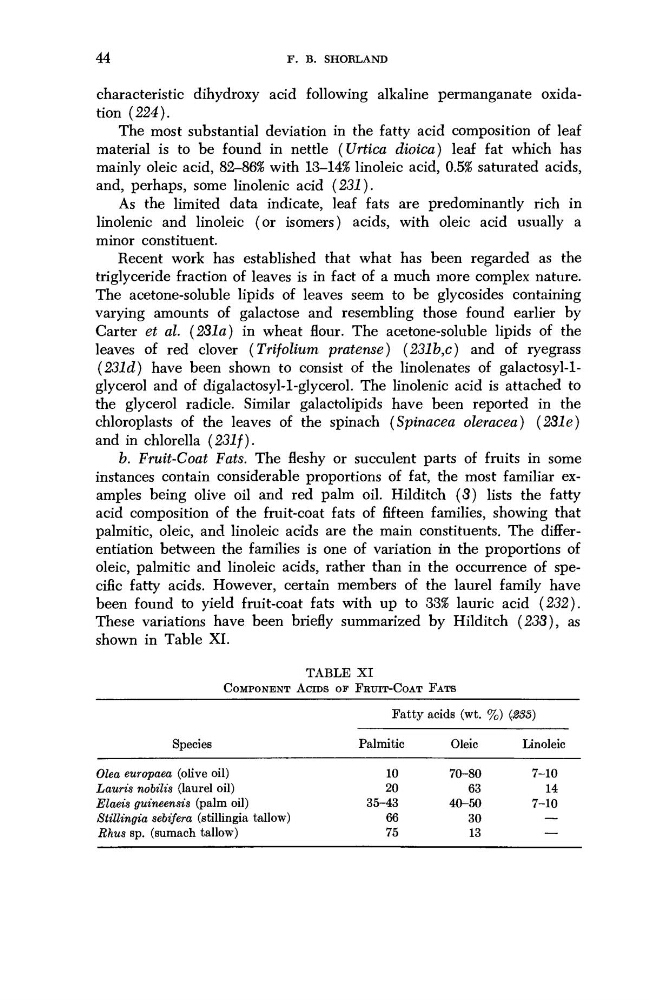
b. Fruit-Coat Fats. The fleshy or succulent parts of fruits in some
instances contain considerable proportions of fat, the most familiar examples being olive oil and red palm oil. Hilditch (3) lists the fatty
acid composition of the fruit-coat fats of fifteen families, showing that
palmitic, oleic, and linoleic acids are the main constituents. The differentiation between the families is one of variation in the proportions of
oleic, palmitic and linoleic acids, rather than in the occurrence of specific fatty acids. However, certain members of the laurel family have
been found to yield fruit-coat fats with up to 33% lauric acid (232).
These variations have been briefly summarized by Hilditch (233), as
shown in Table XI.
TABLE XI
COMPONENT ACIDS OF FRUIT-COAT FATS
Fatty acids (wt. %) {238)
Species
Olea europaea (olive oil)
Lauris nobilis (laurel oil)
Elaeis guineensis (palm oil)
Stillingia sebifera (stillingia tallow)
Rhus sp. (sumach tallow)
Palmitic
10
20
35-43
66
75
Oleic
70-80
63
40-50
30
13
Linoleic
7-10
14
7-10
—
—
F. B. SHORLAND
characteristic dihydroxy acid following alkaline permanganate oxidation (224).
The most substantial deviation in the fatty acid composition of leaf
material is to be found in nettle (Urtica dioica) leaf fat which has
mainly oleic acid, 82-86% with 13-14% linoleic acid, 0.5% saturated acids,
and, perhaps, some linolenic acid (231).
As the limited data indicate, leaf fats are predominantly rich in
linolenic and linoleic (or isomers) acids, with oleic acid usually a
minor constituent.
Recent work has established that what has been regarded as the
triglyceride fraction of leaves is in fact of a much more complex nature.
The acetone-soluble lipids of leaves seem to be glycosides containing
varying amounts of galactose and resembling those found earlier by
Carter et al. (231a) in wheat flour. The acetone-soluble lipids of the
leaves of red clover (Trifolium pratense) (231b,c) and of ryegrass
(231d) have been shown to consist of the linolenates of galactosyl-1glycerol and of digalactosyl-1-glycerol. The linolenic acid is attached to
the glycerol radicle. Similar galactolipids have been reported in the
chloroplasts of the leaves of the spinach (Spinacea oleracea) (231e)
and in chlorella (231f).
b. Fruit-Coat Fats. The fleshy or succulent parts of fruits in some
instances contain considerable proportions of fat, the most familiar examples being olive oil and red palm oil. Hilditch (3) lists the fatty
acid composition of the fruit-coat fats of fifteen families, showing that
palmitic, oleic, and linoleic acids are the main constituents. The differentiation between the families is one of variation in the proportions of
oleic, palmitic and linoleic acids, rather than in the occurrence of specific fatty acids. However, certain members of the laurel family have
been found to yield fruit-coat fats with up to 33% lauric acid (232).
These variations have been briefly summarized by Hilditch (233), as
shown in Table XI.
TABLE XI
COMPONENT ACIDS OF FRUIT-COAT FATS
Fatty acids (wt. %) {238)
Species
Olea europaea (olive oil)
Lauris nobilis (laurel oil)
Elaeis guineensis (palm oil)
Stillingia sebifera (stillingia tallow)
Rhus sp. (sumach tallow)
Palmitic
10
20
35-43
66
75
Oleic
70-80
63
40-50
30
13
Linoleic
7-10
14
7-10
—
—