

9. SACCHARIDES: ALTERNATE ROUTES OF METABOLISM
487
TABLE IX (Continued)
No.
50
51
Alcohol
CH 2 OH
HCOH
HCOH
HCOH
HOCH
HCOH
HCOH
CH 2 OH
O-gluco-L-talo-Octitol
(D-a,a-Glucooctitol)
CH 2 OH
HOCH
HCOH
HCOH
HOCH
HOCH
HCOH
CH 2 OH
O-gala-L-gala-Octito\
(D-a,a-Galactitol)
Product
CH 2 OH
CO
HOCH
HCOH
HOCH
HOCH
HOCH
CH 2 OH
L-altro-L-sorbo-Octose
(predicted)
Not oxidized
Representative species
and references
A. suboxydans
(308)
A. suboxydans
(308)
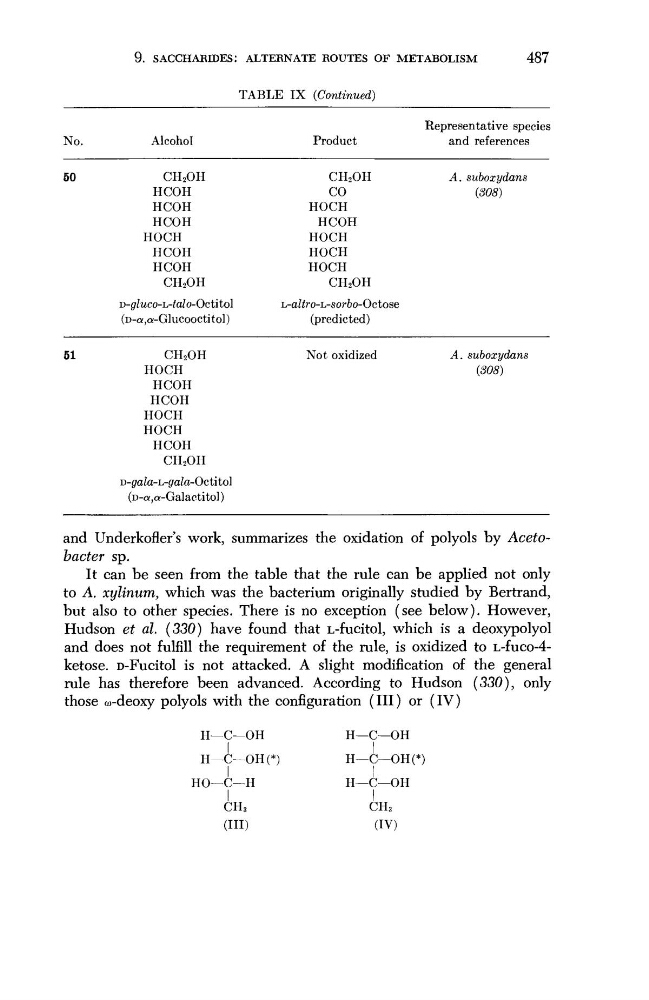
and Underkofler's work, summarizes the oxidation of polyols by Acetobacter sp.
It can be seen from the table that the rule can be applied not only
to A. xylinum, which was the bacterium originally studied by Bertrand,
but also to other species. There is no exception (see below). However,
Hudson et al. (330) have found that L-fucitol, which is a deoxypolyol
and does not fulfill the requirement of the rule, is oxidized to L-fuco-4ketose. D-Fucitol is not attacked. A slight modification of the general
rule has therefore been advanced. According to Hudson (330), only
those ω-deoxy polyols with the configuration (III) or (IV)
HO-C—OH
I
-C—OH(*)
I
-C—H
I
CH 3
(HI)
H—C—OH
I
H—C—OH(*)
I
H—C—OH
CH 3
(IV)
487
TABLE IX (Continued)
No.
50
51
Alcohol
CH 2 OH
HCOH
HCOH
HCOH
HOCH
HCOH
HCOH
CH 2 OH
O-gluco-L-talo-Octitol
(D-a,a-Glucooctitol)
CH 2 OH
HOCH
HCOH
HCOH
HOCH
HOCH
HCOH
CH 2 OH
O-gala-L-gala-Octito\
(D-a,a-Galactitol)
Product
CH 2 OH
CO
HOCH
HCOH
HOCH
HOCH
HOCH
CH 2 OH
L-altro-L-sorbo-Octose
(predicted)
Not oxidized
Representative species
and references
A. suboxydans
(308)
A. suboxydans
(308)
and Underkofler's work, summarizes the oxidation of polyols by Acetobacter sp.
It can be seen from the table that the rule can be applied not only
to A. xylinum, which was the bacterium originally studied by Bertrand,
but also to other species. There is no exception (see below). However,
Hudson et al. (330) have found that L-fucitol, which is a deoxypolyol
and does not fulfill the requirement of the rule, is oxidized to L-fuco-4ketose. D-Fucitol is not attacked. A slight modification of the general
rule has therefore been advanced. According to Hudson (330), only
those ω-deoxy polyols with the configuration (III) or (IV)
HO-C—OH
I
-C—OH(*)
I
-C—H
I
CH 3
(HI)
H—C—OH
I
H—C—OH(*)
I
H—C—OH
CH 3
(IV)