

472
VERNON H. CHELDELIN, CHIH H. WANG, AND TSOO E. KING
tensively used in other laboratories (cf., for example, references 273276).
It has been found that A. suboxydans not only can extensively oxidize
polyalcohols and sugars, but also possesses a multiple pathway in the
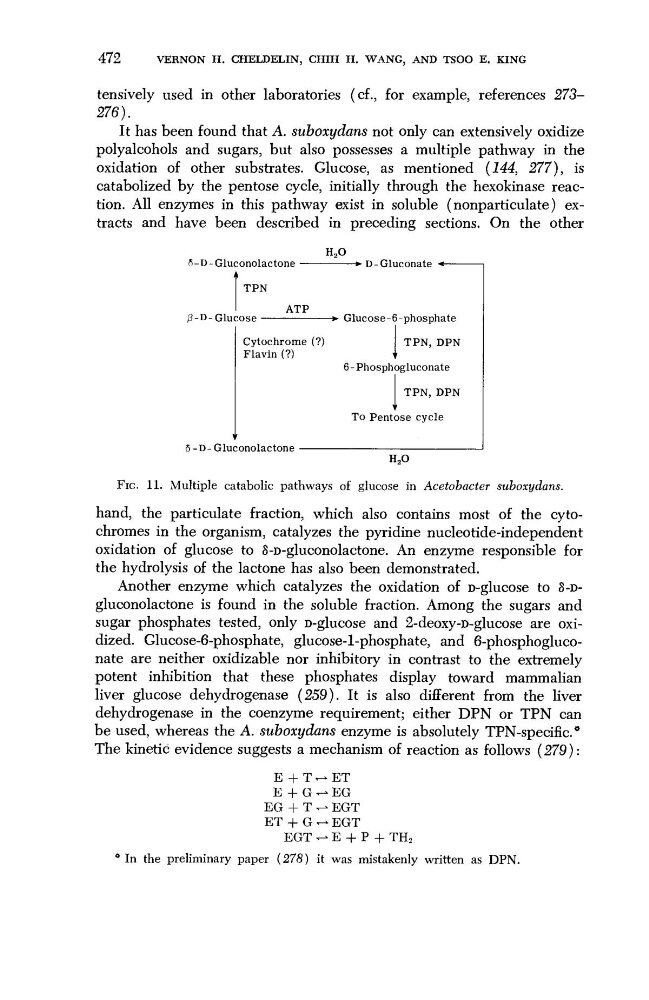
oxidation of other substrates. Glucose, as mentioned (144, 277), is
catabolized by the pentose cycle, initially through the hexokinase reaction. All enzymes in this pathway exist in soluble (nonparticulate) extracts and have been described in preceding sections. On the other
H 2 O
fi-D-Gluconolactone
TPN
• D-Gluconate
0-D-Glucose -
ATP
Cytochrome (?)
Flavin (?)
-> Glucose-6-phosphate
TPN, DPN
6 - Phosphogluconate
TPN, DPN
To Pentose cycle
δ-D-Gluconolactone
H 9 0
FIG. 11. Multiple catabolic pathways of glucose in Acetobacter
suboxydans.
hand, the particulate fraction, which also contains most of the cytochromes in the organism, catalyzes the pyridine nucleotide-independent
oxidation of glucose to δ-D-gluconolactone. An enzyme responsible for
the hydrolysis of the lactone has also been demonstrated.
Another enzyme which catalyzes the oxidation of D-glucose to 8-Dgluconolactone is found in the soluble fraction. Among the sugars and
sugar phosphates tested, only D-glucose and 2-deoxy-D-glucose are oxidized. Glucose-6-phosphate, glucose-1-phosphate, and 6-phosphogluconate are neither oxidizable nor inhibitory in contrast to the extremely
potent inhibition that these phosphates display toward mammalian
liver glucose dehydrogenase (259). It is also different from the liver
dehydrogenase in the coenzyme requirement; either DPN or TPN can
be used, whereas the A. suboxydans enzyme is absolutely TPN-specific*
The kinetic evidence suggests a mechanism of reaction as follows (279):
E + T v- ET
E + G — EG
EG + T — EGT
ET + G — EGT
EGT ^- E + P + TH 2
* In the preliminary paper (278) it was mistakenly written as DPN.
VERNON H. CHELDELIN, CHIH H. WANG, AND TSOO E. KING
tensively used in other laboratories (cf., for example, references 273276).
It has been found that A. suboxydans not only can extensively oxidize
polyalcohols and sugars, but also possesses a multiple pathway in the
oxidation of other substrates. Glucose, as mentioned (144, 277), is
catabolized by the pentose cycle, initially through the hexokinase reaction. All enzymes in this pathway exist in soluble (nonparticulate) extracts and have been described in preceding sections. On the other
H 2 O
fi-D-Gluconolactone
TPN
• D-Gluconate
0-D-Glucose -
ATP
Cytochrome (?)
Flavin (?)
-> Glucose-6-phosphate
TPN, DPN
6 - Phosphogluconate
TPN, DPN
To Pentose cycle
δ-D-Gluconolactone
H 9 0
FIG. 11. Multiple catabolic pathways of glucose in Acetobacter
suboxydans.
hand, the particulate fraction, which also contains most of the cytochromes in the organism, catalyzes the pyridine nucleotide-independent
oxidation of glucose to δ-D-gluconolactone. An enzyme responsible for
the hydrolysis of the lactone has also been demonstrated.
Another enzyme which catalyzes the oxidation of D-glucose to 8-Dgluconolactone is found in the soluble fraction. Among the sugars and
sugar phosphates tested, only D-glucose and 2-deoxy-D-glucose are oxidized. Glucose-6-phosphate, glucose-1-phosphate, and 6-phosphogluconate are neither oxidizable nor inhibitory in contrast to the extremely
potent inhibition that these phosphates display toward mammalian
liver glucose dehydrogenase (259). It is also different from the liver
dehydrogenase in the coenzyme requirement; either DPN or TPN can
be used, whereas the A. suboxydans enzyme is absolutely TPN-specific*
The kinetic evidence suggests a mechanism of reaction as follows (279):
E + T v- ET
E + G — EG
EG + T — EGT
ET + G — EGT
EGT ^- E + P + TH 2
* In the preliminary paper (278) it was mistakenly written as DPN.