

9. SACCHARIDES: ALTERNATE ROUTES OF METABOLISM
469
note that the enzyme does not show fluorescence within the pH range
2-8. The activity of the enzyme is parallel to its bactericidal action, and
both are inactive beyond this pH range. In fact it is now known that
the bactericidal action is from an enzymatic product, hydrogen peroxide
(234).
A long list of specially purified sugars and sugar derivatives has
been tested for specificity of the enzyme. Only 6-methyl glucose and
4,6-dimethyl glucose show about 2% of the glucose activity; mannose,
xylose, trehalose, maltose, galactose, melibiose, and cellobiose possess
less than 1% of the activity toward glucose, whereas all others are inactive (234, 237). In fact, this enzyme has been used as a specific agent
in the microdetermination of glucose (238). Recently, however, it has
been found that 2-deoxy-D-glucose reacts actively (239) to give 2-deoxyD-gluconic acid (240).
Glucose oxidase catalyzes the oxidation of the ß sugar much faster
than it does the a variety (237, 241). Here again it resembles the
chemical oxidation; ß-glucose is oxidized by bromine about 35 times
more rapidly than the a isomer (242, 243). It has been postulated (244,
245) that the ring form of glucose, but not the free carbonyl group, is
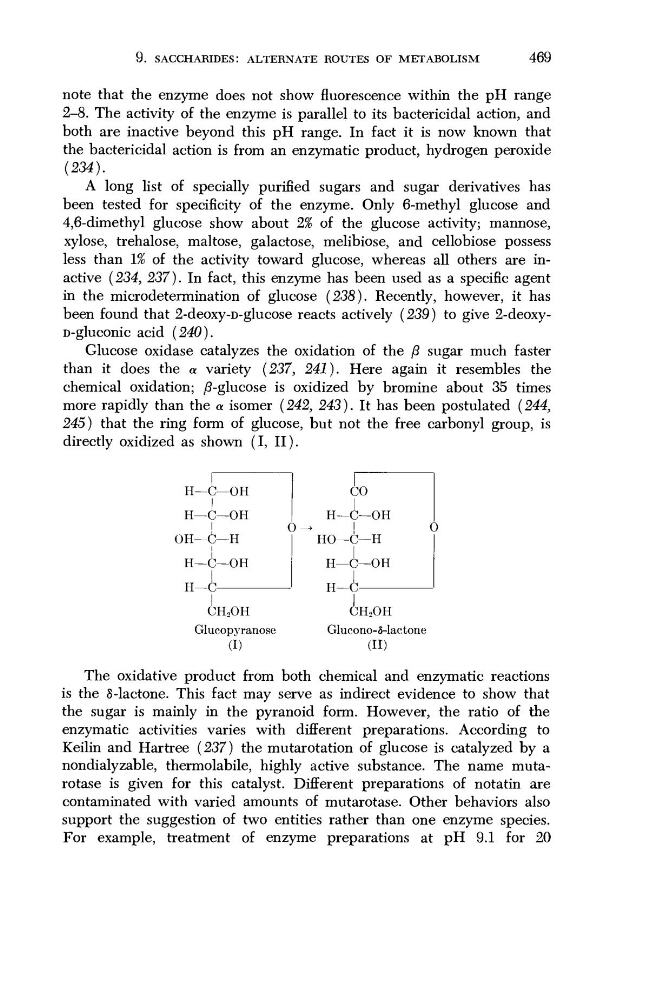
directly oxidized as shown (I, II).
H—C—OH
H—C—OH
I
OH—C—H
I
H—C—OH
I
H—C
I
CHoOH
Glucopyranose
(I)
CO
I
H—C—OH
I
HO—C—H
H—C—OH
H—C
O
CH 2 OH
Glucono-5-lactone
(Π)
The oxidative product from both chemical and enzymatic reactions
is the δ-lactone. This fact may serve as indirect evidence to show that
the sugar is mainly in the pyranoid form. However, the ratio of the
enzymatic activities varies with different preparations. According to
Keilin and Hartree (237) the mutarotation of glucose is catalyzed by a
nondialyzable, thermolabile, highly active substance. The name mutarotase is given for this catalyst. Different preparations of notatin are
contaminated with varied amounts of mutarotase. Other behaviors also
support the suggestion of two entities rather than one enzyme species.
For example, treatment of enzyme preparations at pH 9.1 for 20
469
note that the enzyme does not show fluorescence within the pH range
2-8. The activity of the enzyme is parallel to its bactericidal action, and
both are inactive beyond this pH range. In fact it is now known that
the bactericidal action is from an enzymatic product, hydrogen peroxide
(234).
A long list of specially purified sugars and sugar derivatives has
been tested for specificity of the enzyme. Only 6-methyl glucose and
4,6-dimethyl glucose show about 2% of the glucose activity; mannose,
xylose, trehalose, maltose, galactose, melibiose, and cellobiose possess
less than 1% of the activity toward glucose, whereas all others are inactive (234, 237). In fact, this enzyme has been used as a specific agent
in the microdetermination of glucose (238). Recently, however, it has
been found that 2-deoxy-D-glucose reacts actively (239) to give 2-deoxyD-gluconic acid (240).
Glucose oxidase catalyzes the oxidation of the ß sugar much faster
than it does the a variety (237, 241). Here again it resembles the
chemical oxidation; ß-glucose is oxidized by bromine about 35 times
more rapidly than the a isomer (242, 243). It has been postulated (244,
245) that the ring form of glucose, but not the free carbonyl group, is
directly oxidized as shown (I, II).
H—C—OH
H—C—OH
I
OH—C—H
I
H—C—OH
I
H—C
I
CHoOH
Glucopyranose
(I)
CO
I
H—C—OH
I
HO—C—H
H—C—OH
H—C
O
CH 2 OH
Glucono-5-lactone
(Π)
The oxidative product from both chemical and enzymatic reactions
is the δ-lactone. This fact may serve as indirect evidence to show that
the sugar is mainly in the pyranoid form. However, the ratio of the
enzymatic activities varies with different preparations. According to
Keilin and Hartree (237) the mutarotation of glucose is catalyzed by a
nondialyzable, thermolabile, highly active substance. The name mutarotase is given for this catalyst. Different preparations of notatin are
contaminated with varied amounts of mutarotase. Other behaviors also
support the suggestion of two entities rather than one enzyme species.
For example, treatment of enzyme preparations at pH 9.1 for 20